

Syria May Turn Into A ‘New Afghanistan’
A new Afghanistan is being born in the lap of the Mediterranean Sea. Such a speculation has intensified a couple of months after the fall of the Bashar al-Assad Regime in Damascus (on December 8, 2024). Defence experts believe that the victory of rebels under the leadership of Abu Mohammad al-Julani (or Abu Mohammed al-Golani; born Ahmed Hussein al-Sharaa), the Chief of the Hayat Tahrir al-Sham (HTS) militant outfit, in the decades-long Syrian Civil War has made the situation worse. It may be noted that HTS and its affiliate Jaish al-Izza (the Army of Pride) took control of the West Asian nation after the fall of the al-Assad Regime and installed a caretaker government. Experts are of the opinion that Syria may turn into a new Afghanistan as the ruling HTS has much more in common with the Taliban.
Political analysts have found great theoretical similarities between the Taliban and the HTS. Many countries did not recognise the Taliban Government when it came to power in Afghanistan for the second time in 2021. Experts believe that the HTS might face a similar problem in Syria as the US, the European Union (EU) and the UN Security Council still consider the Syrian outfit as a terrorist organisation. Hence, the HTS-led interim government in Damascus would face difficulties in getting recognition from the global community.
HTS appointed Mohammed al-Bashir as Prime Minister of the caretaker government after the fall of al-Assad and he would serve as the 70th Prime Minister of Syria till March 1, 2025. In fact, HTS occupied and also ruled the northwestern part of Syria, including Idlib Province, during al-Assad’s tenure as President. Therefore, al-Bashir has prior experience of running a government in that particular region. It made him an automatic choice (for HTS) for the prime ministership. For the past couple of months, both al-Julani and al-Bashir have been talking about the economic development and overall progress of Syria.
It may be noted that the Taliban did the same after capturing Kabul in 2021, as they formed an interim government and promised to establish a representative administration. However, the Afghans realised the real character of the Taliban with the passage of time. The Taliban continues to indulge in Fundamentalism and remains committed to Jihad. They rule the war-torn South Asian nation by suppressing all other groups. The Rights of Afghan women and minorities have been under attack repeatedly under the Taliban Regime. The current rulers in Kabul have banned girls from going to schools and colleges! They have also introduced public executions in compliance with Sharia Law, apart from imposing a ban on Western music and the use of musical instruments. According to a section of analysts, the HTS might follow the Taliban’s path in Syria as both the outfits believe in the ideology of Jihad. The Taliban and the HTS stand on a solid foundation of fundamentalism, extremism and Sharia Law. Hence, it is somehow impossible for the Syrian outfit to accept other views.

Secondly, the HTS, like the Taliban, has been fighting against the US forces for a long time. The armed conflict between the Taliban fighters and the US forces continued for nearly two decades. Although the HTS started fighting against the US forces in Iraq, the battlefield shifted to Syria later. Both the Taliban and the HTS used to maintain close ties with al-Qaeda that had set up its bases in Afghanistan in the 1990s and used to receive support from the ruling Taliban. On the other hand, HTS was born as a wing of the pan-Islamist militant organisation led by Sunni jihadists who self-identify as a vanguard spearheading a global Islamist Revolution to unite the Muslim World under a supra-national Islamic Caliphate. Even before the Syrian Civil War broke out in 2011, al-Qaeda created an organisation, called al-Nusra Front, in West Asia mainly to counter the dominance of the Islamic State in Iraq and Syria.
Once, HTS chief al-Julani fought against the US forces as a member of the al-Nusra Front. He snapped ties with al-Qaeda in 2016 and created the HTS in Syria to fight against the al-Assad Regime. al-Julani openly criticised al-Qaeda and the ISIS after the fall of Damascus, stressing that the HTS never targeted women, children and innocent civilians.
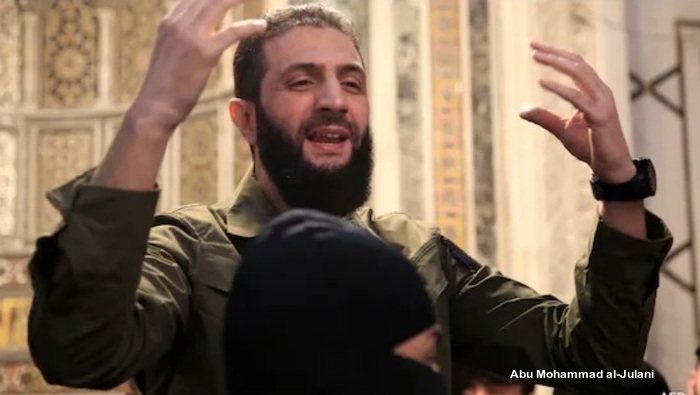
Meanwhile, there are also some differences between the Taliban and the HTS. Firstly, HTS is in favour of taking a Centrist stand, instead of following the policy of Fundamentalism, as far as administrative policies are concerned. Hence, they have considerable sympathy for Christians living in Syria. al-Julani has assured all the ethnic, as well as religious, groups that they could live peacefully in the West Asian nation. Secondly, HTS, unlike the Taliban, does not believe in medieval Sharia Law. Rather, they want to follow the model of Turkey in order to ensure the economic stability of Syria. HTS has a dream of reestablishing the Ottoman Culture in the country. Hence, some analysts consider HTS as a comparatively modern extremist outfit.
Interestingly, the Taliban is trying to strengthen ties with Russia. According to sources close to the Kremlin, Moscow has decided to remove the Taliban from its list of terrorist organisations! The situation in Syria is completely different. As Russia used to back the al-Assad Regime, the relation between Moscow and the HTS is not so good (although the Vladimir Putin Administration has made an attempt to communicate with HTS). Experts are of the opinion that the HTS would merge with the Syrian Government Forces in future, arguing that the only goal of the outfit is to get global recognition by erasing its existence as a terrorist organisation.
Also, there is a strong possibility that Syria would be divided into pieces in the coming days! Neighbouring Israel has already occupied Syrian lands near the Golan Heights. On the other hand, forces loyal to former President al-Assad made an attempt to stage a coup within two-and-a-half weeks of losing power. On the contrary, the Taliban Regime is quite strong and there is almost no possibility that Afghanistan could break up due to the Taliban ban on Afghan women from raising voices, internal conflicts, separatist ethnic groups or other factors.
Boundless Ocean of Politics on Facebook
Boundless Ocean of Politics on Twitter
Boundless Ocean of Politics on Linkedin
Contact: kousdas@gmail.com

 ISMC
ISMC Boundless Ocean Of Politics