

Surprising Dev.: US Imposes Sanctions On Pakistan
The paradise of terrorists has started developing long-range ballistic missiles! The Central Intelligence Agency (CIA) recently informed Washington DC that the Pakistani ballistic missiles might target the US in the coming years! Immediately after receiving such information from the intelligence agency, the US imposed sanctions on Pakistan. The outgoing Joe Biden Administration also expressed serious concern over Islamabad’s ballistic missile programme, apart from taking actions against four Pakistani companies. As expected, the Government of Prime Minister Mian Muhammad Shehbaz Sharif in Islamabad has condemned the US’ move. Political analysts have opined that bilateral ties have touched a new low because of this.
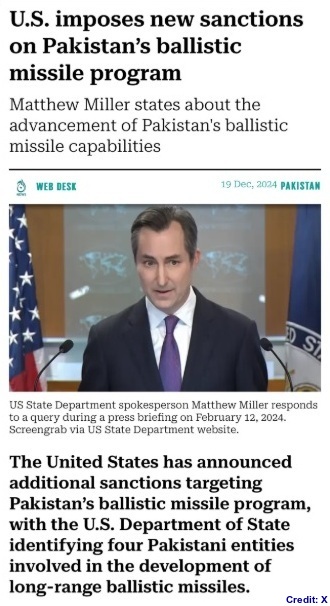
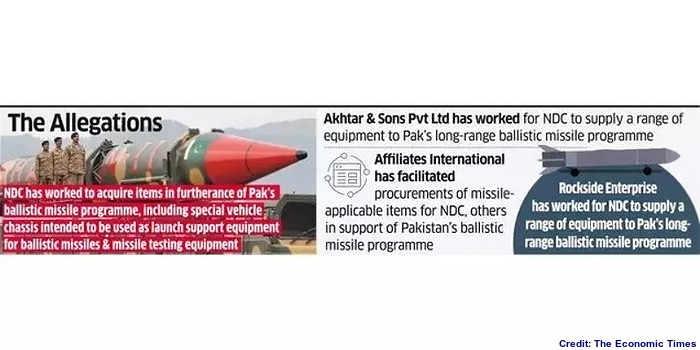
White House issued a statement on Pakistan’s missile programme on December 19, 2024, saying that the South Asian nation posed a serious threat to the US by actively developing long-range ballistic missiles. Later, the US announced sanctions on four Pakistani organisations, including Islamabad-based National Development Complex (NDC). The NDC is an aerospace and defence agency of the Pakistani Ministry of Defence. According to Washington DC, this State-owned company is leading the missile programme.

Jonathan Finer, the Deputy National Security Adviser of the US, has claimed that the ballistic missile programme of Pakistan is a serious issue. Speaking at an event titled Carnegie Endowment for International Peace, he stressed that Pakistan pursued “increasingly sophisticated missile technology, from long-range ballistic missile systems to equipment, that would enable the testing of significantly larger rocket motors“. He added: “If these trend lines continue, Pakistan will have the capability to strike targets well beyond South Asia, including in the US.” Finer further said: “So, candidly, it is hard for us to see Pakistan’s actions as anything other than an emerging threat to the US.“
Apart from the NDC, the US has also imposed sanctions on three Karachi-based organisations: Akhtar and Sons Private Limited, Affiliates International and Rockside Enterprises. They are reportedly involved in the supply of various components to the missile programme! In a rare first, Washington DC has imposed sanctions on a Pakistani State-owned organisation, hitting the missile programme hard. However, there is no reason to think that Pakistan would make a volte face because of the US’ move.
According to the CIA, Pakistan needs to develop ballistic missiles with a range of at least 12,000km to hit the US. Currently, Russia, North Korea and China have such missiles. The US wants the Pak Army not to get access to that technology. In such a scenario, Washington DC has accused Islamabad of breach of trust! Finer stated: “We have been a longtime partner with Pakistan on development, on counter-terrorism and other security issues, including quite sensitive issues. We have provided support to Islamabad during difficult times and we continue to desire a cooperative relationship in these areas of shared interest.” He added: “That makes us question even more why Pakistan will be motivated to develop a capability that could be used against us. Unfortunately, it is our sense that Pakistan has failed to take these concerns and, frankly, the concerns of others in the international community seriously and continues to advance these capabilities. Just looking at a map and looking at ranges, we believe that this is fundamentally focused on us.”
Meanwhile, the Shehbaz Sharif Government has hit back at US sanctions to halt the missile programme of Pakistan as discriminatory. In a statement, the Foreign Ministry of Pakistan has mentioned that the sanctions “have dangerous implications for strategic stability of our region and beyond”. It added that the sanctions “were based on mere doubts and suspicion without any evidence whatsoever”. Pakistan has historically pursued nuclear weapons and missile programmes to counter neighbouring India. However, the Pak Army has not yet achieved the capability to launch nuclear strikes from land, water and air (like India). Hence, experts have found a different reason behind the US’ strict attitude towards the Pak Army.
Pakistan has been directly supporting armed groups, like the Palestinian Hamas Movement and Hezbollah, in their ongoing war against Israel since October 2023 as Islamabad considers the Jewish Nation as its enemy. Therefore, Pakistan could easily target Israel, if it manages to develop long-range ballistic missiles. Analysts believe that the US has made the move as a precautionary measure to protect Israel.
The relationship between Pakistan and the US is a complicated one. The erstwhile Soviet Union had occupied Afghanistan in 1979, increasing its influence in Central Asia. Over the next decade, the US made a serious attempt to liberate Afghanistan from the Soviet occupation. At that period of time, the US used Pakistan as a pawn. The CIA reportedly created Mujahideens (an Arabic term that refers to people who fight for their religion, community or God) to fight against the Soviet forces. The US used to deliver arms and ammunition to the Mujahideens through Karachi port. However, repeated military coups in Pakistan disturbed Washington DC. The Pentagon, too, has considerable objections to Islamabad’s nuclear programme.
The US and Pakistan came closer yet again after 9/11 as the Pentagon realised that it would require the support of Islamabad to eliminate al-Qaeda terrorists. The Pakistani Government and Armed Forces backed the US’ anti-terror operations in neighbouring Afghanistan. However, the bilateral relations deteriorated after the withdrawal of US troops from Afghanistan in 2021 mainly because of Pakistan’s friendship with China. In October 2022, US President Joe Biden said that Pakistan might be “one of the most dangerous nations in the world” as the country had “nuclear weapons without any cohesion”.
Beijing recently accused Islamabad of “blackmailing” the Asian Giant! The Xi Jinping Administration said on December 20, 2024 that Pakistan allegedly made an aggressive demand, suggesting that China could only establish a military base in Gwadar Port if it helped Islamabad develop nuclear technology capable of a second-strike, similar to India’s. Although the Pakistani port is expected to be acquired by the Red Army as a part of the China-Pakistan Economic Corridor (CPEC) project, Pakistan tried to arm-twist China. Reports suggest that Beijing has rejected the proposal and seems to have indefinitely suspended further negotiations.
In such a situation, Pakistan can seek help from North Korea or Turkey. Islamabad received help from Pyongyang and Ankara several times in the past. In that case, it would not be difficult for the South Asian nation to develop long-range ballistic missiles (with the help of foreign technology)!
Boundless Ocean of Politics on Facebook
Boundless Ocean of Politics on Twitter
Boundless Ocean of Politics on Linkedin
Contact: kousdas@gmail.com

 ISMC
ISMC Boundless Ocean Of Politics