

18th G20 Summit: India’s Diplomatic Milestone
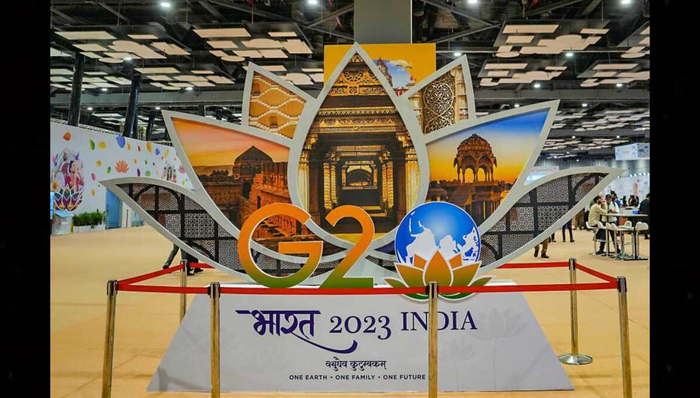
There were doubts about whether the 18th G20 Summit, held in the Indian capital of New Delhi on September 9-10, 2023, would be able to reach a consensus even a few hours before the start of the event. However, all the member-countries agreed on the goal of building one future for one family during the two-day event. India, which did not even expect such a success before hosting the Summit in a rare first, was able to maintain its (so called) neutral stand in the Bipolar World amidst Russia-Ukraine conflict.

The member-states backed the New Delhi Declaration prepared by India on the first day of the Summit. As expected, India described the achievement as historic and groundbreaking. Addressing the second session of the Summit, Prime Minister of India Narendra Modi told the visiting leaders: “Have just got the good news that due to the hard work of our teams and your cooperation, a consensus has been reached on New Delhi G20 Leaders’ Summit Declaration.“
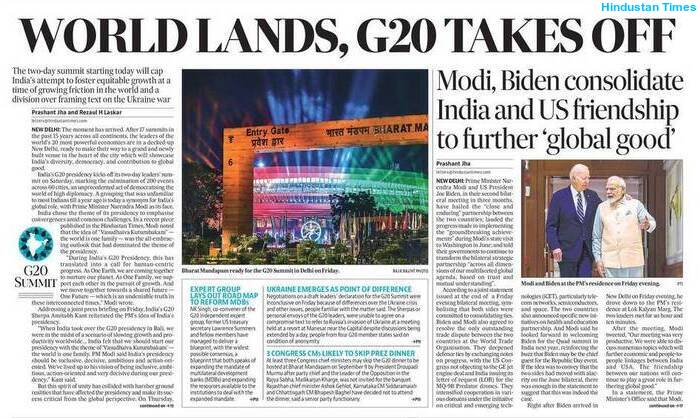
The Government of India issued a statement on September 9 evening, stressing that the G20 member-countries agreed on sustainable and balanced development as mentioned in the Declaration. It further called for multilateral and non-discriminatory trade. In the wake of the Russia-Ukraine War, an old comment of Prime Minister Modi is reflected in the Declaration in a slightly different manner. The Declaration called on all states to uphold the principles of International Law, including territorial integrity and sovereignty, stating: “Today’s era must not be of war.“

The Declaration further stated that in line with the UN Charter, all states must refrain from the threat or use of force to seek territorial acquisition against the territorial integrity and sovereignty or political independence of any state. With this, the G20 echoed India’s Ukraine line, as New Delhi has always upheld principles of territorial integrity and sovereignty of a country. However, the Declaration did not say anything about Russia’s aggression, and also did not condemn Moscow as demanded by the G7.

Apparently, India’s balancing diplomacy can be reminiscent of the days of the Non-Aligned Movement (NAM). However, the current situation is quite different from the Cold War Era, as the global geopolitical landscape has changed a lot since the Second World War. The only similarity is that the entire world is horizontally divided into two parts. The tactics of war have also changed over time (except for the US), and India’s diplomatic position, too, has changed in a subtle way.

The Declaration of the 17th G20 Summit in Bali (Indonesia) in 2021 had stated that “the majority of members condemn the war in Ukraine“. At the same time, it was admitted that there were also other opinions among the member-states about the war. It should be noted that India has not supported the resolution brought against Russia on the Ukraine War in any international forum, including the UN, till now; despite continuous pressure from the US and the Western World. India has also refused to snap trade ties with Russia. Instead, New Delhi still imports crude oil from Moscow, ignoring Western sanction on the Kremlin. Time and again, India has urged both Russia and Ukraine to resolve all the outstanding issues through peaceful negotiation.

Meanwhile, different explanations about the decision reached by the member-countries at the 18th G20 Summit have already surfaced. While Russia has claimed that the Joint Declaration can be considered as a “reflection of balance“, France is of the opinion that conclusion of the Summit has cornered Russia. The majority of the member-states believes that India, as the host nation, has been able to advance its balanced diplomacy. The G20 Summit reportedly discussed a proposal to create an economic corridor from India to Europe through West Asia. It is believed that the proposed corridor would be built as a countermeasure to China’s Belt and Road Initiative (BRI). Interestingly, almost all the Western countries backed this proposal.

Various experts are of the opinion that the US influenced India to make a number of important decisions during the Summit. Just as India is worried about the border conflict with China near Ladakh; Washington DC, too, is worried about Beijing’s aggression in the Indo-Pacific Region and the South China Sea. The US also keeps a close eye on Russia-China understanding on several international platforms. China recently objected to accepting the US as the host country for the G20 Summit in 2026. In such a scenario, the US needs an emerging power, like India, as its partner in Asia. Washington DC further wants Beijing not to control international blocs, like BRICS (a grouping of the world economies of Brazil, Russia, India, China and South Africa).
India has joined the QUAD or the Quadrilateral Security Dialogue (QSD) with Australia, Japan and the US in an attempt to stop China’s maritime aggression. According to sources close to the Narendra Modi Administration, the Heads of QUAD member-states might attend India’s Republic Day celebrations on January 26, 2024. Therefore, India is all set to boost understanding with the US in different fields in a newly polarised world. This apparent neutrality may not bear the imprint of Western opposition as seen during the days of the NAM. The recently-held G20 Summit in New Delhi may have hinted at that.
Boundless Ocean of Politics on Facebook
Boundless Ocean of Politics on Twitter
Boundless Ocean of Politics on Linkedin
Contact: kousdas@gmail.com

 ISMC
ISMC Boundless Ocean Of Politics