

Einstein’s Final Prophecy: What Happens After Death
“I know exactly what happens after death.” This is not a statement of faith nor is it a mere speculation. It is the speculation reached by the greatest physicist in human history after decades of studying the fundamental nature of reality itself.
Albert Einstein (March 14, 1879 – April 18, 1955) devoted his entire life to trying to understand the universe. He unlocked the secrets of space and time. He discovered that mass and energy are the same thing. He demonstrated that time itself could bend, stretch and slow down. And in his final years, he turned his attention to the ultimate question that haunts every human being: What happens when we die? What Einstein concluded about death is not what most people expect. It is not comforting in the traditional sense. However, it is profound and once you understand it, you will never think about death the same way again.
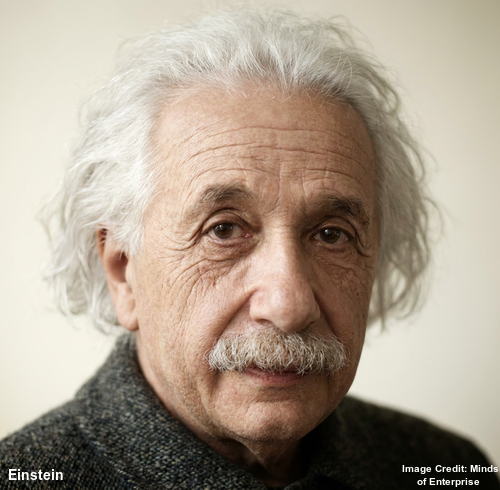
Let us begin with the most important thing that Einstein said about death. In March 1955 (just a month before his own death), Einstein received devastating news. His closest friend died. Michele Angelo Besso (often spelled Mikhailo Besso in Slavic transliterations; May 25, 1873 – March 15, 1955), a Swiss-Italian engineer and mathematician best known as Einstein’s lifelong confidant and intellectual sounding board, passed away.
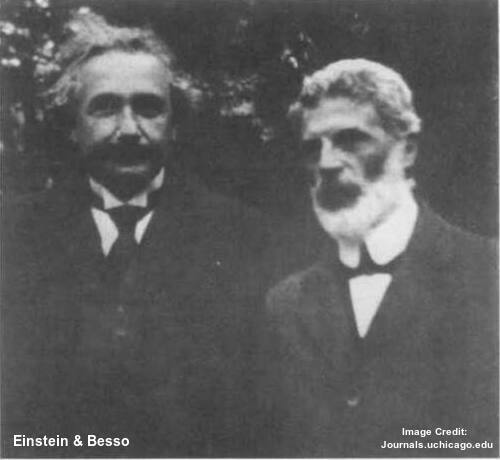
Einstein and Besso had met in 1896, almost 60 years earlier. They were both young then, working at the patent office in Bern, Switzerland. They would walk home together while talking about physics, the nature of light, time and space. It was during those conversations when Einstein developed the ideas that would become the special theory of relativity. Besso was there when Einstein made his greatest breakthrough. In May 1905, Einstein visited Beso and told him that he was stuck on a problem, involving the speed of light. By the next day, Einstein had solved it. Later, he wrote that Besso had been the best sounding board in all of Europe. For nearly six decades, these two men remained close, constantly corresponding and discussing physics, philosophy, life and death. Besso understood Einstein’s mind better than almost anyone else on the earth. And now, Besso is dead.
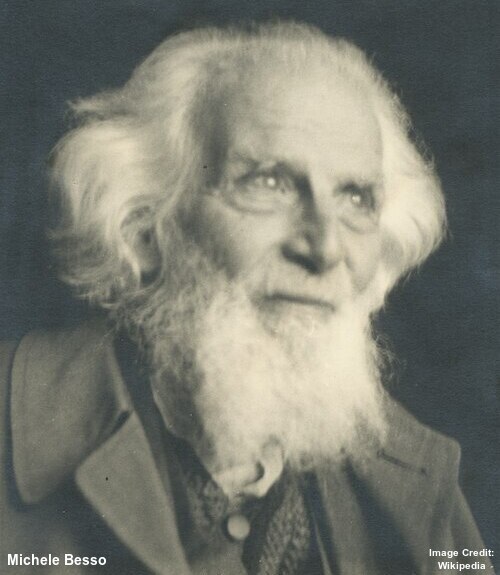
Einstein sat down and wrote a letter to Besso’s family. In that letter, he wrote something that has been quoted millions of times since. However, most people do not understand what he really meant. Einstein wrote: “Now, he has departed from this strange world a little ahead of me. That means nothing. People, like us who believe in physics, know that the distinction between past, present and future is only a stubbornly persistent illusion.” Read that again slowly. Einstein is saying that his friend’s death means nothing. It is not because he did not care. He cared deeply. Then why did he say so? From the perspective of physics, death does not work the way we think it does. The distinction between past, present and future is only an illusion. What does that mean? What could Einstein have meant when he said that the difference between yesterday, today and tomorrow is not real. To understand this, one needs to understand what Einstein discovered about time.
Before Einstein, everyone used to believe that time was absolute. And there was a single moment, called Now, which existed everywhere in the universe simultaneously, the past was gone forever and the future had not yet happened. And that time flowed forward like a river, carrying all of us from birth to death. Einstein showed that all of this was wrong. He demonstrated that time is not separate from space. Instead, they are intertwined in a single fabric called Spacetime and this fabric can bend, stretch and warp near massive objects. Time moves more slowly at high speeds. Two persons can experience different amounts of elapsed time even if they started at the same moment. This is not philosophy. This is physics. It has been tested and verified thousands of times. GPS satellites have to account for time dilation. Else, they would give us the wrong location.
According to Einstein, particles in accelerators live longer when they move faster. Time is not what we think it is. And here is the profound implication Einstein understood. If time is woven into the fabric of spacetime, then the past is not gone, the future has not yet happened. And from our perspective, yet everything that has ever existed or will ever exist is there all at once within the four-dimensional block of spacetime.
Think of a movie. Before you watch it, the entire movie was already there on the reels. The beginning is there, the middle is there and the ending is there. When you watch the movie, you experience it moment by moment. However, the entire movie exists simultaneously. Physicists call this the Block Universe Theory. Imagine all of spacetime as one enormous four-dimensional block. The past is at one end and the future at the other. And we are somewhere in the middle, moving through it and experiencing it, slice by slice. But here is the key: The block is already complete. The future is not empty, waiting to be filled. It is already there. Your death has already happened in the Block Universe. But so has every moment of joy you will ever experience, every laugh, every kiss, every beautiful sunset you will ever see. This is not fatalism. It does not mean that your choices do not matter. Your choices are part of the block. They shape what the block looks like. But once the block exists, it exists forever. Nothing can be done; nothing can be erased. Einstein believed that the universe was like this.
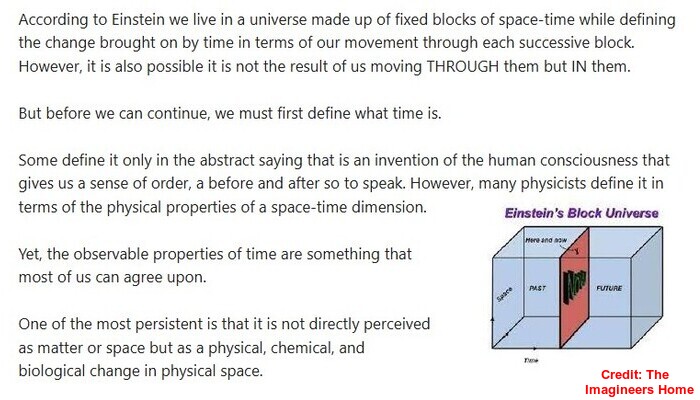
Your birth is still there; your death is already there. Every moment of your life exists eternally within the fabric of spacetime. You are not travelling through time, but just experiencing time. Everything already exists. This is what Einstein meant when he said that the distinction between past, present and future is only an illusion. When Besso died, he did not cease to exist. He moved forward along the timeline. But his life, his entire existence, every moment he ever lived are still there within the fabric of spacetime. They are not gone. They can never be gone. And Einstein knew that he would soon follow Besso. His own life was also eternal in the sense that every moment he had ever experienced was permanently woven into the structure of reality itself. This is what Einstein understood about death and it changes everything. However, there is more.
Einstein was directly asked about life after death many times throughout his career and he gave clear honest answers that most people have never heard. In an interview published after his demise, Einstein said that the fear of death is the most unjustified of all fears because there is no risk of accident for someone who is dead. Think about what he is saying… how much of your life have you spent worrying about death… how many nights have you stayed awake wondering what happens everything ends… how much anxiety have you felt about the inevitable end that awaits us all… Einstein is pointing out something that most of us overlook in our fear. We are afraid of a state in which there is nothing to fear. We spend our lives fearing death. We fear the moment of death, we fear what comes out afterward. However, Einstein is pointing out something obvious that we often ignore. Once you are dead, there is nothing to fear. You cannot be hurt or suffer or fail. All the anxieties and worries that tormented your life are gone. The fear of death is the fear of something that once it arrives contains nothing to fear. This is not meant to be cruel.
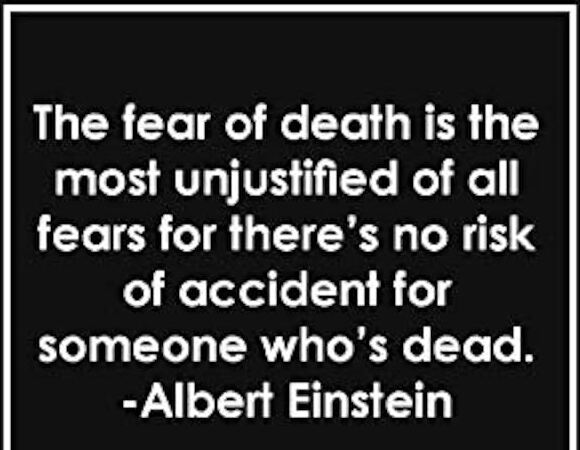
Einstein is trying to help us see death differently, to stop wasting our precious time alive, being afraid of something that is not worth fearing. He also said: “I cannot imagine a god who rewards and punishes the objects of his creation whose purposes are modelled after our own. A god, in short, who is but a reflection of human frailty. Neither can I believe that the individual survives the death of his body, although feeble souls harbour such thoughts through fear or ridiculous egotism.” This statement appeared in Einstein’s obituary in The New York Times on April 19, 1955. It was his final public statement on this subject.
Now, some people find these words harsh, cold and dismissive of the hopes that sustain so many people in the face of mortality. But consider what Einstein is actually saying. He is not mocking people who believe even in an afterlife. He is trying to explain why they believe so. It is fear, ego and the inability to accept that we are not the centre of the universe. Our individual consciousness is not so important that the Laws of Nature must bend in order to preserve it. Einstein believed that facing the truth, however uncomfortable it might be, was always better than living in comforting illusions. And the truth as he saw it was that individual consciousness does not survive physical death. Einstein did not believe that a person as an individual consciousness survive the death of her/his physical body. He thought that the belief in personal immortality was a sign of weakness, fear and ego. He believed that we were deceiving ourselves because we could not accept the reality of our own mortality. This may sound harsh and cold. But Einstein, being honest, believed in following the truth wherever it led even when that truth was uncomfortable.
However, this is not the whole picture because Einstein also believed in something else, something that gives death a different kind of meaning. In 1926, Einstein wrote a letter to the widow of physicist Heinrich Zahner. Her husband had just died and she was devastated. Einstein offered her few words of comfort. He wrote: “Our death is not an end if we can live on in our children and younger generation for, they are us. Our bodies are only withered leaves on the tree of life.” Einstein is offering a different kind of immortality here. Not the survival of the individual soul, but something deeper. You are connected to everyone who came before you and everyone who will come after you. Your parents and grandparents live in you, and you will live on in your children and their children after your death. Our bodies are only withered leaves of the tree of life. The leaves fall; they die. But the tree continues to live and the tree what matters. Life itself is what matters, and not any individual leaf. This is not the kind of immortality most religions promise. You do not retain your memories, personality or your individual sense of self. However, it is a real kind of continuation. Your genetic material, ideas, influence, the ripples you created in the world would continue long after the return of your body to the earth. Einstein found comfort in this. He saw himself as part of something larger, something that would continue long after he was gone. He was a leaf on the tree of life and content with that.
Einstein also spoke about different kinds of immortality in a fascinating way. He said that there are two kinds of immortality. The first lives in the imagination of people and is, therefore, an illusion. There is a relative immortality that may preserve the memory of an individual for a few generations. But there is only one true immortality on a cosmic scale and that is the immortality of the cosmos itself.
Think about what he is describing here. The first kind of immortality is what most religions promise – the survival of the individual soul. Einstein called this an illusion that exists only in our imaginations. The second kind is what we might call fame or legacy. Shakespeare is immortal in this sense and so is Einstein himself. People remember them and their names survive. But this immortality is limited. In a few hundred years or a few thousand or a few million, even the greatest names will be forgotten. The third kind is the only true immortality. This immortality is cosmic. The universe itself is immortal. The atoms that compose it endure, the laws that govern it are timeless and you are part of that not as an individual, but as matter, energy and as a temporary configuration of the eternal substance of the universe. This is the immortality Einstein believed in. It is not personal and not based on fame; but cosmic, eternal and real.
There is yet another dimension to Einstein’s understanding of death and it connects to his most famous equation: E=mc². Everyone knows this equation. But most people do not understand what it actually means. Energy equals mass multiplied by the speed of light squared. This tells us that mass and energy are two forms of the same thing. You can convert mass into energy and energy into mass. They are interchangeable. Now, consider what it means for death. When you die, your body does not disappear. The atoms that make up your body continue to exist. They disperse and they become part of the soil, air and water. They are absorbed by plants and animals. Eventually, they become part of other living beings. The matter that makes you has existed since the beginning of the universe. It was forged in the hearts of dying stars. It has been part of countless creatures before you and it will become part of countless creatures after you. You are not a thing, but a pattern, a temporary arrangement of atoms. It will be rearranged into something else after your demise. Einstein understood this deeply. From a physical perspective, he knew that nothing is truly created or destroyed. Energy is conserved; matter is conserved. Everything that exists has always existed in some forms and will always exist in some forms.
In 1950, a rabbi, named Robert Marcus, wrote to Einstein after the former’s 11-year-old son had just died of polio. The devastated rabbi asked Einstein whether immortality might perhaps be found in the scientific principle of the conservation of energy. Einstein responded with compassion, but also with honesty. He reminded the grieving father that science could not provide the assurance of immortality that he desperately longed for, at least not in literal sense. That kind of promise belongs to religions, and not physics. However, Einstein did offer something. He spoke about the unity of the universe, about how everything is connected and also about the boundaries between individuals. They are not as solid as they seem. “Your son’s energy has not been destroyed,” he wrote to the rabbi. Einstein might have said that it has been transformed. The atoms that made him still exist in the universe. The love you shared, the memories you have, the impact he had on the world; all of this continues not in the way religion promises, but in a real physical sense. This is perhaps the most honest answer anyone can give about death. The greatest physicist of the 20th Century could not promise a grieving father that the soul of his son was in heaven. But he could promise that nothing is ever truly lost and that the universe preserves everything. That what once was will always be in some form.
Now, let’s share what Einstein said about his own death. As he grew older, Einstein became increasingly comfortable with the idea of dying. He did not fight or rage against it. He accepted it as something natural, even beautiful. He reportedly said: “I want to go when I want. It is tasteless to prolong life artificially. I have done my share. It is time to go. I will do it elegantly.” Einstein died on April 18, 1955 after suffering an abdominal aortic aneurysm. Doctors wanted to operate on him. Einstein refused, saying that it was time. On his final night, Einstein was working. He had papers beside his bed. He was still trying to solve the Unified Field Theory, the equation that would unite all the forces of nature. Even in his final hours, he was still trying to read the mind of God. The nurse, who was with him that night, did not speak German. At around 1am, Einstein said two sentences… his final words. But the nurse could not understand them. And so, Einstein’s final thoughts, whatever they were, were lost to history. What might he have said… was it something about physics, about his family or about the nature of death itself; we will never know. However, we do know how he lived and what he believed. We also know that he faced his end with the same courage and curiosity which defined his entire life.
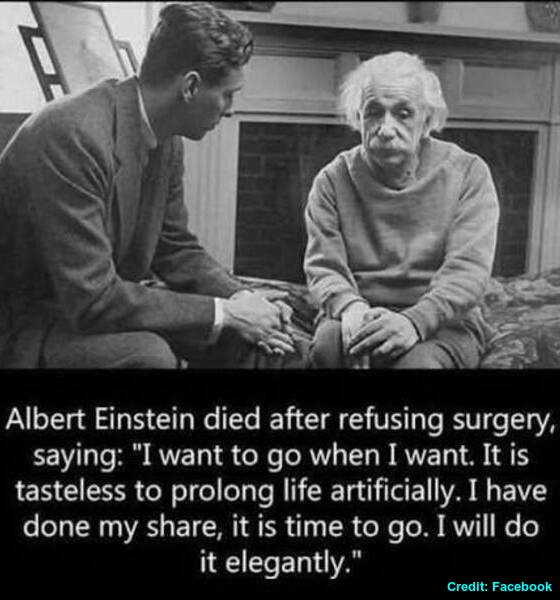
Einstein also made a specific request concerning his body. He said: “I want to be cremated so people do not come to worship my bones.” Einstein did not want to become a saint; he did not want his body to become a relic. He wanted to return to the universe in order to become part of the earth again and to complete the cycle. Interestingly, this request was partially violated. His brain was removed without permission and studied for decades. Scientists wanted to understand what made Einstein different. They found some unusual characteristics, more glial cells than average and an unusual parietal lobe. But they never found the secret of genius. The brain was only tissue; the magic was gone. However, his body was cremated as he wished and his ashes was scattered in an undisclosed location. Some say that they were scattered in the Delaware River, while others say somewhere near Princeton. The exact location is unknown. Perhaps, that is appropriate.
Einstein wanted to return anonymously to the universe in order to become part of everything without anyone knowing where. He became Adams again, scattered to the wind… part of everything… part of the air you breathe, part of the water you drink, part of the earth beneath your feet. He is everywhere now just as he always was. This is what Einstein understood about death.
Let’s summarise it for you. First, time is an illusion. The distinction between past, present and future is not real. Every moment of your life exists eternally within the fabric of spacetime. When you die, you are not gone. You are still there in every moment you ever lived. Second, there is nothing to fear. The fear of death is the most unjustified of all fears. Once you are dead, there is nothing to fear. Stop wasting your life being afraid of something that when it arrives contains nothing to fear. Third, individual immortality is an illusion. You will not survive the death of your body. As a conscious individual, believing otherwise is a sign of weakness and ego. Accept death. It is the truth. Fourth, you are part of something greater. You are a leaf on the tree of life. The tree continues even when the leaf falls. You live on your children, in your ideas and in ripples you created in the world. Fifth, nothing is ever truly lost. Energy is conserved; matter is conserved. The atoms that make you have existed for billions of years and they will exist for billions more. You are a temporary pattern, but the material that makes you is eternal. Sixth, death is natural and it should be accepted with grace. Do not fight against it and do not artificially prolong life. When the time comes, let go elegantly. This is what the greatest physicist in history concluded about death.
It is not the comforting answer that religion provides. It does not promise you heaven, reincarnation or eternal life. But it is honest and there is a profound kind of peace in honesty. Now, if you found value in understanding Einstein’s perspective on death, his ideas will certainly make you think differently about your own mortality.
Source: The Hidden One
Meanwhile,













Boundless Ocean of Politics on Facebook
Boundless Ocean of Politics on Twitter
Boundless Ocean of Politics on Linkedin
Contact us: kousdas@gmail.com

 ISMC

