

Top al-Qaeda Leader Roaming Freely In B’desh
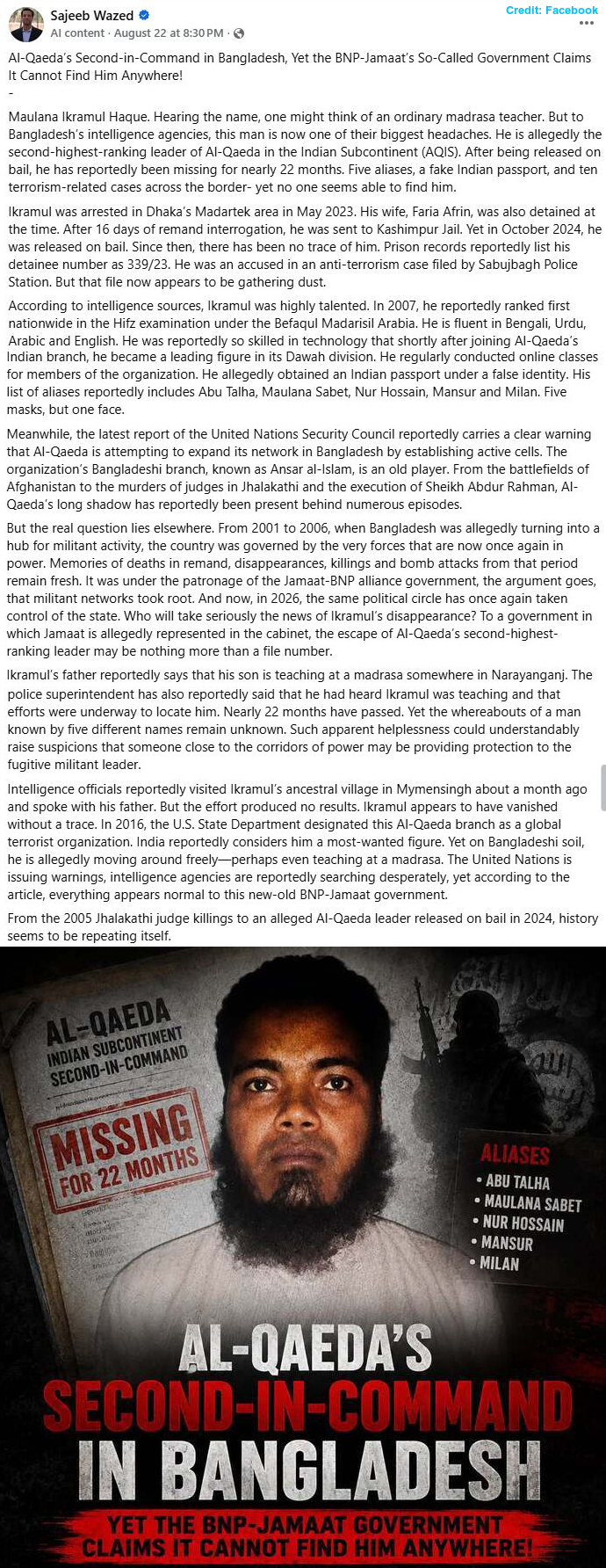
Maulana Ikramul Haque, alias Abu Talha – the Second-in-Command of al-Qaeda in South Asia – is roaming freely in Bangladesh. Sajeeb Wazed, the son of former Bangladeshi Prime Minister Sheikh Hasina Wazed, has made such a claim in a post on X. This piece of information has raised concern in neighbouring India as a UN Security Council (UNSC) monitoring report, published in the second week of August 2026, mentioned that al-Qaeda in the Indian Subcontinent (AQIS) was attempting to exploit Bangladesh in order to establish small operational cells for anti-India activities.
It may be noted that Haque, the Deputy Head of AQIS and Head of the terror outfit’s propaganda wing, was arrested in Bangladesh in May 2023 due to his alleged involvement in recruiting, as well as radicalising, AQIS members in both Bangladesh and India, particularly through religious education institutions. Later, he was released. A senior Indian official said: “Haque is on the National Investigation Agency’s (NIA) most wanted list. He is accused in at least 10 cases related to terrorist activities in India.“
It is not just Haque; several recent developments in Bangladesh have caused serious concern for Indian intelligence officials. They have opined that Islamic terrorist organisations are once again finding a favourable environment in Bangladesh to reorganise themselves.
Haque, a resident of Mymensingh (Bangladesh), arrived in Deoband in northern Indian Province of Uttar Pradesh for higher education in 2018. Later, he became inspired by al-Qaeda’s ideology in Deoband and subsequently became the head of the recruitment cell or Dawah-wing of AQIS. He also obtained Indian documents, and even an Indian passport, by listing a couple from Dinhata (in eastern Indian Province of West Bengal) as his parents. The NIA investigation revealed that the 33-year-old Haque stayed in West Bengal for nearly two years. During his stay in the province, he established multiple sleeper cells and modules, spanning from central Indian Province of Madhya Pradesh to western Province of Gujarat.
According to NIA officials, Haque fled to Bangladesh in 2022 after the Indian Police arrested several members of the module. He was arrested in Dhaka, along with his wife, in July of the following year. Hasina lost power and resigned as Prime Minister of Bangladesh in August, and Haque was granted bail on October 10. He has been missing ever since. His father recently informed the local media that his son is teaching at a madrasa in Narayanganj.
Meanwhile, Indian intelligence agencies have claimed that Haque is not alone; 370 individuals directly involved in militant activities have been granted bail since the fall of the Hasina Government. Among them are Mufti Jashimuddin Rahmani, a radical Bangladeshi cleric who founded the outlawed militant group Ansarullah Bangla Team (ABT) that is aligned with al-Qaeda, and 185 leaders, as well as activists, of the Jamaat-ul-Mujahideen Bangladesh (JMB). They are roaming almost openly in Bangladesh.
Two high-powered Improvised Explosive Devices (IEDs) were recovered from the Ashulia and Motijheel areas of Dhaka on July 26 and 31, 2026, respectively. A JMB operative was arrested for his alleged involvement in this incident. Another IED explosion had occurred at a madrasa in Dhaka in December 2025. The investigation revealed that terrorists were running an IED manufacturing unit there. These events are a cause for concern not only for Bangladesh, but also for India. Referring to the arrest of several members of an organisation named the Fatah Combat System, a senior Indian Police officer stated that the group was carrying out fundamentalist activities under the guise of martial arts training.
A UN report has mentioned that AQIS is operating primarily from Afghan soil. The outfit aims to expand its own organisation by bolstering groups, like the JMB, with funds and other forms of assistance. An explosion involving a moving car took place near the Red Fort in the Indian capital of New Delhi on November 10, 2025, resulting in approximately 10 deaths and multiple injuries. The UN report has held AQIS responsible for that incident, noting how they are emerging as one of the dangerous militant organisations in Southeast Asia. They have decentralised the entire organisation by creating small cells or modules. Hence, India’s concerns are mounting along both its western and eastern borders.
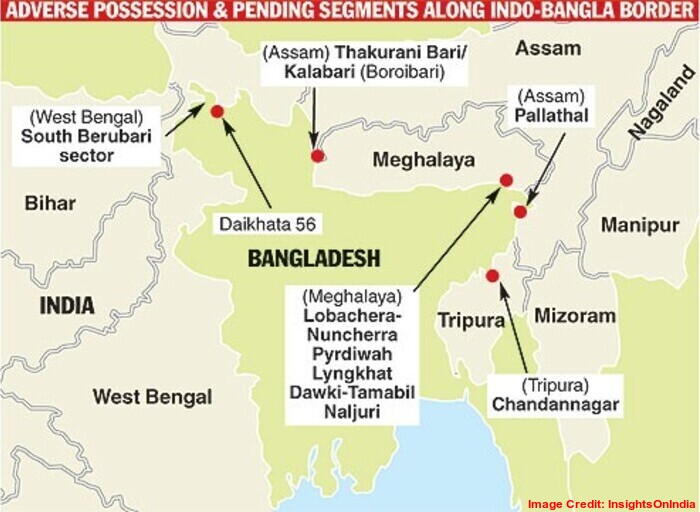
The Narendra Modi Government has been active in securing the Bangladesh border for the past few years. The recent visit to Dhaka by four Indian officials, including Parag Jain, the chief of the Research and Analysis Wing (RAW, the primary foreign intelligence agency of India), is quite significant. The RAW officials held a meeting with their counterparts from the Directorate General of Forces Intelligence (DGFI), the principal military intelligence agency of Bangladesh. Although Bangladesh has described it as a routine visit; Indian intelligence sources have hinted that the issue of current militant activities in the neighbouring country was also discussed during the meeting.
An Indian Police Officer, investigating various JMB and Haque modules, has said: “Border controls have been tightened and infiltration has decreased. However, the danger will not subside unless the modules that were already established are completely uprooted.“
Meanwhile,





Boundless Ocean of Politics on Facebook
Boundless Ocean of Politics on Twitter
Boundless Ocean of Politics on Linkedin
Contact us: kousdas@gmail.com

 ISMC
ISMC
