

Study: Humans Preferred To Hunt Female Mammoths
Modern humans had appeared on the Earth more than 20,000-30,000 years ago, although they did not start farming until about 12,000 years ago. They used to survive by hunting and gathering fruits. Those hunter-gatherers displayed signs of intelligence, as they used to select their prey based on which animal would yield the greatest profit. Recent research suggests that humans hunted female mammoths more frequently than males during that period of time.
Mammoths first appeared around five million years ago in Africa during the early Pliocene epoch. While most mainland populations vanished by 10,000 years ago, a tiny isolated group survived on Wrangel Island until roughly 4,000 years ago. During the Pleistocene epoch (2.6 million to 11,700 years ago), repeated cycles of cooling covered over 30% of the Earth’s land with glacial ice at their peak. This era featured massive ice sheets, lower sea levels, large mammals, like woolly mammoths, and the evolution of modern humans. In such an environment, the woolly mammoth became a preferred target for hunter-gatherers for various reasons and among them, female mammoths were hunted frequently.
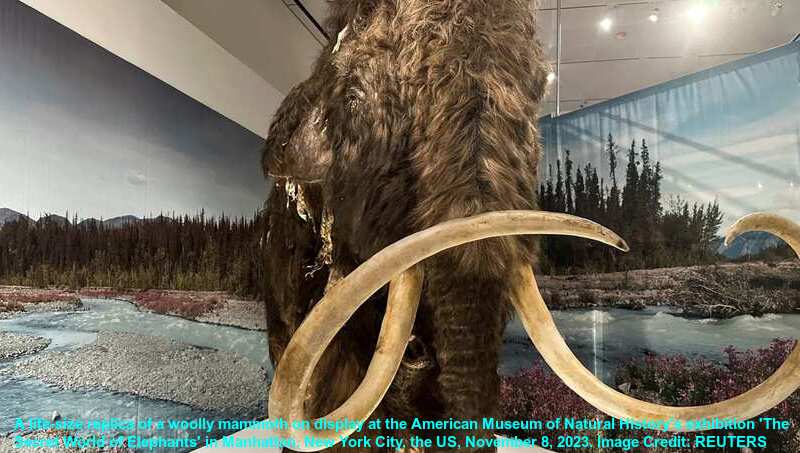
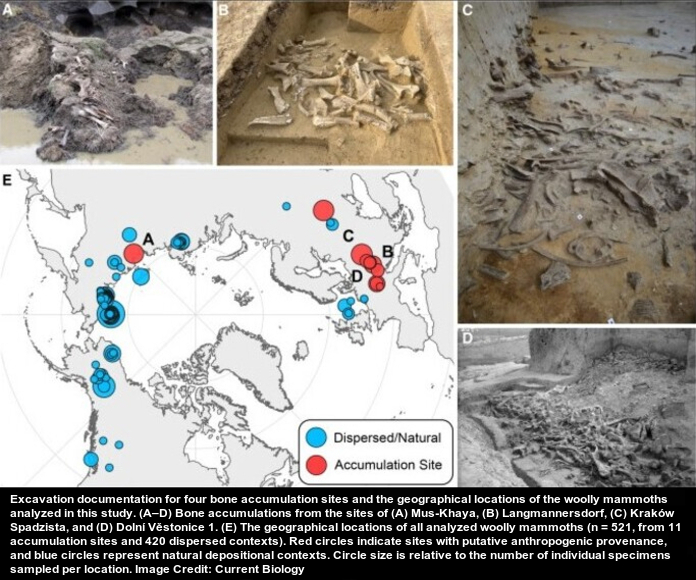
Hannah Moots – a Postdoctoral Researcher at the Centre for Palaeogenetics, a collaboration between Stockholm University and the Swedish Museum of Natural History – led this study. She and her colleagues analysed genetic data from mammoth fossils found in a total of 11 locations across Poland, Austria, the Czech Republic, Germany and Russia. They also analysed DNA from a total of 521 mammoth bones of which 100 bones had been accumulated by hunter-gatherers primarily from 10 sites in Central and Eastern Europe, and one in Siberia. Carbon dating has revealed that they all date back 20,000-30,000 years. The remaining 421 bones were found in a natural setting.
Research has shown that 70% of the bones accumulated by Ice Age people after hunts belonged to female mammoths and just 30% belonged to males. However, this ratio was completely the opposite in the case of bones recovered from natural settings. While 66% of mammoth bones recovered from natural settings were from males, only 34% from females. The research has recently published in the journal Current Biology.
The question arises here: What is the reason for such gender disparities between bone samples found in natural environments and those accumulated by humans? “That’s a great question, and one we’re still actively investigating,” stressed Moots. Although there is no clear idea, the Lead Researcher has highlighted several possibilities behind such a selection.
In fact, mammoths diverged from the ancestors of modern Asian elephants about five-six million years ago, forming a distinct evolutionary branch. This split took place during the late Miocene epoch. Later, they shared a closer genetic relationship with Asian elephants than African elephants do. Moots said: “One possibility is that if woolly mammoths lived in female-led herds, like modern elephants, those groups may have moved across the landscape in more predictable, seasonal ways. Today, female elephant herds have relatively stable home ranges and movement patterns, whereas adult males are more solitary and often roam much more widely. That predictability may have made female-led herds easier for Ice Age people to locate repeatedly.” According to Moots, the herds were most likely matriarchal, comprising adult females, plus juveniles of both sexes.
For his part, Centre for Palaeogenetics Evolutionary Geneticist and Study Co-senior Author Professor Love Dalén stated: “One could also speculate that it would have been easier to pin down a herd with juveniles, where the females would have been reluctant to run away.” He explained that female mammoths generally were smaller than males and perhaps somewhat easier to kill. An adult male weighed up to about six tonnes and stood up to about 11ft tall at the shoulder, compared to about four tonnes and about 9.5ft for an adult female.
Meanwhile, David Díez-del-Molino, another Study Co-senior Author, said: “I think ancient humans likely hunted mammoths by using terrain to their advantage. For example, I could imagine them using landscape features, such as mud or bogs, to help immobilise the animals before attacking them using spears, darts or arrows.“
Researchers have identified Kraków Spadzista in southern Poland as the largest mammoth-hunting site, dating to about 25,000-30,000 years ago. This region contains the remains of more than 100 mammoths, stone tools and evidence of mammoth butchery.
Meanwhile,











Boundless Ocean of Politics on Facebook
Boundless Ocean of Politics on Twitter
Boundless Ocean of Politics on Linkedin
Contact us: kousdas@gmail.com

 ISMC
ISMC
