

India, Australia To Take Care Of Indo-Pacific
In today’s era of volatile geopolitics, having a reliable ally with a clear vision is a major asset for any country. India is keen to see Australia step into that role to strengthen its position in the Indo-Pacific region, amidst uncertainty regarding the US’ future role in the Quad (or the Quadrilateral Security Dialogue, an Indo-Pacific diplomatic and strategic partnership between Australia, India, Japan and the US). Hence, the South Asian nation made a serious attempt to further strengthen its security cooperation with Australia in the Indo-Pacific region during recent diplomatic engagements, including the India-Australia Defence Ministers’ Dialogue and the Quad Foreign Ministers’ Meeting in New Delhi.
The defence ministers of the two countries reiterated their commitment to finalising a Joint Maritime Security Collaboration Roadmap during the second India-Australia Defence Ministers’ Dialogue in New Delhi on June 1, 2026. According to the two ministers, the roadmap is aimed at strengthening surveillance across the Indo-Pacific region and advancing joint military initiatives to address regional instability. They also emphasised advancing collaborative maritime domain awareness, exploring undersea surveillance and deepening industrial collaboration.
It may be noted that the Indo-Pacific region is the global economic engine, producing over 60% of the global GDP and facilitating more than 60% of all maritime trade. Connecting the Indian and Pacific Oceans, it serves as the most critical artery for international supply chains, natural resources and energy corridors. The region, which contains several of the world’s most critical maritime chokepoints (including the Strait of Malacca), also bridges Asia with the Middle East, Africa, Oceania and the Americas.
According to a statement issued by the Quad in May 2025, concerns regarding China’s activities in this region are mounting not only among Quad members, but also among other countries mainly because of Beijing’s increasing militarisation and territorial claims in the South and East China Seas. China suspended high-level political exchanges and also imposed a range of informal sanctions and trade blockages against Australia in the wake of a series of escalating disputes, culminating in Canberra’s call for an independent inquiry into the origins of COVID-19 Pandemic in April 2020. The move also impacted bilateral trade. Differences of opinion between the two countries still persist due to fundamentally opposing views on Indo-Pacific security, with Australia prioritising alliances to counter China’s regional influence and China viewing this as US containment.
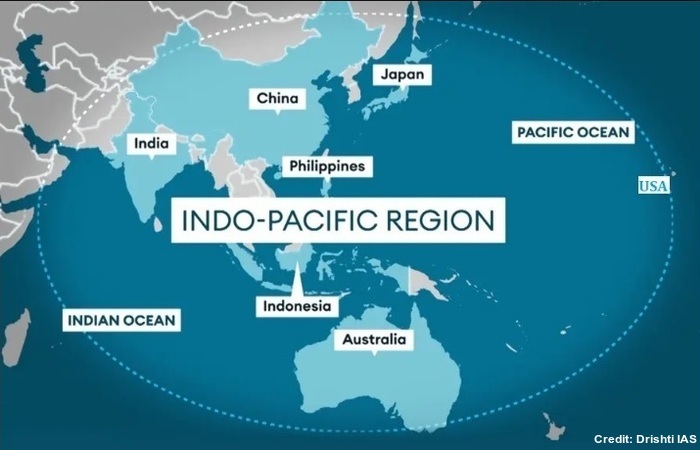
One should not forget that Beijing has secured port access all around the Indian Subcontinent, stretching from Djibouti in the Horn of Africa to Gwadar in Pakistan, Hambantota in Sri Lanka and Kyaukpyu in Myanmar. This strategic port network, often referred to as the String of Pearls, is a cornerstone of China’s Indo-Pacific strategy. While primarily focussed on energy security and trade routes from the Middle East, these footholds increasingly intersect with the global supply lines vital to Australia’s economy.
China’s expanding footprint in the Indo-Pacific region directly challenges India’s maritime security, as well. In fact, the Asian giant has encircled India through projects, like the String of Pearls and the massive USD 62 billion China-Pakistan Economic Corridor (CPEC). The Chinese dominance in this particular region has prompted India to intensify hard and soft balancing acts by boosting its naval capabilities, deepening the Quadrilateral Security Dialogue (Quad) with the US, Australia and Japan, and bolstering defence exports to Southeast Asian partners.
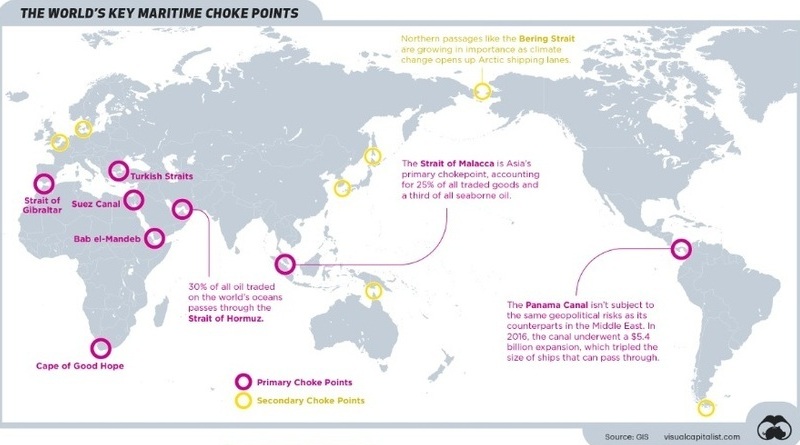
In such a situation, keeping Indo-Pacific waterways free from dominance of any single power is an economic, as well as strategic, necessity. Hence, India and Australia have decided to bolster cooperation beyond diplomatic understanding through the exchange of intelligence inputs, joint maritime surveillance and coordinated military exercises. To counter Beijing, New Delhi should focus on establishing military bases in strategically important locations and modernising its naval fleet, alongside further strengthening bilateral cooperation.
Meanwhile,





Boundless Ocean of Politics on Facebook
Boundless Ocean of Politics on Twitter
Boundless Ocean of Politics on Linkedin
Contact us: kousdas@gmail.com

 ISMC
ISMC
