

Earliest DNA Evidence Of Father-Daughter Pairing Found
Scientists have previously found evidence of close physical (reproductive) relationships between family members in ancient populations. The matter was not considered particularly unusual at that period of time. A recent genetic study has confirmed the earliest known evidence of a father-daughter incestuous relationship from the Bronze Age in southern Italy, dating back approximately 3,700 years. The findings have been published in the Communications Biology journal.
A team of German archaeologists, alongside Italian researchers, recently studied some Bronze Age remains found at Grotta della Monaca (Monk’s Cave) cemetery in Calabria, Italy. People had been buried at this cemetery since BCE 1380 and the final burials took place in 1780. Here, archaeologists have uncovered the earliest known evidence of parent-child incest in ancient DNA, revealing that a 3,700-year-old teenage boy was the son of an adult male and his daughter. They have also found that the community had a unique genetic link to Sicily, but distinct from Eastern Mediterranean groups, suggesting its own cultural path.
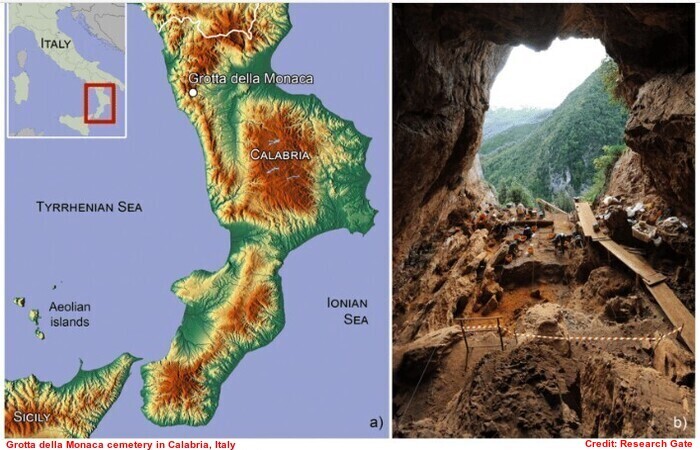
Scientists have conducted DNA tests on the remains of 23 individuals from this Bronze Age burial site in an attempt to trace their genetic origin, as well as background. They have used genetic analysis (specifically Y-chromosome and mitochondrial DNA) to determine the sex of those individuals because the skeletons were fragmented and mixed up. While 10 individuals have been identified as female, eight individuals have been identified as male and the remaining five were likely juveniles whose sex was harder to determine with the help of available methods.
Interestingly, the mitochondrial (mtDNA) and Y-chromosome (Y-DNA) DNAs of those 23 individuals are different. It may be noted that the mtDNA traces the maternal line (mother’s mother’s line), while the Y-DNA traces the paternal line (father’s father’s line). Hence, the scientists have come to the conclusion that while most of the individuals form a relatively homogeneous cluster, the overall group displays enough genetic variation (across maternal and paternal lineages) to indicate that they came from different genetic backgrounds and did not belong to a single, tightly related community or group.
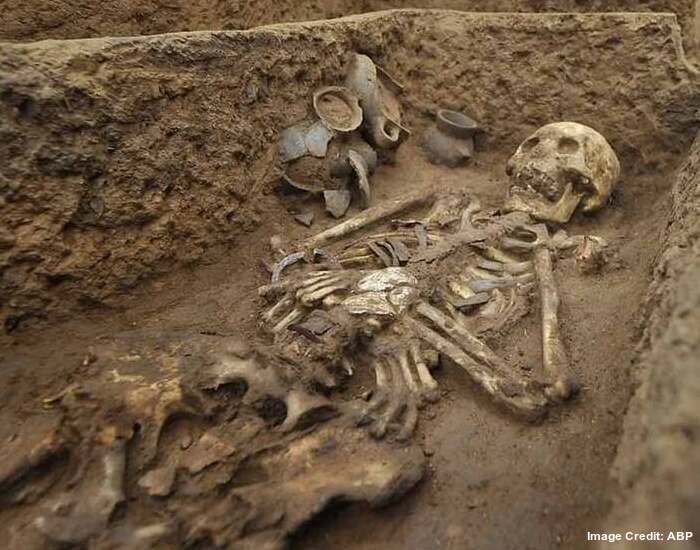
DNA tests have helped scientists to confirm that those 23 individuals buried at the Bronze Age site had both typical family connections and extreme parental consanguinity. Only two individuals had physical relationships with their parents. Archaeologists have also observed that many were buried alongside their loved ones (like a mother and her daughter) at this site, suggesting that Grotta della Monaca was a communal burial ground. According to many, being buried with a loved one was perhaps a custom at that time.
Archaeologists have found the remains of the teenage boy next to the grave of an adult man. After analysing the Runs of Homozygosity (ROH) in the DNAs of the father-son duo, they have confirmed that the boy was the offspring of a rare, first-degree incestuous union between the adult man buried nearby and his own daughter. ROH are long stretches of DNA where an individual inherits identical genetic segments from both parents, indicating recent shared ancestry or inbreeding, and are key for understanding population history, inbreeding levels and the genetic basis of traits or diseases. Longer ROH suggests closer recent ancestors. Analysis of their frequency, length and distribution helps scientists to trace demographic events, like population bottlenecks or selection pressures.

High levels of ROH have been observed in all of the individuals (buried at the Grotta della Monaca burial site) whose bone DNA has been tested, indicating significant recent inbreeding or consanguinity within that Bronze Age community. It has also revealed extremely close familial relationships, potentially even parent-offspring or sibling pairings, leading to magnified recessive traits and strong local genetic isolation.
Marriage between brother and sister was common among ancient Egyptian royalty, particularly from the 18th Dynasty onward, as royal families wanted to preserve divine bloodlines and to consolidate power. The remains of a Stone Age man, found in the Newgrange passage tomb in Ireland in 2020, were revealed by DNA analysis to be the product of a first-degree incestuous union. In other words, his parents were either siblings or a parent and child. Genetic analysis of Neanderthal remains has revealed evidence of significant inbreeding within their populations. Studies of the nearly complete genome of a female Neanderthal from the Altai Mountains in Siberia have shown that her parents were closely related, likely half-siblings or perhaps even full siblings. However, scientists have not previously found much evidence of sexual intercourse and reproduction between parents and their children.
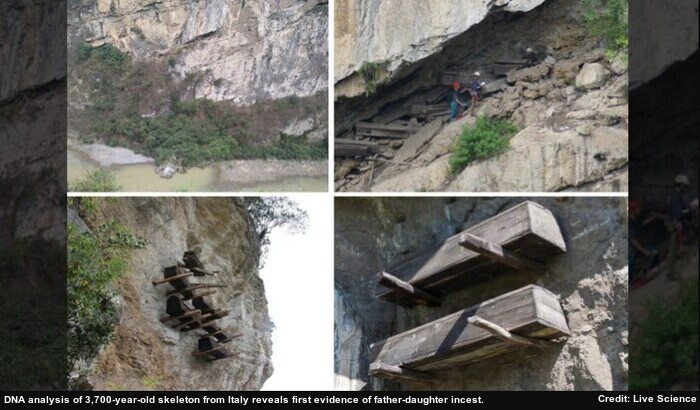
Scientists refer to sexual intercourse between a parent and child as first-degree incest. They are of the opinion that the offspring born as a result of this may have genetic issues. However, no genetic problems were detected in the remains of the teenage boy found at Grotta della Monaca burial site. It is still unclear to scientists exactly why the reproductive union between a father and his daughter occurred thousands of years ago at this Bronze Age burial site. They have described the matter as rare.
Scientists are certain that those graves belong to ordinary people. Professor Alissa Mittnik of the Max Planck Institute for Evolutionary Anthropology in Germany has stated: “This finding emphasises the distinction between unambiguous biological evidence and its social meaning. This exceptional case may indicate culturally specific behaviours in this small community, but its significance ultimately remains uncertain.” She believes that this particular incident could be an anomaly in society, or it could also be the result of some form of violence.
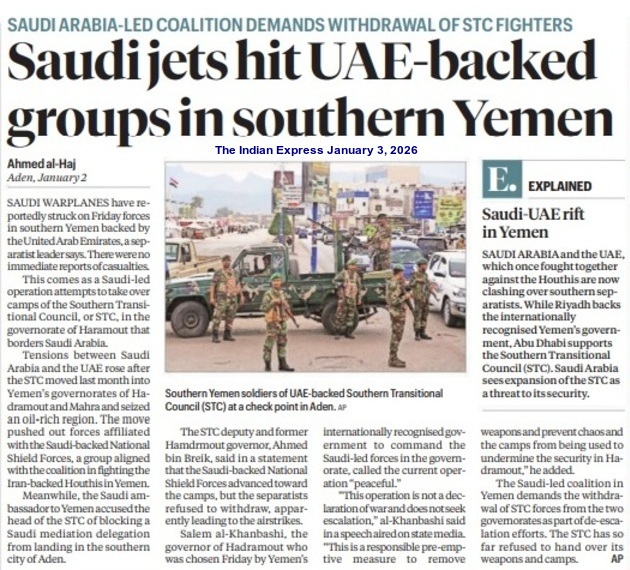
Meanwhile,


Boundless Ocean of Politics on Facebook
Boundless Ocean of Politics on Twitter
Boundless Ocean of Politics on Linkedin
Contact us: kousdas@gmail.com

 ISMC
ISMC Boundless Ocean Of Politics