

Trump Looms Over India-Russia Summit
The pressure of US tariffs and an unfinished trade deal with Washington DC have dampened the quality of the agreements signed by India and Russia during President Vladimir Vladimirovich Putin‘s December 4-5, 2025 visit to New Delhi.
Foreign policy experts believe that the outcome of the India-Russia Summit is quite simple as the accords signed by President Putin and Indian Prime Minister Narendra Modi do not showcase the real strength of bilateral relationships. According to experts, such deals could have been easily signed at secretarial- or bureaucratic-level talks. Also, there was no joint message from India and Russia to China, the US or the Western World. The visiting Russian President remained silent on the Sino-Indian rivalry in Asia.
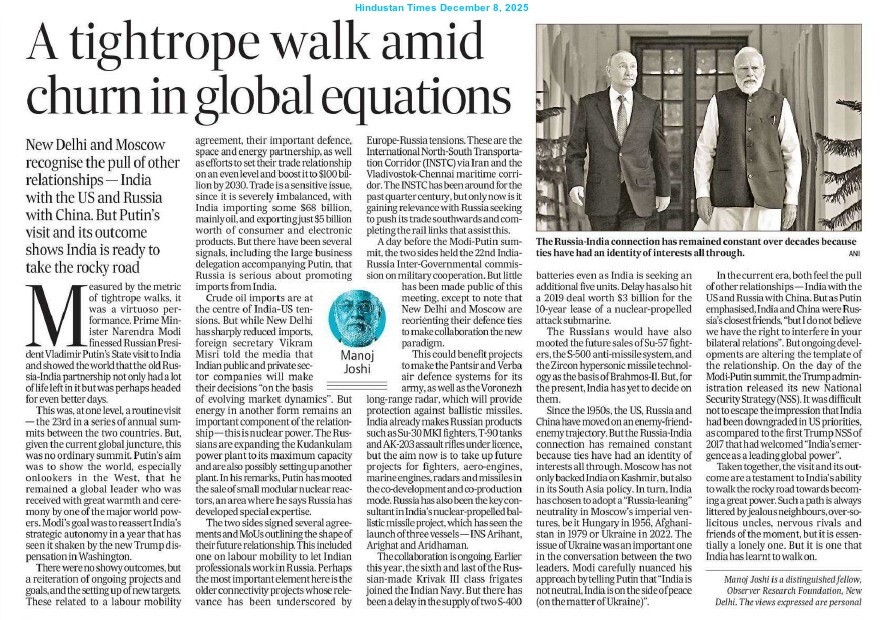
According to some senior officials of the Indian Ministry of External Affairs, bilateral ties are determined based on mutual interests and the balance of power, and not on mutual relations. Of course, personal relationships between leaders have an importance, but they are based mainly on self-interests. Many are of the opinion that the chemistry of personal relationships (between Prime Minister Modi and President Putin) is being brought to the fore in India. New Delhi made a similar mistake with US President Donald John Trump in the past and is paying the price now.
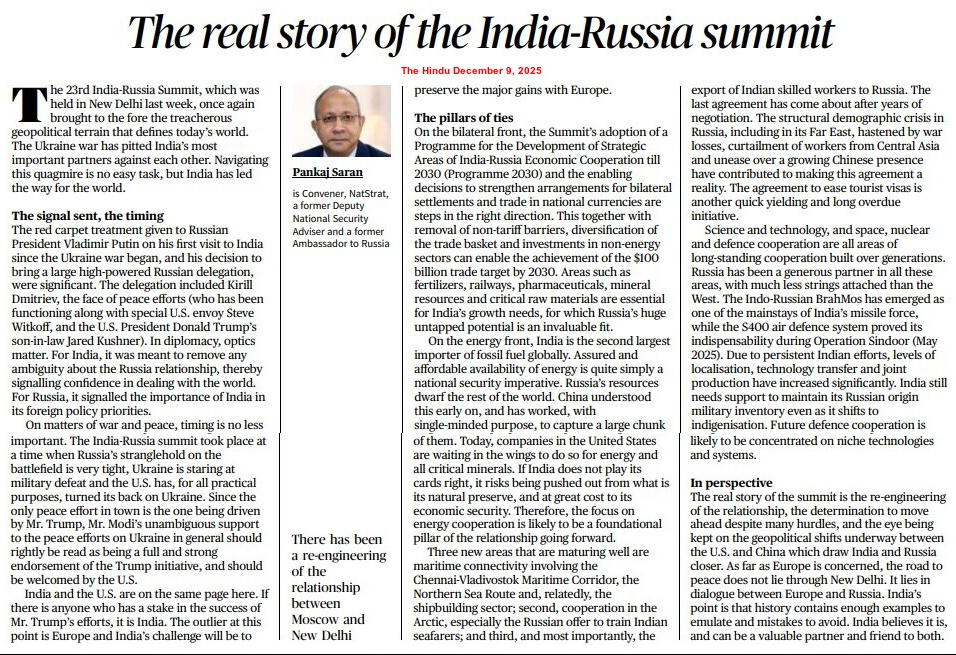
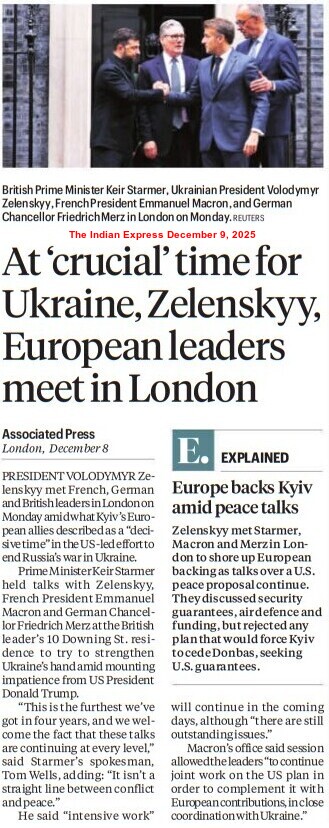
Political analysts have opined that Moscow, too, is paying a strategic compensation for engaging in a long-term armed conflict with neighbouring Ukraine. It may be noted that Finland joined NATO as its 31st member on April 4, 2023, a historic shift from its long-held military non-alignment, driven by Russia’s invasion of Ukraine; followed by Sweden that became the 32nd member in March 2024, making all three Nordic nations (Finland, Sweden and Norway) part of the Western defence alliance, significantly altering European security and the High North dynamics. The development has helped President Trump to increase his influence in the Nordic region.
In such a scenario, President Putin’s visit to India was supposed to deliver a strong message against global geopolitical pressure. However, Russia and India have not taken any such steps. Therefore, it has been proven that Moscow and New Delhi are not able to be aggressive in terms of bilateral policy.
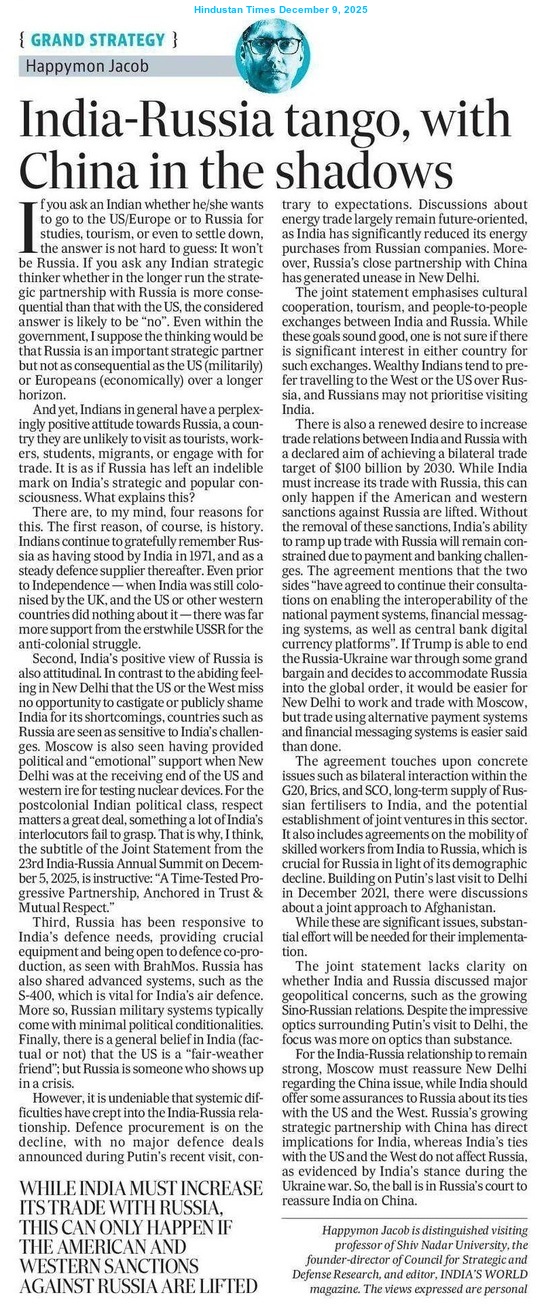
President Trump, through his bizarre and unpredictable diplomacy, has at least proven that India does not have much choice. In the presence of Prime Minister Modi, President Putin announced that Moscow would continue to supply crude oil to New Delhi. However, Vikram Misri, the Foreign Secretary of India, admitted that the South Asian country recently reduced its oil imports from Russia. Instead, India prepared a statement about new military agreements with Russia ahead of the arrival of President Putin in New Delhi. However, it has been put on hold for now, possibly due to the pending trade deal with the US. Discussions are active for India to potentially acquire Russia’s advanced S-400 or S-500 missiles. Although the Indian missiles used during Operation Sindoor have been more effective than the Russian missiles launched against Ukraine, the Indian Army wants to acquire the Russian missiles as those are technologically advanced enough.
According to diplomatic sources, Prime Minister Modi was unable to convey India’s concerns about China during his meeting with President Putin. It has become clear that Russia would not help India to resolve its outstanding issues with China. Russia’s obligations are much greater now. A series of conflicts with Europe has put the Kremlin under immense pressure as the combined capital of Europe is much greater than that of Russia.
The resilience of India-Russia relations is being tested by the shifting global geopolitical alignments and Moscow’s growing dependence on Beijing.
Meanwhile,
Boundless Ocean of Politics on Facebook
Boundless Ocean of Politics on Twitter
Boundless Ocean of Politics on Linkedin
Contact us: kousdas@gmail.com

 ISMC
ISMC Boundless Ocean Of Politics