

Why Gen Z Triggers Regime Change In Nepal
When Khadga Prasad Sharma Oli, the ousted Prime Minister of Nepal, attended the SCO Summit in Tianjin, China on August 31-September 1, 2025, he had no idea that the fall of his government was imminent.
Political analysts are of the opinion that corruption and frustration (among common people) prompted Generation Z to trigger the fall of the government in Kathmandu on September 9, 2025. Protesters have claimed that Oli, who served as the 38th Prime Minister of Nepal from 2015 to 2016, 2018 to 2021, and 2024 to 2025, became a dictator long ago.

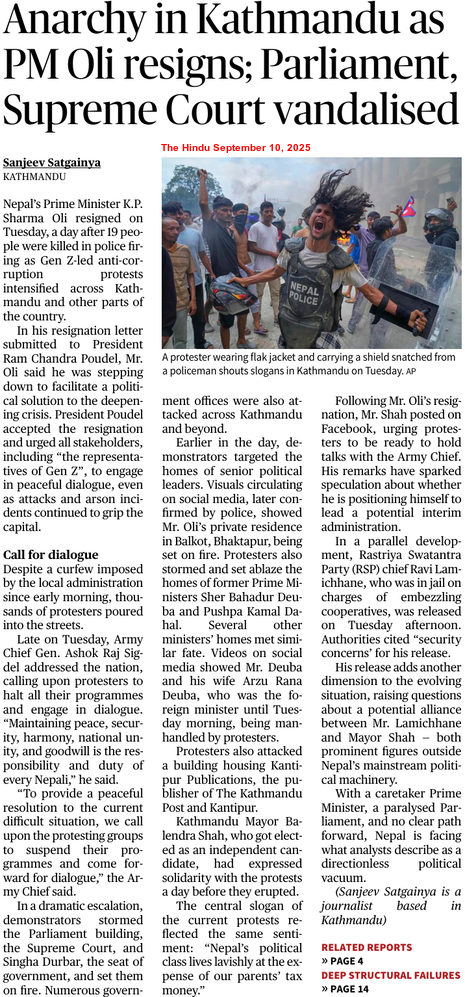
After taking oath as Prime Minister for the first time in October 2015, Oli followed the path of Ultra-Nationalism in the Himalayan nation. His second term as Prime Minister marked the beginning of the dictatorship in 2018, as hopes of moving the national economy forward gradually faded away. Oli consolidated the National Intelligence Department, Revenue Intelligence Department and Financial Crimes Investigation Department, bringing them under the Prime Minister’s Office. Playing the card of nationalism, he approved a new political map that included the territories of Lipulekh, Limpiyadhura and Kalapani as part of Nepal in May 2020. He made the move soon after India inaugurated a road project that touched these territories. With this, Oli escalated an existing border dispute with neighbouring India. However, the move also led to divisions within his party and partners of the ruling alliance.

Interestingly, Oli’s decision to strengthen ties with China did not cause public anger. Instead, he recently passed some bills which have gradually increased the anger. Political anger grows over issues, such as the government’s strict control over the Freedom of Speech, the judiciary and parliamentary committees. On the other hand, the economy has started collapsing. As per a recent survey, around 2,000 people leave Nepal every day on an average to work abroad as the rate of unemployment among youth has touched 25%.
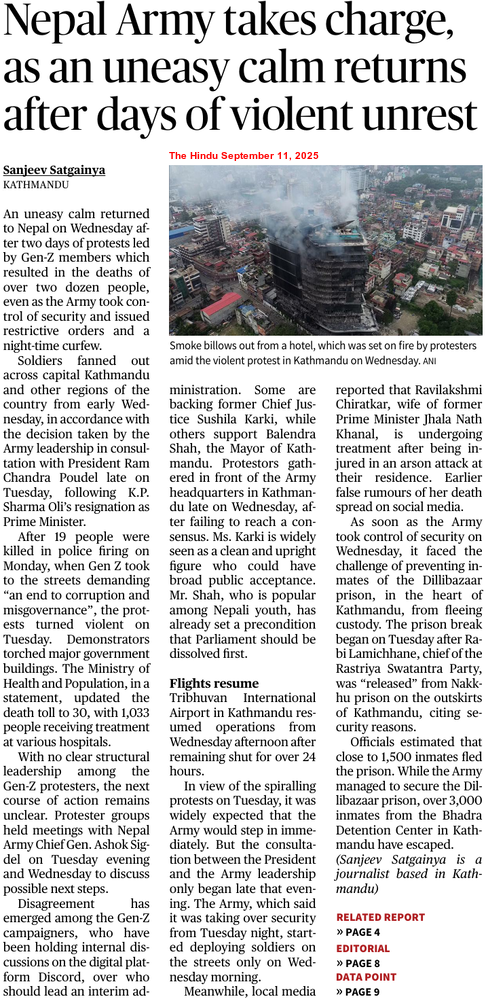
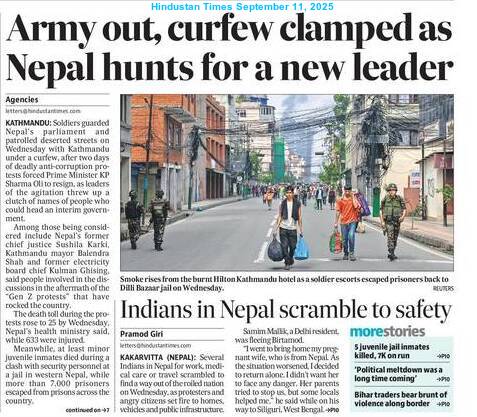
Also, there are NepoKids (or Nepotism Babies, a term referring to those whose career is similar or related to the career in which a parent succeeded). They have exposed social discrimination by highlighting the unfair treatment to common people. According to the local sources, the root of Gen Z’s protests was anger against NepoKids. The protesters accuse these Nepokids of benefiting from corrupt earnings, which aligns with the broader anti-corruption theme of the agitation. They have used social media platforms to expose the lavish lifestyle of Nepokids, prompting the Oli Administration to ban social media.

On Reddit‘s Nepal subreddit, a person recently wrote: “Children of elite politicians know exactly where their parents’ money and luxury come from – taxpayers – like you and me. While we struggle, they live in utter privilege. Start listing their social media accounts and archiving their content to hold them accountable and prevent them from erasing the evidence.” Another person stressed: “Our taxes, their luxury… We pay, you flex.” In a widely shared TikTok video, a person stated: “Nepo Kids show off their lifestyle on Instagram and TikTok, but never explain where the money comes from.“
It may be noted that the average people of Nepal used to earn USD 1,400 per year prior to the protests, while families of the ruling elite class displayed their wealth on social media. In the current situation, it is believed that not only the bullets, but also the entire political system, as well as the musical chair of power, are under attack.
Boundless Ocean of Politics on Facebook
Boundless Ocean of Politics on Twitter
Boundless Ocean of Politics on Linkedin
Contact us: kousdas@gmail.com

 ISMC
ISMC Boundless Ocean Of Politics