

Trump’s Tariff War & The Changing Equation In Asia
Indian Prime Minister Narendra Modi used to consider US President Donald John Trump as his friend. However, the US President has made it clear that India is one of the main targets of the tariff war triggered by him by imposing 50% tariffs on goods from the South Asian nation. Perhaps, Prime Minister Modi and his government forgot that “there are no permanent friends or enemies, but only permanent interests” in diplomacy.
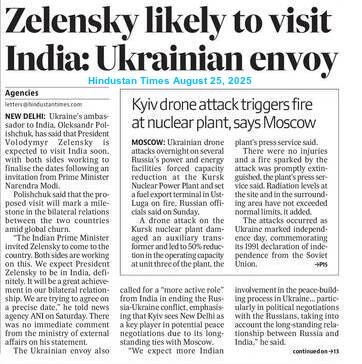
President Trump imposed 50% tariffs on most US imports from India, posing a threat to punish the world’s fourth-largest economy over its purchases of discounted Russian oil. No one knows how long this additional duty will last. As long as it continues, the issue of trade uncertainty will haunt India. Hence, the Modi Administration has decided to focus on rapidly renewing relations with Russia, China, Japan and the BRICS, an intergovernmental organisation comprising 10 countries – Brazil, Russia, India, China, South Africa, Egypt, Ethiopia, Indonesia, Iran and the United Arab Emirates.

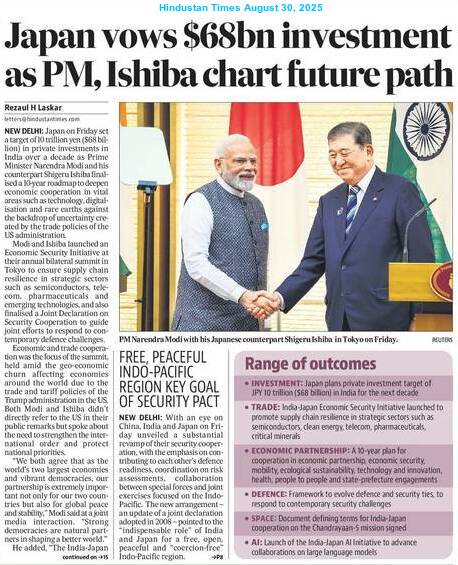
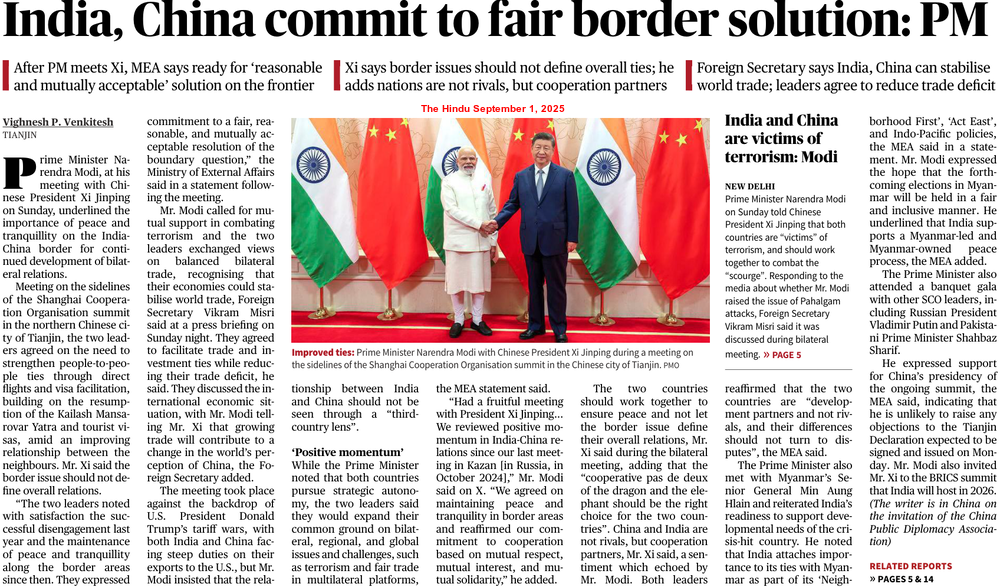
Prime Minister Modi visited Japan on August 29-30, 2025 to participate in the 15th India-Japan Annual Summit before attending the Shanghai Cooperation Organisation (SCO) Summit, held in Tianjin, China from August 31 to September 1. In China, he discussed several contentious bilateral issues with President Xi Jinping. Meanwhile, political analysts have opined that although India plans to form an Asian Alliance to counter the US threat, it would ultimately have to rely on the West rather than the East for economic development.

India’s annual exports to the US are much higher than its exports to the BRICS nations combined. And in Asia, India maintains a trade surplus only with the Philippines, as it has significant trade deficits with other major Asian partners, like China, South Korea and several ASEAN countries. Hence, the Modi Government would have to reshape the India-US ties in the near future by resolving all outstanding issues. New Delhi has already decided to boost cooperation with the QUAD (a grouping of Australia, India, Japan and the US) in the South China Sea.

Unfortunately, India’s ties with the US have touched a new low over the tariff issue at a time when China has started dominating the global economy. India’s active participation in South China Sea diplomacy shows how widespread the fear of Chinese aggression is. The April 22, 2025 Pahalgam terror attack (in India) proved the depth of China’s relations with Pakistan. The resumption of direct flight service between Beijing and New Delhi may be a good piece of news, but the lack of any sign of retreat of the Chinese Armed Forces advancing along the Himalayan border or the supply of sophisticated weapons to Pakistan is a major concern for India. Furthermore, China has strengthened ties with almost all the neighbouring countries of India in recent times.

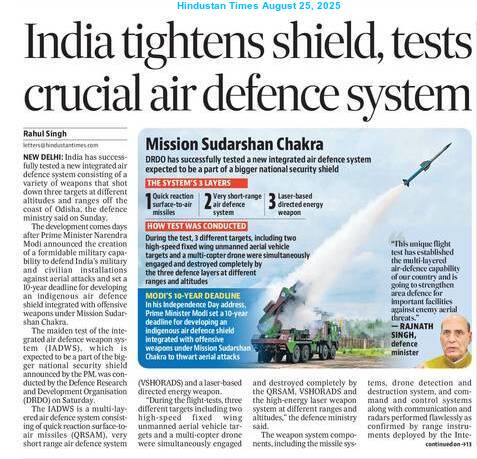
In comparison, India’s relations with Japan are somewhat promising. The Japan-China conflict is also favourable to New Delhi. The New Delhi-Tokyo friendship is expected to gain a new momentum in the areas of defence, security, technology and trade, especially after the visit of Prime Minister Modi. In such a scenario, the activities of QUAD are particularly important for India, in spite of the presence of the US. The importance of the US to India has not decreased, but rather increased, as a result of President Trump’s tariff war mainly because of the strangely complex geopolitical situation in Asia.
For now, India needs to maintain a balance between China and Japan on one side, and the US and Russia on the other.
Boundless Ocean of Politics on Facebook
Boundless Ocean of Politics on Twitter
Boundless Ocean of Politics on Linkedin
Contact us: kousdas@gmail.com

 ISMC
ISMC Boundless Ocean Of Politics