

Blunders Made By A Statesman
The creation of Bangladesh from erstwhile East Pakistan is a bright milestone in the history of the Bengalis. However, the South Asian nation has faced various covert political attacks since its birth in 1971. It was not easy for the Awami League Party and its leader Sheikh Mujibur Rahman (March 17, 1920 – August 15, 1975), also known by the honorific Bangabandhu, to leave Pakistan. Manash Ghosh, an Indian journalist who recently penned a book, titled Mujib’s Blunders: The Power and the Plot Behind His Killing, witnessed the Liberation War of Bangladesh and spent more than three years in the neighbouring country for professional purposes. In this publication, Ghosh has portrayed eyewitness accounts of the internal politics of the Awami League and the (lack of) understanding between its main leaders during the birth of Bangladesh.
A large part of the book is devoted to the relationship between Sheikh Mujib and Tajuddin Ahmad (July 23, 1925 – November 3, 1975), the first Prime Minister of Bangladesh and one of the most instrumental figures in the birth of the country. Sheikh Mujib was arrested by the Pakistani Army on March 25, 1971 and was subsequently held in a jail in West Pakistan. It may be noted that the arrest marked a significant escalation in the tensions between East and West Pakistan, ultimately leading to the Liberation War (of Bangladesh). Hence, other Awami League leaders and figures within the Mukti Bahini (the Brigade of Freedom Fighters), like Mohammad Abdul Hannan and Major Ziaur Rahman, led the struggle for independence in the absence of Bangabandhu.

During the Liberation War, the Provisional Government of Bangladesh, also known as the Mujibnagar Government, was formed in Mujibnagar (formerly Baidyanathtala), India on April 17, 1971, with its headquarters in Kolkata (then Calcutta). Tajuddin, who served as the Prime Minister of this government, successfully led the Liberation War to its goal with the help of other leaders. He was a loyal comrade-in-arms of his leader Mujib Bhai. However, when Sheikh Mujib returned to independent Bangladesh after spending nine months in a Pakistani jail, an anti-Tajuddin group, which included Khondaker Mostaq Ahmad and (Mujib’s nephew) Sheikh Fazlul Haque Moni, infuriated Bangabandhu against Tajuddin.
Ghosh mentioned in his book that Mujib informed Tajuddin, who was serving as the Prime Minister of the Provisional Government, that he wanted to assume the position of Prime Minister. The conversation took place on the way to a reception celebrating Mujib’s homecoming. Sheikh Mujib became the first Prime Minister of independent Bangladesh when the Provisional Government was dissolved on January 12, 1972 and Tajuddin became the Minister of Finance. The author has claimed that the incident showcases the weakness of Sheikh Mujib, as well as the success of the malicious Awami League leaders. According to Ghosh, it is quite natural that Bangabandhu, as the undisputed leader of the Liberation War, wanted to keep the administrative power of the new nation in his hands.

In the aftermath of the 1971 Liberation War of Bangladesh, some of Tajuddin’s political opponents, particularly within the Awami League, reportedly spread anti-India sentiment to undermine his influence and also portrayed him as overly reliant on India. These actions were part of a broader effort to create a narrative that India was interfering in internal affairs of Bangladesh and exploiting the newly independent nation.

Tajuddin, as the Prime Minister of the Mujibnagar Government, decided to introduce the own currency of independent Bangladesh as soon as possible. Hence, he requested India to print 800 million One Taka notes to replace the existing Pakistani currency. He made the move in an attempt to avoid a potential financial crisis due to Pakistan’s contemplation of demonetising certain currency denominations. Many, including business organisations, were happy when those notes were first introduced in Bangladesh. However, a section of the Awami League leaders spread rumours that India wanted to destroy the Bangladeshi economy by importing fake notes. They made a serious attempt to project Tajuddin as a leader manipulated by the Government of India and Indira Gandhi, the then Indian Prime Minister. Although those leaders could not prove the allegation, they weakened the understanding between Sheikh Mujib and Tajuddin.
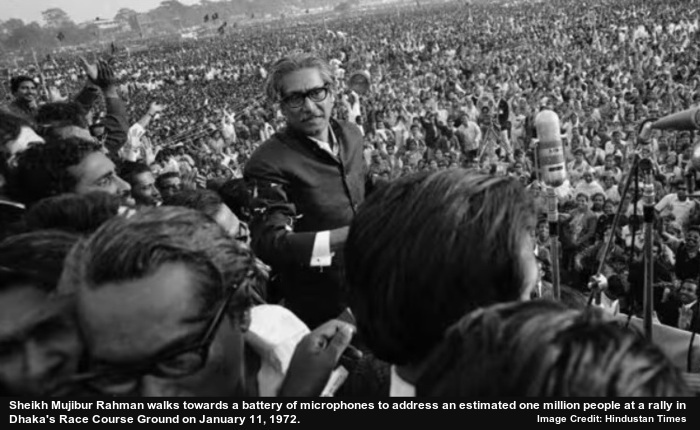
Ghosh has claimed that Bangabandhu failed to realise that the group was actually strengthening anti-India sentiment by calling Tajuddin pro-India and their real target was Sheikh Mujib himself. Their intention became clear only after the assassination of Mujib and the subsequent killings.
The author has further mentioned that Sheikh Mujib’s decision to suppress opposition politics in independent Bangladesh using state power is another significant mistake. This move, which included banning political parties and the independent press, is widely considered as a departure from his initial commitment to democracy. It also contributed to his downfall. His actions, particularly the shift to a one-party state, led to an authoritarian rule, apart from fuelling criticism about his desire for power. Bangabandhu’s move to consolidate power through the creation of the Bangladesh Krishak Sramik Awami League (BKSAL) and the banning of other political parties raised concerns about democratic principles.

Read: How Sheikh Mujibur Rahman ignored Fidel Castro’s friendly advice and paid the price
Once, Bangabandhu reportedly told Indian High Commissioner to Dhaka Subimal Dutt that no one, including Maulana Abdul Hamid Khan Bhashani (one of the founders of the Awami League), could harm him or his party. This feeling of invincibility could stem from the immense popular support he enjoyed, the successful culmination of the liberation struggle and his strong personality. However, such a feeling triggered his downfall. According to Ghosh, Sheikh Mujib’s undemocratic authoritarian attitude not only harmed national interests of Bangladesh, but also led to his horrific death.
In his publication, Ghosh further discussed the 1972 Indo-Bangladesh Treaty of Friendship, Cooperation and Peace, also known as the Indira-Mujib Treaty. It was a 25-year agreement signed on March 19, 1972 between India and the newly formed nation of Bangladesh, aimed at fostering close bilateral relations and cooperation. The treaty was a key outcome of the 1971 Liberation War, as India supported Bangladesh’s independence from Pakistan. Interestingly, the editor-in-chief of the Dhaka-based Sangbad daily told the author that the agreement would become a tool for those who were against the Liberation War, as well as India. At that period of time, a large section of the Bangladeshi media and various anti-Mujib forces claimed that Bangladesh had compromised with its sovereignty because of this agreement which also discouraged China to recognise Bangladesh as an independent state. Chinese ambassadors conveyed Beijing’s objections to their Bangladeshi counterparts in different countries.

It seems that Sheikh Mujib made no (political) mistake by signing this agreement. It would have been better if this accord had not mentioned military or political cooperation. Some understandings are best left undisclosed in politics and diplomacy. Apart from suppressing the opposition parties, Sheikh Mujib also failed to maintain the balance of power in regional geopolitics. Ultimately, he had to pay quite a high price for his lack of experience and expertise in tackling foreign policy crisis.
The author has created a new opportunity to understand the politics of Bangladesh by identifying the mistakes made by Bangabandhu, the tragic hero. Mujib-worship alone would not benefit the Awami League without understanding the major flaws in Bangabandhu’s political vision. At the same time, India’s diplomatic direction must also be fair and smart. New Delhi should not consider the Awami League as the only friend of India (in Bangladesh). Instead, India should strengthen ties with Bangladesh, despite differing political affiliations among Bangladeshi political parties.
Boundless Ocean of Politics on Facebook
Boundless Ocean of Politics on Twitter
Boundless Ocean of Politics on Linkedin
Contact us: kousdas@gmail.com

 ISMC
ISMC Boundless Ocean Of Politics