

Not A Threat, But An Opportunity
The Tariff War triggered by US President Donald John Trump has made a few things clear from India’s perspective. Snapping trade ties with the US is harmful for India, at least in the short term. As the US President is well aware of this fact, his decision to impose a 25% tariff on Indian goods, alongside an additional but unspecified “penalty” for India’s defence and energy imports from Russia, can be seen as an attempt to put the South Asian nation under tremendous diplomatic pressure. There is also a possibility that the US President may change his decision later.
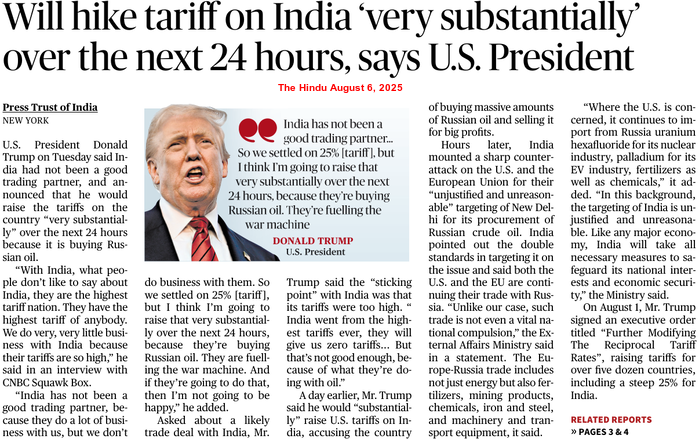
India has various reasons to get upset by President Trump’s recent announcement. Of course, India would have to bow to this pressure to some extent. However, how India will tackle the pressure depends on its diplomatic (and also economic) skills. The Narendra Modi Administration has already reduced tariffs on various American products and agreed to purchase large amounts of defence equipment from the US.
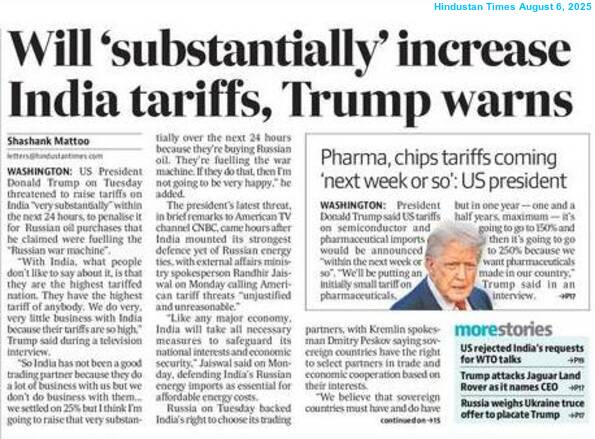
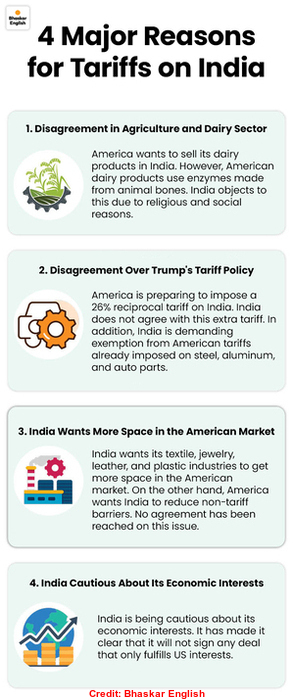
The US has put India under diplomatic pressure in an attempt to get access of the South Asian country’s agricultural market. However, New Delhi is reluctant to grant the US access as it fears that its agricultural products would not be able to compete with subsidised US agricultural products.
In such a situation, India needs to keep a few things in mind. Firstly, there is a risk of market takeover if high tariffs on Indian agricultural exports, especially fish, continue. Secondly, India still imports agricultural products, such as corn or dairy items, which the US wants to sell in the Indian market. Hence, Indian consumers would benefit if the prices of such products decrease.
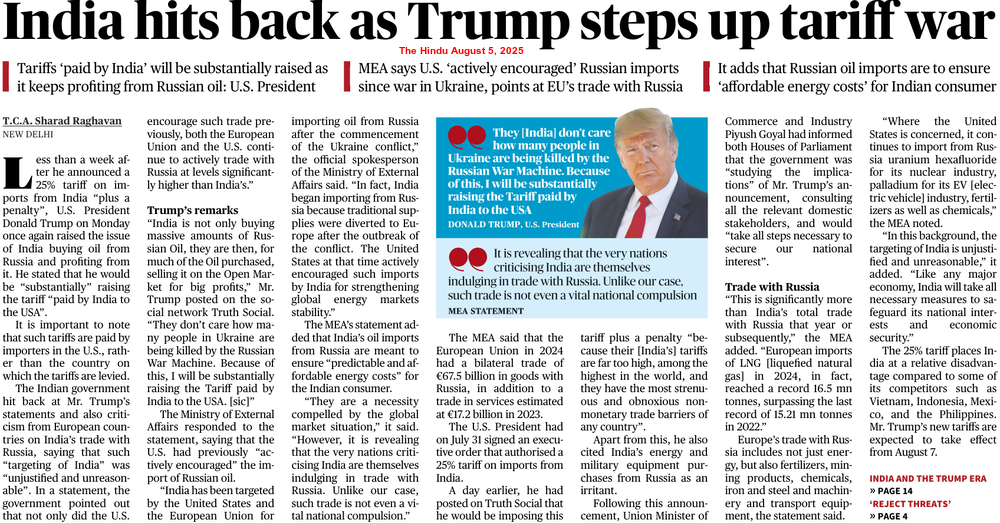
In fact, President Trump has imposed a 25% tariff on Indian goods mainly to block Russian imports. India’s imports from Russia have increased significantly in recent times, with Moscow supplying roughly one-third of India’s oil imports. India has benefited from purchasing oil at discounted prices, particularly from Russia, following Western sanctions. It has helped the country to keep domestic fuel prices lower than they would have been otherwise. Furthermore, these discounted purchases have allowed Indian refiners to refine and export fuels, like diesel and jet fuel, benefiting European markets as well. Of course, no third party has the right to dictate India’s trade terms with other countries and it is the duty of the Modi Government to protect the economic sovereignty of the country.
It is also a fact that India’s over-dependence on a particular country for a quite important commodity, like crude oil, is not at all good. New Delhi should reconsider its import policy for its own interest. Therefore, India should consider the US pressure as an opportunity, rather than a threat.
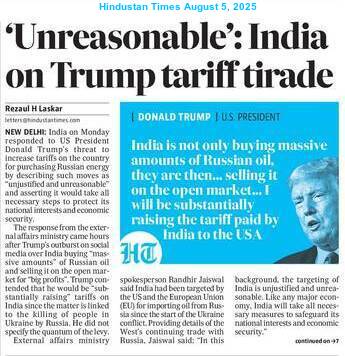
It would be difficult for India to abandon its dependence on the US in the short- or medium-term. One can hope that the situation created by President Trump would help New Delhi to understand that the key to foreign trade is diversification and expansion of trading partners. Therefore, India should find new business partners and establish reliable trade ties with them. India also needs to prioritise multilateral trade agreements in order to counterbalance the power of individual nations and prevent them from dictating terms. The recent Comprehensive Economic and Trade Agreement that India has signed with Britain is a positive step in this direction.
At the same time, the Modi Administration must remember that a conservative trade policy is not beneficial for the country. The way the agricultural trade market was opened up by the previous government led to a huge increase in India’s agricultural exports. The previously observed growth has stopped in recent times. In the 21st Century, free trade is the key to economic prosperity.
You may also like: Political Decisions Analysed By Game Theory
Boundless Ocean of Politics on Facebook
Boundless Ocean of Politics on Twitter
Boundless Ocean of Politics on Linkedin
Contact us: kousdas@gmail.com

 ISMC
ISMC Boundless Ocean Of Politics