

A Tactical Diplomatic Move
A survey has recently been conducted in Denmark and eight largest countries in Europe. Interestingly, more than half of the respondents have claimed that US President Donald John Trump is an enemy of Europe, while 63% believe that the world has become less secure due to his victory in the 2024 US Presidential Elections. It seems that the surge of anti-Trump sentiment in Europe is a reflection of global sentiment. Uncertainty has gripped the entire world since the 47th US President announced his Tariff Policy on April 2, 2025. At a time when the US tariff policy has hit the European economies hard, Israel continues to bomb Gaza, violating the ceasefire agreement.
All these have raised questions about the US’ global leadership. That’s why when Trump claimed that he would stop the Russia-Ukraine War, his real intention came under scanner. He has already undermined the decades-old close cooperation between the US and Europe by imposing negotiating terms on Ukraine to end the war, without discussing the issue with European leaders. Europe believes that President Trump’s move would encourage his Russian counterpart Vladimir Vladimirovich Putin to attack other European countries in the future.

Trump has further advised Europe to ensure its own security, without relying on the US. He has hinted that the US would soon leave the North Atlantic Treaty Organisation (NATO), the intergovernmental transnational military alliance established by the US during the Cold War mainly to check on the threat posed by the erstwhile Soviet Union. When the US, along with 11 European countries, established the collective security system in 1949, major European powers were devastated after losing their colonies and bearing the huge costs of the Second World War. They did not hesitate to join the anti-communist coalition in the hope of financial support. Now, NATO has 32 member-states, including 30 European and two North American countries. Hence, those 30 European countries would be in trouble, if the US leaves the military alliance.
After the end of the Cold War with the collapse of the Soviet Union in 1991, the US assured Russia that NATO would not move an inch towards Moscow in the future. Since then, NATO forces have advanced towards Moscow seven times with the help of various former Soviet Republics. Ukraine, too, decided to join NATO and become a member of the European Union (EU). As expected, Russia became furious about Ukraine’s proposed move. When the US and European leaders made an attempt to influence the top political leadership in Kiev in 2014, Russia invaded Ukraine and annexed Crimea. Thereafter, NATO started providing Ukraine with modern weapons and military training. The move ultimately led to the Ukraine War.

President Trump recently announced that he would try his best to end the Russia-Ukraine War. He also announced that the US would not help the European countries to weaken Russia by providing defence support. He is of the opinion that there is no need to view Russia separately from other European countries in terms of security. Instead, it is essential to ensure stability in entire Europe, including Russia. Meanwhile, European leaders believe that the US President has a different plan.
According to political analysts, President Trump’s controversial Tariff Policy is actually a diplomatic move. He is trying to explore avenues for bargaining hard with major world powers by putting them under (economic) pressure. Initially, the move has disrupted the global trading system by creating uncertainty. Several European countries have increased their defence budget, too. President Trump is happy with this development as they would have to purchase sophisticated weapons from the US arms manufacturers and it would ultimately boost the US economy. On the other hand, Europe would not be able to increase the budget for other sectors. It would certainly increase political instability in the continent, as most European leaders do not have an absolute majority in the Parliament.
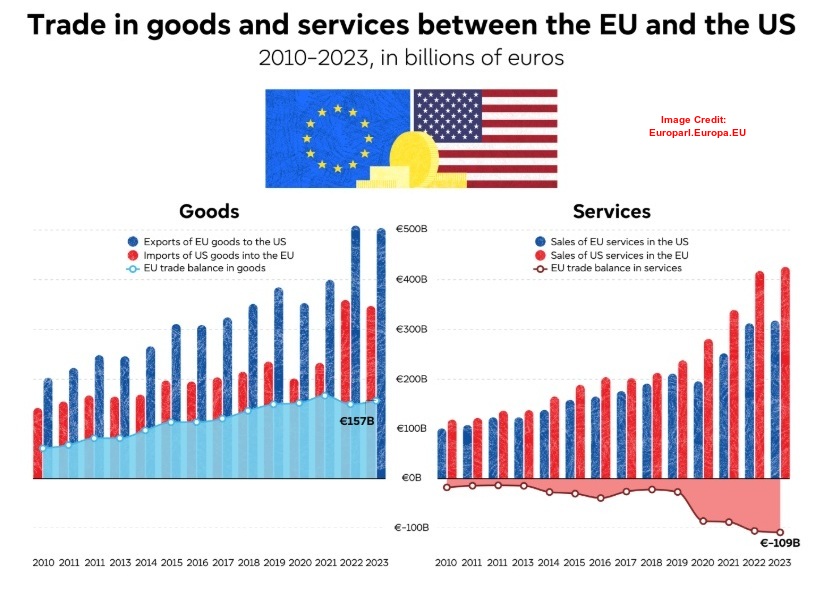
There are also disagreements between Europe and the US on various other issues, such as climate change, trade, investment, environment and relations with China. According to foreign policy experts, the future of the US-Europe relationships largely depends on the pace of the Ukraine War, as well as the ties between Washington DC and Moscow.
Latest Release: Tegart’s War: A Story of Empire, Rebellion and Terror by Stuart Logie
Available on Amazon, Amazon India and Kindle
Boundless Ocean of Politics on Facebook
Boundless Ocean of Politics on Twitter
Boundless Ocean of Politics on Linkedin
Contact us: kousdas@gmail.com

 ISMC
ISMC Boundless Ocean Of Politics