

IAEA Fears Destruction Of Iran’s Nuclear Reactor
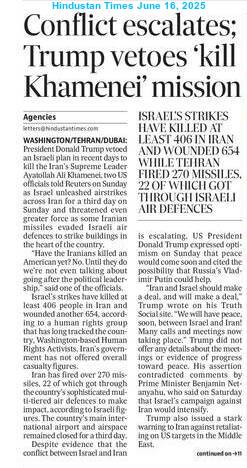
The above-ground part of Iran’s Natanz Nuclear Facility was badly damaged during the Israeli airstrikes on June 13, 2025 night. The Natanz Nuclear Facility, officially the Shahid Ahmadi Roshan Nuclear Facilities, is one of the nuclear facilities in Iran that was built in Isfahan Province mainly for uranium enrichment. This centre is a part of the Islamic Republic’s USD 2-3 trillion nuclear programme. Although the underground enrichment facility of the centre is protected by a concrete shield with a thickness of approximately 7.6mt, Israel’s Operation Rising Lion has struck “at the heart” of the enrichment facility at Natanz.
Rafael Mariano Grossi, the Director General of the International Atomic Energy Agency (IAEA), has expressed grave concern over the issue during a meeting of the UN Security Council, stressing that radioactive and chemical substances have already spread dangerously inside the nuclear plant. He also said that the entire region would suffer in case of a disaster.

Earlier, Israeli Prime Minister Benjamin ‘Bibi’ Netanyahu stated: “If not stopped, Iran could produce a nuclear weapon in a very short time. It could be a year. It could be within a few months.” According to the Israeli Armed Forces, it has strong evidence that Tehran was producing the necessary elements for making a nuclear bomb. Meanwhile, the IAEA has made it clear that no matter what the situation, nuclear power plants should not be attacked.
Grossi has informed the UNSC that the IAEA is in constant touch with the Nuclear Regulatory Authority of Iran. Experts are currently assessing the extent of the damage, what could be done and how the nuclear safety system could be further strengthened. They are also closely monitoring all the nuclear power plants in Iran. The IAEA Director General has confirmed that the radioactive contamination detected inside the Natanz Nuclear Facility after the Israeli airstrike is primarily alpha particle radiation, saying that while the contamination is localised within the facility, it is manageable with appropriate protective measures. Grossi has also confirmed that the level of radioactivity outside the Natanz site remains at normal levels, indicating no widespread external impact on the population or environment.
Explaining the situation, Grossi stressed: “At Natanz, the above-ground part of the Pilot Fuel Enrichment Plant, where Iran was producing uranium enriched up to 60% U-235, has been destroyed. Electricity infrastructure at the facility (electrical substation, main electric power supply building, emergency power supply and back-up generators) has been destroyed.” He added: “There is no indication of a physical attack on the underground cascade hall containing part of the Pilot Fuel Enrichment Plant and the main Fuel Enrichment Plant. However, the loss of power to the cascade hall may have damaged the centrifuges there.“
The IAEA Director General further said: “Due to the impacts, there is radiological and chemical contamination inside the facilities in Natanz. The type of radiation present inside the facility, primarily alpha particles, is manageable with appropriate radiation protection measures.“
Meanwhile, Iran has informed the IAEA that several of its other nuclear facilities, including the Fordow Fuel Enrichment Plant in Isfahan, have been damaged. Commenting on the issue, Grossi stated: “All these developments are deeply concerning. I have repeatedly stated that nuclear facilities must never be attacked, regardless of the context or circumstances, as it could harm both people and the environment. Such attacks have serious implications for nuclear safety, security and safeguards, as well as regional and international peace and security.“
Read: IAEA Director General’s statement to UNSC on situation in Iran
Grossi has advised both Israel and Iran to show restraint. “As Director General of the IAEA and consistent with the objectives of the IAEA under the IAEA Statute, I call on all parties to exercise maximum restraint to avoid further escalation. I reiterate that any military action that jeopardises the safety and security of nuclear facilities risks grave consequences for the people of Iran, the region, and beyond,” he stressed.
Boundless Ocean of Politics on Facebook
Boundless Ocean of Politics on Twitter
Boundless Ocean of Politics on Linkedin
Contact us: kousdas@gmail.com

 ISMC
ISMC Boundless Ocean Of Politics