

‘Munir Doctrine’ Will Be Defeated
Usually, he is not seen in public much as his movements and activities are shrouded in mystery. However, New Delhi believes that he played an important role in the April 22 (2025) Pahalgam terror attack and also in the ongoing conflict between India and Pakistan.
General Syed Asim Munir Ahmed Shah, the Chief of the Army Staff of the Pakistani Army, faces criticism even from politicians and a section of the Army in his own country. There are demands to remove Munir who becomes a symbol of Pakistan’s radical anti-India jihadist entity.
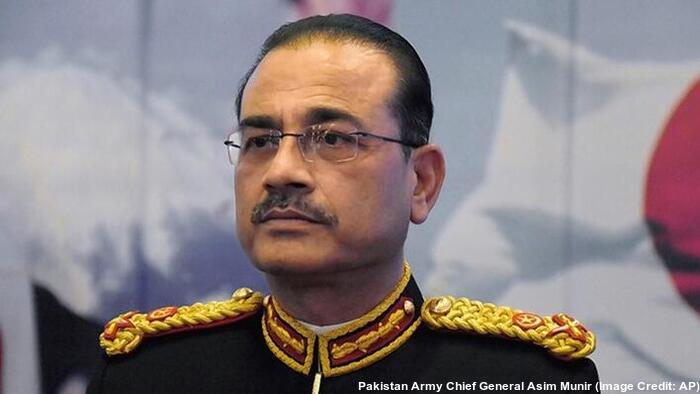
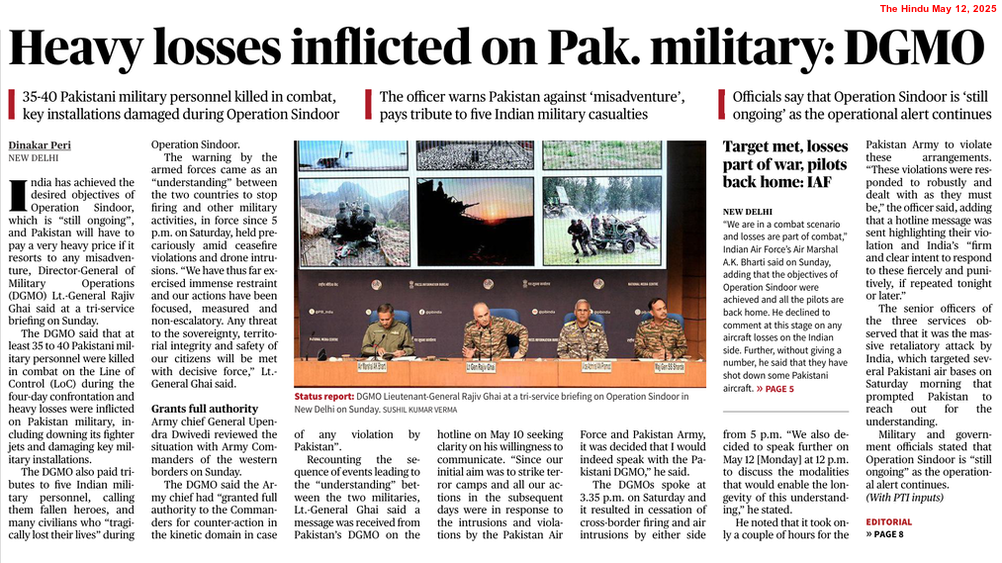
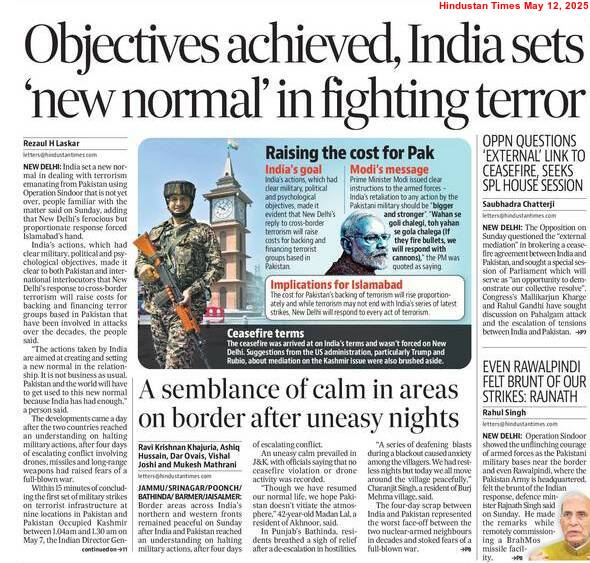
Defence analysts are of the opinion that the jihadi Army Chief of Pakistan masterminded the entire Pahalgam terror attack. Analysts have argued that just five days before that horrific terrorist attack, General Munir stressed: “Our stance (on Kashmir) is absolutely clear, it was our jugular vein, it will be our jugular vein, we will not forget it. We will not leave our Kashmiri brothers in their heroic struggle.” He made this comment while addressing a conference of Pakistani ambassadors. According to analysts, his comments are quite significant. General Munir also urged his country’s ambassadors not to forget that they belong to a “superior ideology and culture“, stating: “You should definitely tell Pakistan’s story to your children. Our forefathers thought that we are different from the Hindus in every aspect of life. Our religions, our customs, traditions, thoughts and ambitions are different. That was the foundation of the Two-Nation Theory that was laid.” As expected, his comments triggered a controversy in neighbouring India. However, General Munir was able to hit India hard in the first round by masterminding the terror attack in Pahalgam. The scenario changed only after India carried out Operation Sindoor on May 7 to destroy the bases of terrorist outfits in Pakistan. Now, the Pak Army Chief has to take responsibility for India’s retaliation.
Immediately after India’s retaliation, Pakistani Defence Minister Khawaja Muhammad Asif announced that his country’s military was “ready to refrain” from further action, “provided India halts its ongoing operations“. However, General Munir reportedly asked the Army to target the Indian military bases with drones and missiles on May 7.
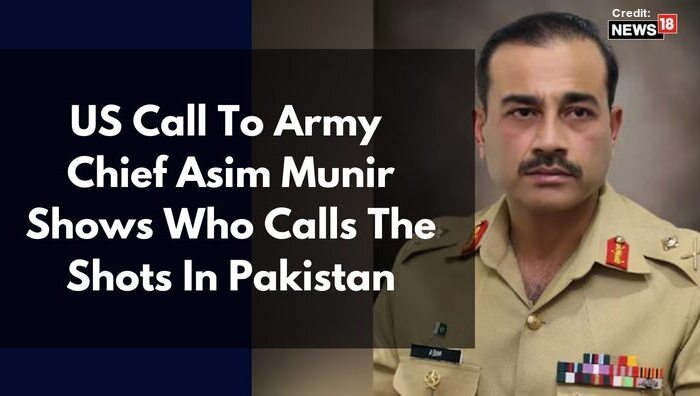
The question arises here: Why did Munir risk everything to first mastermind such a large-scale terrorist attack in India (although his direct involvement is not yet proven) and then practically start an armed conflict? According to diplomats, the answer lies within Pakistan’s Militarism. It may be noted that the term of the Pakistani Army Chief is three years. In an unprecedented move, General Munir got an amendment passed in the Parliament that extended his three-year tenure to five. Also, he has not had to go through any military coup.
Meanwhile, General Munir has created an ideology, called the Munir Doctrine, which includes a mixture of extremism and jihad. His doctrine is deeply rooted in the Two-Nation Theory, and not in modern military wisdom. Like Muhammad Ali Jinnah (born Mahomedali Jinnahbhai; December 25, 1876 – September 11, 1948; the founder of Pakistan), General Munir portrays Hindus and Muslims as two separate civilisations. However, Jinnah had used that theory as a specific political weapon and at a specific historical juncture. On the other hand, the Pak Army Chief has presented the theory as an ultimate truth. Hence, he has described Kashmir as the “jugular vein” of Pakistan in an attempt to strengthen his country’s belligerent stance on India.
General Munir has borrowed the ideas of mullahism (governance or rule by Islamic clerics) and militarism from the former military ruler of Pakistan, General Muhammad Zia-ul-Haq (August 12, 1924 – August 17, 1988). Under his leadership, the main task of the Pakistani Army is not only to protect the border, but also to safeguard the radical Islamic ideology. General Munir’s speech was full of fundamentalist messages, and the majority of his countrymen find the reflection of General Zia in his actions. It is believed that General Zia inspired him to take action against popular political leaders (like former Prime Minister Imran Ahmed Khan Niazi), crush the opponents and make of militarism, as well as orthodox Islamist ideology, into state policy.
General (Retired) Qamar Javed Bajwa, the predecessor of General Munir, prioritised geostrategic economics to some extent. However, General Munir’s path is completely different. He uses ideology and religious hatred as weapons to wage a war against India, without thinking much about trade and economy. It may be noted that General Munir was the Director General of the Inter-Services Intelligence (ISI, the premier intelligence agency of Pakistan) during the 2019 Pulwama attack that occurred on February 14, 2019 when a convoy of vehicles, carrying Indian security personnel on the Jammu–Srinagar National Highway, was attacked by a vehicle-borne suicide bomber at Lethapora in the Pulwama District of India-administered-Kashmir. The attack killed 40 Central Reserve Police Force (CRPF) personnel, as well as the perpetrator, Adil Ahmad Dar, who was a local Kashmiri youth.

Read: Story of Asim Munir, Pakistan’s jihadi general
General Munir has increased the importance, influence and relevance of the military leadership, amid political turmoil in Pakistan. Instead of reforms, he has emphasised on military operations and played a crucial role in sending Imran Khan to prison. In spite of the attacks on the Pakistani Army from the outside world, the jihadi Army Chief has tried his best to boost the unity of his forces. Although it is a common phenomenon in the military history of Pakistan, General Munir has created a different image of the Pakistani Army.
Defence experts believe that General Munir’s ideology is not sustainable for a longer period of time in the 21st Century as the Munir Doctrine lacks in several key areas, such as economic direction, technological philosophy and regional coordination. Only a handful of countries, like China, Turkey and Azerbaijan, now stand by Pakistan. Instead, conflicts are constantly increasing in Balochistan, Gilgit–Baltistan and Pakistan-occupied-Kashmir (PoK). Munir’s ideology has started losing popularity within Pakistan as it relies solely on religious nationalism, the old legend of a failed state and laments of geographical deprivation. The downfall of General Munir is only a matter of time.
Boundless Ocean of Politics on Facebook
Boundless Ocean of Politics on Twitter
Boundless Ocean of Politics on Linkedin
Contact us: kousdas@gmail.com

 ISMC
ISMC Boundless Ocean Of Politics