

US Creates Trouble For Asia, Europe
India has started preparing to adapt to the changing global geopolitical environment. In a recent interview with US computer scientist and podcaster Lex Fridman, Indian Prime Minister Narendra Modi described the 21st Century as the Century of Asia. At the same time, he hinted that US President Donald John Trump started creating troubles for the Asian nations.
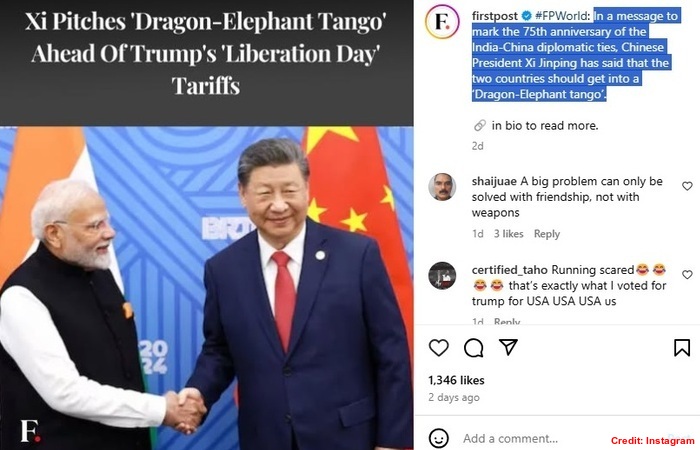
The Indian Prime Minister stressed on the deep cultural ties between China and India, stating that cordial relations between the two Asian neighbours were essential for the sake of global stability and peace. It may be noted that President Trump’s decision to strengthen ties with Russia (in an effort to end the Russia-Ukraine War) has prompted European countries to change the regional geopolitical equation. The US President has also decided to boost ties with China and to meet his Chinese counterpart Xi Jinping in near future. As expected, the changing equation between Washington DC and Beijing has raised concerns in South and Southeast Asia, including India.

Although India has been able to thwart China’s attempts to stamp its authority in the Indo-Pacific Region for so long with the help of QUAD (a grouping of Australia, India, Japan and the US), President Trump’s recent foreign policy moves would make it difficult for the Modi Government in New Delhi to counter the Chinese influence in the coming days. If the US President adopts a policy of isolationism in the Indo-Pacific Region, it would not only fuel Beijing’s attempt to seize disputed Exclusive Economic Zones in the South China Sea, but also encourage the Asian Giant to annex Taiwan.

Meanwhile, one of India’s objectives is to strengthen its position in the Indo-Pacific Region in an attempt to safeguard its interests. The maritime trade routes in this particular region are vital to the economic prosperity and energy security of the South Asian country. The Modi Administration is well aware of the fact that China is trying its best to reduce India’s influence in South Asia by boosting trade with various countries in the region through its Belt and Road Initiative (BRI) project.

Hence, India has no other option, but to strengthen ties with neighbouring countries through its Act East Policy (an effort by the Government of India to cultivate extensive economic and strategic relations with the nations of Southeast Asia to bolster its standing as a regional power and a counterweight to the strategic influence of the People’s Republic of China). In fact, Prime Minister Modi’s recent visit to Mauritius and Sri Lanka is a part of this policy.
Furthermore, one of the most important components of India’s evolving maritime diplomacy is its Maritime Domain Awareness (MDA) capability. The MDA capability enables India to provide neighbouring countries, like Mauritius, Maldives and Sri Lanka, with real-time information about waterway movements and maritime environment. It has helped these island nations to curb the activities of smugglers in their Exclusive Economic Zones. India also offers humanitarian assistance, as well as disaster relief, to its neighbours especially after natural disasters.

Political analysts are of the opinion that New Delhi would continue these efforts for now in order to survive in the complex geopolitical landscape in the Indo-Pacific Region, amidst the fear of China’s growing dominance.
Boundless Ocean of Politics on Facebook
Boundless Ocean of Politics on Twitter
Boundless Ocean of Politics on Linkedin
Contact us: kousdas@gmail.com

 ISMC
ISMC Boundless Ocean Of Politics