

Baloch Rebels: Next Target Will Be Islamabad
Since the Balochistan Liberation Army (BLA) hijacked the Jaffar Express in Bolan on March 11, 2025 and took all the passengers on board hostage, political tension has increased in Pakistan. The train was travelling from Quetta to Peshawar with 440 passengers. Defence analysts are of the opinion that the Pakistani Army may launch attacks on the rebels with full force at any time. The rebels, too, believe that they might be attacked because of the train hijacking incident.
Mian Muhammad Shehbaz Sharif, the Prime Minister of Pakistan, visited Balochistan on March 13 to meet injured passengers rescued from the hijacked train. Later, he stressed that “such cowardly acts” would not deter the nation’s “resolve for peace“. The PM also hinted that the Pakistani Army would give a befitting response to the rebels.

The BLA rebels, too, have made it clear that they are fully prepared to wage a war against the Army. A senior BLA commander recently told Al Jazeera: “If the Pakistani Army tries to attack us, our next target will be Islamabad, Lahore or Rawalpindi.” The commander, who wanted to remain anonymous, claimed that the Pakistani Army brutally torture Baloch children and rape women. He further claimed that Baloch people would no longer tolerate torture. Meanwhile, the commander asked the Pakistani Army personnel to change their mindset, stating that (otherwise) they would have to face dire consequences.

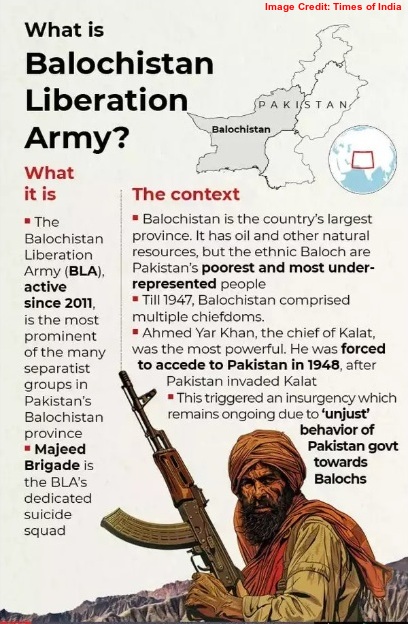
According to political analysts, the Baloch resistance is rooted in the 1947 betrayal of Muhammad Ali Jinnah (December 25, 1876 – September 11, 1948), the founder of Pakistan. The Baloch rebellion started when Pakistan was carved out of India in 1947. The region of Balochistan existed as four Princely States: Kalat, Kharan, Las Bela and Makaran. Three states, influenced by Jinnah, merged with Pakistan, while Kalat opted for independence.

In 1946, Khan Mir Ahmadyar Khan, popularly known as the Khan of Kalat, appointed Jinnah as his legal adviser to represent his case before the British Crown. During a meeting in 1947 in Delhi, Jinnah supported the Khan of Kalat’s decision for independence in the presence of Lord Mountbatten and Pandit Jawaharlal Nehru, the first Prime Minister of India.

Kalat declared independence on August 15, 1947. However, a British memorandum, dated September 12, 1947, stated that it could not assume the responsibilities of an Independent State. Then, Jinnah urged the Khan to merge Kalat with Pakistan. However, Khan refused to accept the proposal, seeking help from India before yielding. On March 26, 1948, the Pakistani Army moved into the Baloch coastal region, and Khan had to agree to Jinnah’s terms. The Khan of Kalat also signed the accession.
However, Prince Abdul Karim, the brother of Khan, led a 1948 uprising that, despite being suppressed, fuelled Baloch nationalism. Balochistan was merged into Pakistan after 226 days of independence, against the people’s will and through Jinnah’s betrayal, fuelling resistance due to exploitation and resource theft.
The betrayal of Jinnah not only led to the first armed rebellion by Prince Abdul Karim in 1948, but also marked the beginning of Balochistan’s decades-long struggle for freedom. In 1958-59, Pakistan merged the provinces to centralise power by imposing the One Unit policy that also marginalised Baloch leaders. Nawab Nauroz Khan led an armed resistance that was suppressed, leading to his arrest and the execution of his family members.

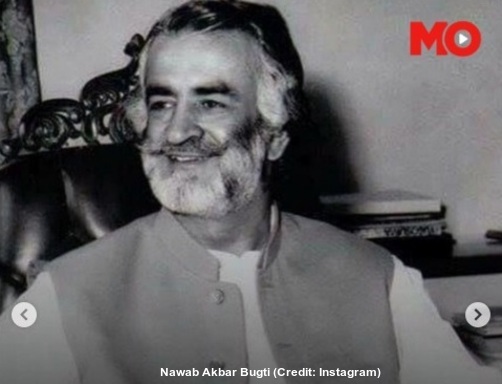
Tensions escalated yet again in 1963-69 over the Government of Pakistan‘s control of natural resources of Balochistan. Led by Sher Muhammad Bijrani Marri, a guerrilla warfare ensued, aiming for a fair share of the region’s wealth. The dismissal of the Provincial Government and military operations intensified the conflict in 1973-77. Thousands of casualties occurred as Baloch nationalists fought for greater autonomy and recognition. The 2006 assassination of Nawab Akbar Bugti, a key Baloch leader, further fuelled in insurgency and anti-state sentiment.

The current phase of insurgency began in 2003, with Baloch groups demanding political autonomy and control over natural resources. The conflict has led to numerous Human Rights violations and displacement. Reports of enforced disappearances and extrajudicial killings by the Pakistani Armed Forces have been a significant grievance, leading to international Human Rights concerns.
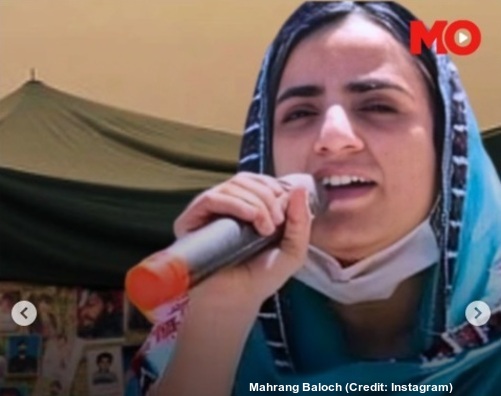
Amidst violence, leaders, like Mahrang Baloch, advocate for peaceful protests, uniting thousands in non-violent resistance against oppression. In 2025, the BLA rebels ambushed the Jaffar Express, resulting in the death of 21 hostages. The Pakistani Security Forces intervened, killing all 33 assailants and rescuing the remaining passengers. However, the Baloch rebels have claimed that they killed 214 hostages and not just 21 as claimed by the Pakistani Army!
With inputs from India Today & MO of Everything
Boundless Ocean of Politics on Facebook
Boundless Ocean of Politics on Twitter
Boundless Ocean of Politics on Linkedin
Contact: kousdas@gmail.com

 ISMC
ISMC Boundless Ocean Of Politics