

Oligarchy: The Present Danger
Former US President Joseph Robinette Biden Jr mentioned about the existence of the tech-industrial complex in his farewell speech and also warned that democracy was gradually turning into an oligarchy in his country. He further expressed a serious concern over the dangerous concentration of power in the hands of a few ultra-rich people.
One can find close ties between the political power and the economic power in different parts of the globe in the 21st Century. Often, it poses a serious threat to a state. It may be noted that President Donald John Trump‘s cabinet has more billionaires (13) than any in history! Elon Reeve Musk is in charge of the newly formed Department of Government Efficiency. In fact, the CEO of Tesla, Inc. purchased the political power as he backed Trump with over USD 250 million during the latter’s re-election campaign. The richest people in the tech world, including Amazon CEO Jeffrey Preston Bezos, Meta CEO Mark Elliot Zuckerberg and Apple CEO Timothy Donald Cook, attended his inauguration on January 20, 2025. No wonder, many of these people have won valuable tenders from the US Government!

The term Oligarchy can be found in the works of Greek philosopher Aristotle (BCE 384 – BCE 322). In contrast to Aristocracy or control by an elite upper-class, an Oligarchy is the rule of a few, but in a negative sense (for corrupt and unjust purposes). Oligarchs often seize power mainly through their monetary strength. They provide politicians with a lot of money (mainly to win elections) and in return, the politicians run the country as per the wish of oligarchs. In his 2011 publication Oligarchy, Jeffrey A Winters, a Political Scientist at Northwestern University, described the historical rise of the oligarchs, their objectives and the similarities between their methods of operation in different countries. According to Professor Winters, they have a pressure to not only create wealth, but also to protect it. They can do it individually, as well as collectively.
Oligarchy does not necessarily mean a bad system. However, oligarchs disrespect the law, do not control themselves and sacrifice the public interests for their own vested interests in most cases. Historically, it has happened repeatedly. Oligarchs may have different political motives, but their only goal is to preserve (and increase) their wealth (in various ways). In Democracy, they outsource this responsibility to the state. In Jack London‘s much-discussed 1908 dystopian and political novel about oligarchy, The Iron Hill; the government attempts to suppress a revolution before the revolutionaries can take action against the oligarchy. The government stages a strike in Chicago, blames protesters for triggering a riot and crushes the revolution with the help of mercenary forces hired by the oligarchs. Oligarchs also play an important role in shaping public opinion through newspapers, television channels and social media platforms.

Sociologists have labelled some countries, including China and the Philippines, as oligarchies. They have blamed the colonial past and some powerful families of the Philippines for this. Although China calls itself a People’s Republic, many consider the Asian country an oligarchy because power has been concentrated in the hands of a few for decades. In the 21st Century, the term oligarch is used mainly to refer to rich and politically powerful Russian businessmen. When Vladimir Vladimirovich Putin came to power at the very beginning of the 21st Century, he reportedly asked them to choose between “going to prison” and “showing loyalty in return for security“.
In 2022, US Senator Bernard Sanders stressed: “Of course, the oligarchs run Russia. But guess what? Oligarchs run the United States, as well. And it’s not just the United States, it’s not just Russia; Europe, the UK, all over the world, we’re seeing a small number of incredibly wealthy people running things in their favour. A global oligarchy. This is an issue that needs to be talked about.”

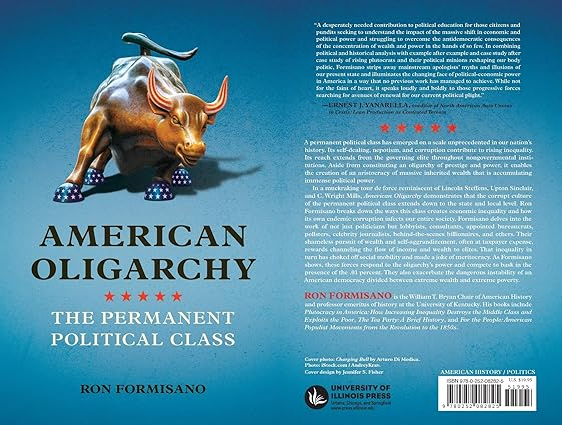
Oligarchs have always influenced politics in different parts of the world. However, oligarchy has taken a different shape in recent times. Ronald P Formisano, a historian of US political culture, theorised this neo-political class in his 2017 publication American Oligarchy: The Permanent Political Class. He mentioned that the involvement of oligarchs in corruption and nepotism triggered the increasing social inequality. According to Formisano, politicians, lobbyists, consultants, bureaucrats, eminent journalists safeguard the vested interests of the wealthy oligarchs who enjoy the real power from behind the scenes.
British-American economist Simon H Johnson has claimed that the financial concentration only accelerated as a result of the Great Financial Crisis that began in 2007, giving rise of the financial elites. On January 21, 2010, the US Supreme Court issued a 5-4 decision in favour of Citizens United, striking down the Bipartisan Campaign Reform Act of 2002 (BCRA) restrictions on independent political expenditures by corporations as violations of the First Amendment. With this, the Supreme Court allowed dark money to flood the political arena. Former President Jimmy Carter (born James Earl Carter Jr; October 1, 1924 – December 29, 2024) characterised the US as an “oligarchy with unlimited political bribery” following the Supreme Court’s decision to remove limits on donations to political campaigns. Thereafter, it became easier for business tycoons to purchase political power. All these have strengthened oligarchy.
It may not be right to blame only Donald Trump for the rise of oligarchy in the US. One should also consider the number of billionaires who sponsored the electoral campaign of Joe Biden in 2024.
Boundless Ocean of Politics on Facebook
Boundless Ocean of Politics on Twitter
Boundless Ocean of Politics on Linkedin
Contact: kousdas@gmail.com

 ISMC
ISMC Boundless Ocean Of Politics