

US-China Rivalry In Africa: Turkey Plays Spoilsport
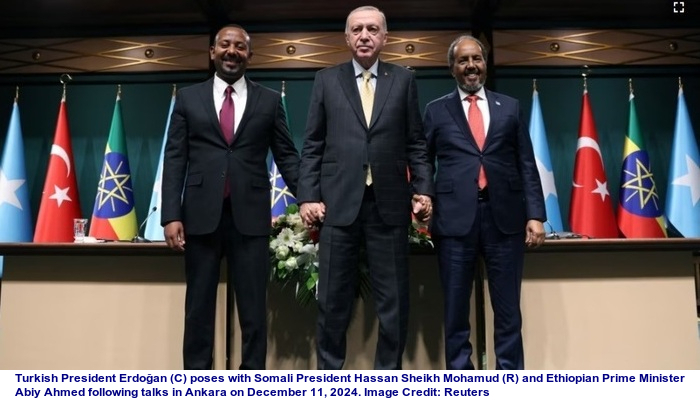
With the rivalry between China and the US intensifying in Africa, a third party has entered the stage. Turkey recently played an important role in resolving the escalating tensions between Ethiopia and Somalia. Reports suggest that the West Asian nation, under the leadership of President Recep Tayyip Erdoğan, hosted three rounds of negotiations between the two neighbouring African countries that culminated in a breakthrough agreement in December 2024. The accord reaffirmed the territorial integrity of both nations while outlining a plan for Ethiopia to gain secure maritime access under Somalia’s sovereign framework. This compromise shall also address Ethiopia’s need for trade routes without undermining the national unity of Somalia.
Political analysts have opined that the accord could play a major role in changing the regional geopolitical landscape in near future. It may be noted that the Horn of Africa has witnessed geopolitical tensions and territorial disputes between Ethiopia and Somalia for a long time. However, the two countries agreed to normalise ties at the beginning of 2025.
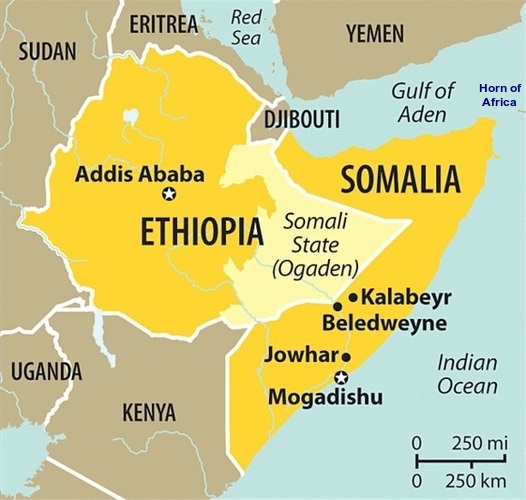
As Ethiopia is a landlocked country, it is somewhat impossible for this East African nation to take part in maritime trade. Since the 1990s, Addis Ababa has been trying to explore a coastal region for this purpose. It is because of this particular issue the conflict between Ethiopia and Somalia reached its peak. After Eritrea gained independence from Ethiopia in 1993, the latter started facing a serious strategic crisis. Earlier, Addis Ababa had the option to use the Red Sea through the Eritrean coast for maritime trade. However, the independence of Eritrea made Ethiopia fully dependent on Djibouti. The East African nation was in trouble due to the increase in cost of using the ports of Djibouti. Hence, Ethiopia turned its attention to another neighbouring country… Somalia.
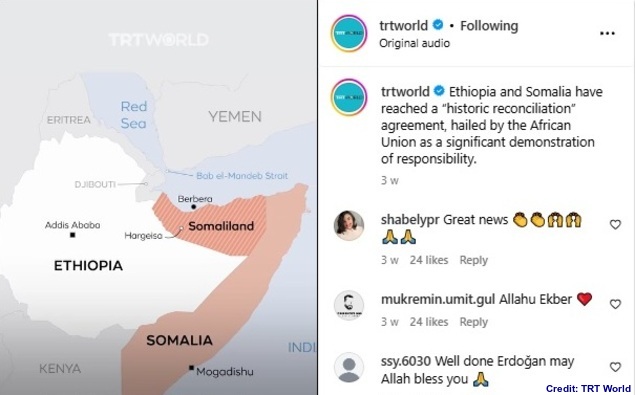
In 2004, Ethiopia signed an agreement with the representatives of Somaliland, an unrecognised country in the Horn of Africa and still a part of Somalia. It was a game changer for Ethiopia as the agreement allowed Addis Ababa to use the Red Sea and the Gulf of Aden for maritime trade. However, the ties between Ethiopia and Somalia touched a new low because of this accord as Mogadishu considers Somaliland as its integral part. Somalia, which considers the accord as a major blow to its sovereignty and integrity, has advised Ethiopia to immediately cancel the agreement. However, Addis Ababa has made clear that it would not be possible to withdraw from the agreement with Somaliland, triggering a fresh geopolitical tension in the Horn of Africa. After considering the situation, Somalia has decided to boost its military strength.
In such a scenario, Turkey came forward to resolve the crisis. Ankara rightly realised that a bloody war between the two neighbouring countries in the Horn of Africa would eventually disrupt maritime trade in the entire region. It is expected that the Turkey-brokered deal would spur thaw in relations between Ethiopia and Somalia. Reports suggest that the agreement between Ethiopia and Somalia would be fully operational by April 2025. Ankara has confirmed that President Erdoğan was present in all the three rounds of talks between the officials of the two African countries.
Analysts believe that the normalisation of ties between Ethiopia and Somalia is quite significant as both the countries would benefit from the agreement. Ethiopia is not only facing ethnic conflicts, but also experiencing an economic crisis as its currency is depreciating rapidly. Therefore, it would have been quite difficult for Ethiopia to afford a war. On the other hand, Somalia can concentrate on internal issues after signing the agreement with Ethiopia. Now, the main task of Mogadishu is to oust the independent government from Somaliland and to take necessary steps against al-Shabaab, a clan-based insurgent and terrorist group that has continued its violent insurgency in southern and central Somalia.
Meanwhile, Egypt is yet to welcome the Turkey-brokered deal between Ethiopia and Somalia. Cairo has been trying to isolate Ethiopia for a long time. Hence, the Ethiopia-Somalia deal can be considered as a major blow to Egypt. The Grand Ethiopian Renaissance Dam is currently under construction on the Nile. Egypt believes that the dam would pose a geopolitical challenge to other countries in the region in the coming days. On the other hand, the agreement has helped Turkey to emerge as a major player in Africa. Ankara is also working on the infrastructural development of several Somalian Army Bases in Mogadishu. Hence, Turkey may get an opportunity to set up naval bases in the Horn of Africa and to sell arms to the Dark Continent in future.
The Ethiopia-Somalia agreement can also be seen as a major setback to Somaliland’s dream for a separate statehood. Donald Trump decided to recognise Somaliland as an independent state in order to set up US naval bases in the Horn of Africa. Now, it has become difficult for the 47th US President to execute his plan. Even China, Saudi Arabia and the United Arab Emirates (UAE) were planning to increase their influence in the Horn of Africa by taking advantage of the political instability in the region. However, Turkey’s strategy to checkmate major powers in Africa is believed to be a successful one.
As the peace deal between Ethiopia and Somalia has jeopardised Trump’s game plan for Africa, it would have a negative impact on ties between the US and Turkey, which is a member of NATO. At the same time, the US military commanders would be happy to see that China would not be able to set foot in the Horn of Africa. One has to wait to see the impact of Ethiopia-Somalia friendship on global geopolitics.
Boundless Ocean of Politics on Facebook
Boundless Ocean of Politics on Twitter
Boundless Ocean of Politics on Linkedin
Contact: kousdas@gmail.com

 ISMC
ISMC Boundless Ocean Of Politics