

In January… 160 Years Ago!!!
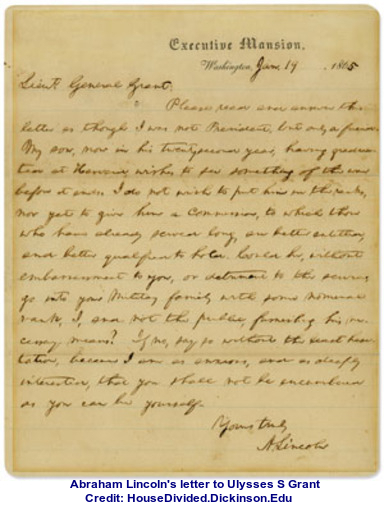
“Please read and answer this letter as though I was not President, but only a friend….” wrote Abraham Lincoln (February 12, 1809 – April 15, 1865), the 16th President of the US who was in office from 1861 until his assassination in 1865, in a letter (dated January 19, 1865) to Ulysses S Grant (born Hiram Ulysses Grant; April 27, 1822 – July 23, 1885), the then Commanding General of the Union Army who later became the 18th US President.
At that period of time, the American Civil War was in its final stage as the Confederacy of 11 rebel states in the cotton-producing south was in retreat. Their Army personnel were hungry, as well as unpaid. The troops of those Confederate States also started surrendering to Grant. The 20 northern states and their leader, President Lincoln, were determined not to allow the rich and powerful southern states to secede from the US.
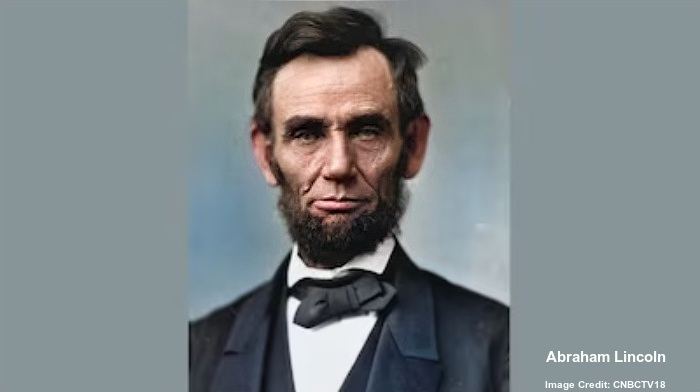
The Civil War affected the Lincoln Family, as well! Robert, the eldest son of President Lincoln, wanted to join the war, while his mother Mary Ann Todd Lincoln decided not to let him go. Embarrassed, Lincoln wrote to Grant, asking the Commanding General whether Robert could join the Union Army before the end of the war. General Grant immediately recruited 21-year-old Robert Todd Lincoln in the Army as a Captain. The Civil War ended just three months later, with Confederate General Robert E Lee surrendering to General Grant at Appomattox Court House in Virginia on April 9, 1865. The unity of the US was saved at the cost of more than 0.6 million lives! This event laid the foundation of the US’ emergence as a global power in the 20th Century. Unfortunately, President Lincoln was shot by an assassin, named John Wilkes Booth, five days later (on April 14, 1865 and died nine hours later on April 15, 1865).
What happened in the US 160 years ago found its place in World History. The US Congress passed the 13th Amendment to the Constitution on January 31, 1865 (and ratified it on December 6, 1865), abolishing slavery in the country. The move not only emancipated the Blacks (or the Afro-Americans) from slavery, but also prompted the political administration, as well as business leaders, to change their old stand on sensitive issues, like slavery and the value of human life, in different parts of the globe. The four-year-long American Civil War changed the international laws of war, too! The use of submarines, balloons, Gatling guns (the early version of the machine gun) and even the military use of railways proved their effectiveness to the global community during the American Civil War. Historians believe that the success of mines and torpedoes in naval warfare paved the way for using landmines and grenades in future.
The American Civil War had a huge impact on the Indian Economy, too! The southern states of the US used to supply cotton to textile mills in Britain until the 1860s. On the other hand, the amount of cotton imported from India was just 12%. After the first year of the Civil War, nearly 90% of Britain’s cotton imports started coming from India. It destroyed India’s own textile industry as the South Asian nation had no other option, but to stop exporting textile products to foreign countries. India gradually became a victim of Colonial Economy, as the imperialist British rulers forced the Indian producers to send cotton to London, ignoring the interests of domestic consumers. Indian farmers were reportedly asked to cultivate only cotton, and not food grains or other crops.
You may also like: The Tragic Tale Of Minik
Still, President Lincoln’s letter is quite important from a historical perspective as it shows that each and every war has an impact on personal life, too. The American Civil War had a great impact on every household in the US. It may be noted that the fathers of both Mary (the wife of President Lincoln) and Julia Boggs Grant (the wife of Ulysses S Grant) were slave-owners. As the harsh behaviour of Mary hurt Julia, the latter used to avoid the former. President Lincoln invited the Grant couple to watch a play at Ford’s Theatre to celebrate the surrender of General Lee. However, Grant declined the President’s invitation to attend the performance mainly because of Julia’s objection.
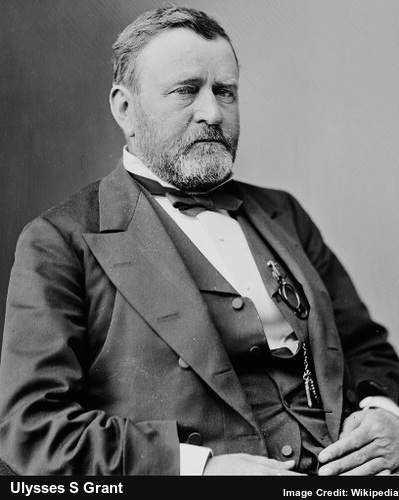
Later, Grant came to know that he, too, was on the hit list of John Wilkes Booth! Had he been at Ford’s Theatre with President Lincoln on April 14, 1865, Grant would not have become the 18th US President on March 4, 1869.
Boundless Ocean of Politics on Facebook
Boundless Ocean of Politics on Twitter
Boundless Ocean of Politics on Linkedin
Contact us: kousdas@gmail.com

 ISMC
ISMC Boundless Ocean Of Politics