

Why Some Nations Thrive While Others Struggle
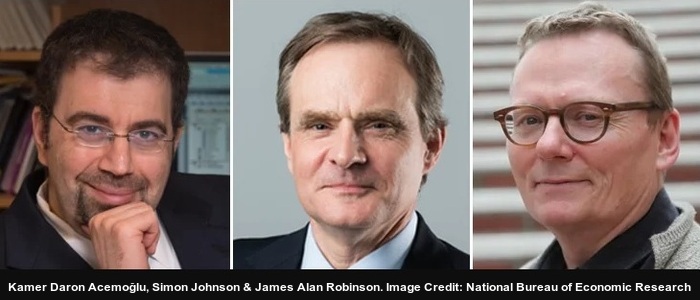
Kamer Daron Acemoğlu and Simon Johnson of Massachusetts Institute of Technology (MIT), and James Alan Robinson of University of Chicago shared the 2024 Nobel Prize in Economic Sciences for their influential work on how institutions shape economic development. The three economists have made a serious attempt to explain how institutions are formed and affect prosperity. The main subject of their research is Political Economy.
Political Science and Economics may seem quite different as subjects, as they used to be considered as two completely different fields of study in higher educational institutions and universities for at least five decades. However, the concept changed three decades ago, with these two subjects coming closer at the theoretical level. The innumerable research papers and books authored by the three Nobel laureates are irrefutable evidence of that closeness. Acemoğlu, Johnson and Robinson have shown how Political Science and Economics can be reconciled by addressing various problems of Political Science through arguments, economic models and analytical methods of modern Economics.
Colonial History, Institutional Arrangements and Economic Prosperity are the three phrases which have appeared repeatedly in their works. Even a common Indian, who is completely unfamiliar with their theory, is well aware of the fact that the root of the present economic condition of India is hidden in the history of British East India Company (established almost three centuries ago) and its activities. The imprint of European Colonialism and the (colonial) institutions built by the imperialists can be traced in the economy, as well as infrastructure, of various countries in Asia, Africa, North America, Latin America and Australia even today!
When the words colony and economy are uttered together, the first question that arises in the mind of an Indian is whether Political Independence can make a former colony economically independent? India is still a Developing Nation even almost eight decades after achieving political freedom from Britain. The question arises here: What is the benefit of being the world’s Largest Democracy? Acemoğlu, Johnson and Robinson have explained the strong correlation between Democracy and Economic Growth through a statistical analysis of economic data from 175 countries in the last half of the 20th Century. They have claimed that a country achieves economic prosperity, albeit late; if democracy prevails.
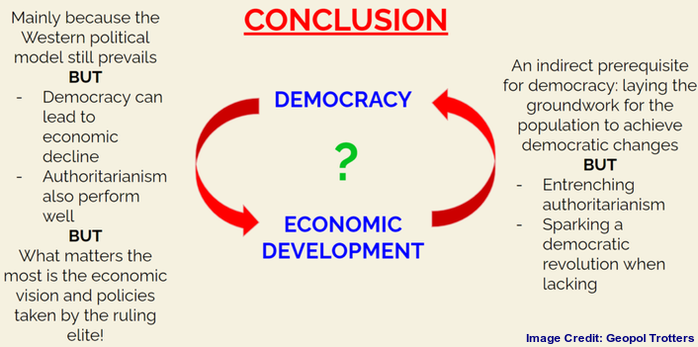
A country has to depend on various institutions. How the laws of that country would be, how reasonably or impartially the laws would be applied, how the government would be formed, how the taxes would be collected and how the government would redistribute the wealth… all depend on those institutions. In other words, the survival of democracy means the survival of some institutions. According to the three Nobel laureates, all these inefficient institutions are leaving us behind!
Interestingly, democracy, itself, has become an institution! Acemoğlu, Johnson and Robinson are of the opinion that the modern democracies are run in an inefficient manner. In the contemporary world, the elite class has taken the responsibility of running the government in a democracy and the rest of the people have joined that system. The three economists believe that it is, therefore, a game between the two parties that could be analysed through Game Theory.
This game is not played once. Instead, both sides have been playing this dynamic game over the years in a bid to retain democracy! As part of this dynamic system, the common people can call for a revolution one day in order to overthrow the system run by the elites, if they want. However, it would be of no use as democracy survives as an equilibrium in this game! The idea, as well as the possibility, that a revolution can take place co-exists with this system. Under the guise of democracy, this elite institution not only kills the possibility of a revolution, but also prevents the use of new initiative, knowledge and technology. Also, democracy does not allow a new system to replace it. Hence, we are left with an inefficient system: Unequal Distribution.
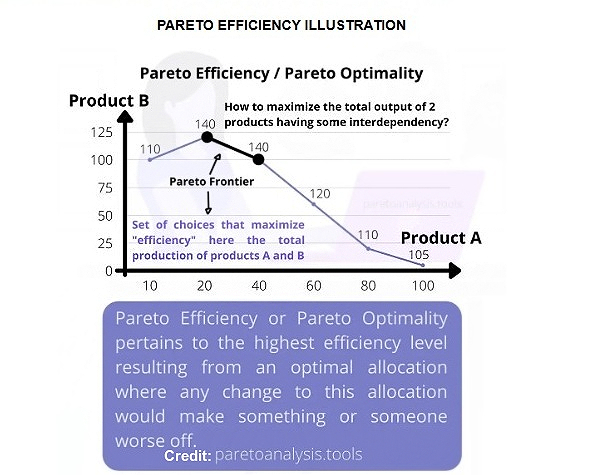
It may be noted that Political Economy used to exist in the early 20th Century, as well. Vilfredo Federico Damaso Pareto (born Wilfried Fritz Pareto; July 15, 1848 – August 19, 1923), an Italian polymath whose areas of interest included Sociology, Civil Engineering, Economics, Political Science and Philosophy, was against such inequality. It is in his name that many still demand that any distribution system be Pareto-efficient!
Boundless Ocean of Politics on Facebook
Boundless Ocean of Politics on Twitter
Boundless Ocean of Politics on Linkedin
Contact: kousdas@gmail.com

 ISMC
ISMC Boundless Ocean Of Politics