

The Chaos & A Fresh ‘Beginning’
The recent mass uprising in Bangladesh has triggered a total anarchy, placing the South Asian country of 170 million at a critical juncture! Mass uprising has never followed any particular political theory in any part of the globe, and Bangladesh is no exception to this. It would take time to understand whether the incompetence of a ruler (who demanded absolute and unquestioning loyalty from her countrymen) triggered the social discontent or external powers played an important role in the fall of the Sheikh Hasina Government on August 5 (2024). In fact, it would be a mistake to judge the suddenness of the country’s dramatic turnaround in the ever-changing socio-political landscape. However, the current political instability in Bangladesh is bound to impact South and Southeast Asia, as well as the Bay of Bengal and the Indian Ocean Region (IOR), because of its geographic location.
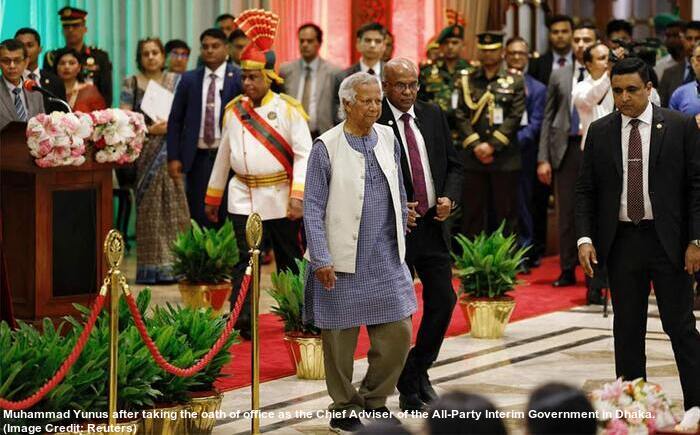
Muhammad Yunus, the Chief Adviser of the newly inaugurated All-Party Interim Government, is comparatively a known figure (especially in the Western Hemisphere) as he was awarded the Nobel Peace Prize in 2006 for founding the Grameen Bank and pioneering the concepts of microcredit and microfinance. Hence, the US has high expectations from the Interim Government of Bangladesh. In recent times, the US, Britain and several European countries have claimed that Democracy is in danger in the country with the highest population density in South Asia! The manner in which the Joe Biden Administration was eager to build cordial relations with the Interim Government even before its formation is particularly significant!
China (which is rapidly expanding its economic and political influence in South Asia), too, is keeping a close eye on the changing political situation in Bangladesh. It may be noted that the top political leadership in Beijing maintained friendly relations with former Prime Minister of Bangladesh Sheikh Hasina Wazed, in spite of the fact that she is a pro-Indian. The 6km-long Padma Bridge, which was inaugurated a couple of years ago, was built by a Chinese company. In fact, Bangladesh also received technical assistance from China during the construction of this stunning bridge. The American Enterprise Institute (AEI), a Washington DC-based think-tank, estimated in 2023 that the total Chinese investment in Bangladesh was about USD 7.07 billion. Additionally, Chinese companies have received construction contracts worth USD 22.94 billion in different sectors. Beijing has also agreed to construct a deep-sea port near Sonadia Island, located in Cox’s Bazar District. Therefore, it is quite natural that China shall keep a close eye on the political developments in Bangladesh.
During Sheikh Hasina’s recent visit to China, Beijing not only congratulated her Awami League Party for winning the last Parliamentary Election, but also pledged to maintain peace and stability in Bangladesh. China also appreciated the Hasina Administration‘s initiatives to develop the country financially in an independent manner by understanding the current political situation. However, the former Prime Minister felt that she did not get much attention of Beijing during the visit! Incidentally, a section of the leadership of the then Opposition Bangladesh Nationalist Party (BNP), which is playing quite an important role in the post-transition phase, met the top leaders of the Communist Party of China (CPC) in Beijing ahead of Hasina’s visit. In this context, it is expected that the political unrest and anarchy in Bangladesh are a cause of concern for China. One should not forget that the Asian Giant considers the South Asian nation as its important trump card in regional geopolitics.
China and Bangladesh have come closer to each other in the last 25 years as far as trade and defence co-operations are concerned. The bilateral trade reached USD 12 billion three years ago as the volume of Chinese exports to Bangladesh was huge. Beijing also provided Dhaka with financial aid, apart from building critical infrastructure in Bangladesh. However, China’s Belt and Road Initiative (BRI) failed to attract the South Asian nation!
India, too, has maintained friendly ties with Bangladesh since 1971. India’s historical role in the Liberation War of Bangladesh founded a solid base of bilateral ties. The geographical proximity between the two countries is also an advantage for India. Furthermore, India allowed Bangladesh to use its territory for exploring trade opportunities with Nepal and Bhutan. By improving road and railway connectivity with Bangladesh, India has further increased the value of bilateral trade to USD 13 million in recent times. Despite such close ties between New Delhi and Dhaka, Bangladesh is unhappy as the water sharing of at least 54 rivers that flow between the two neighbouring countries still remains unresolved.
Experts believe that India’s closeness with the Sheikh Hasina Government fuelled anti-India sentiment in Bangladesh. Diplomatic ties do not depend solely on actions taken in the past. Emotions are normal in politics (or geopolitics). In contemporary world politics, it is necessary to determine the priorities of foreign policy by understanding the socio-economic reality of a country and the regional geopolitical equation. Society and politics are not one-dimensional in any country. The Interim Government is sure to be proactive in ending the anarchy in post-uprising Bangladesh. It would have to restore a healthy political culture and absolute tolerance.
If there is a crisis in Bangladesh, the entire Indian Subcontinent will also face a crisis. Hence, India would have to help Bangladesh to bring back stability. Prime Minister of India Narendra Modi congratulated Muhammad Yunus immediately after the latter took charge of the Interim Government. India gets an opportunity to strengthen ties with Bangladesh by reviewing the changing political situation in the neighbouring country. One should not forget that any new beginning brings a new twist to a relationship!
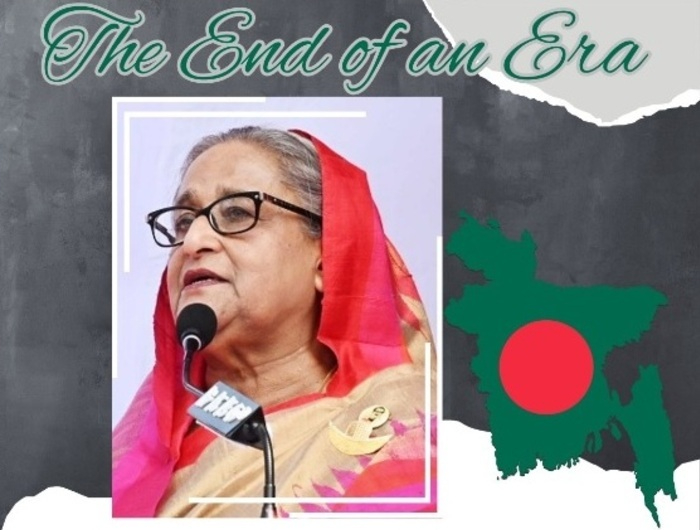
Hasina’s Fall & Uncertain Future Of Bangladesh
(Talk Diplomacy) In a stunning turn of events that would have been hard to predict just weeks ago, Sheikh Hasina Wazed, the long-standing Prime Minister of Bangladesh, ended her 15-year tenure on August 5, 2024 by resigning from her position and fleeing the country. Her sudden departure marks the end of an era that saw both significant economic growth and a troubling descent into autocracy. The military, which has a history of seizing power in Bangladesh, played a crucial role in her exit, urging Hasina to leave as a nationwide uprising reached a critical mass, threatening to overwhelm the country’s security forces.
The chaotic scenes that unfolded in the capital city of Dhaka, where protesters stormed and occupied the Prime Minister’s residence, offered a vivid illustration of the pent-up frustrations of the Bangladeshi people. These unprecedented events culminated in Waker-uz-Zaman, the Army Chief, assuming control of the Government. Zaman promised to form an Interim Government and hold fresh elections, though the path to such a transition remains unclear.
Hasina’s departure closes a complex chapter in Bangladeshi history. The country, once lauded as a model of globalisation and development, now faces significant challenges that have been exacerbated by the very successes it was praised for. Economic disparities, high youth unemployment and an increasingly Autocratic Government under Hasina’s rule have fuelled growing dissatisfaction among the population. These issues came to a head in early July (2024) when protests erupted in Dhaka, quickly spreading across the country.
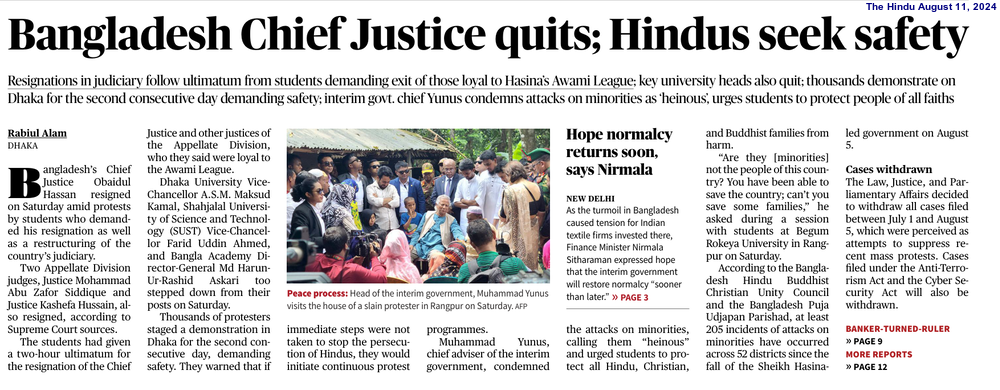
The Government’s response to the protests was brutal. In just a few weeks, security forces killed hundreds of demonstrators, with bodies left unidentified and collected by charity groups. A new wave of demonstrations in early August was met with similar force, resulting in the deaths of 90 more people. This violent repression proved to be the final straw for the Bangladeshi public, who, in a remarkable show of people power, took to the streets in overwhelming numbers, ultimately forcing Hasina to flee to India via military helicopter.
The fall of Hasina, who had long appeared invincible, reveals the fragility of her regime. Her power, which had seemed unassailable, crumbled within a matter of hours, demonstrating that the support she relied on from the bureaucracy and military was weak and conditional at best. The cult of personality Hasina had built around her father, ‘Bangabadhu’ Sheikh Mujibur Rahman, the country’s founding leader, also suffered a significant blow as protesters targeted and burned down a memorial museum dedicated to him.
What makes Hasina’s ousting particularly notable is that it was not orchestrated by the traditional political opposition, but rather by a grassroots movement largely led by young people. This movement, unaffiliated with any political party, managed to topple a regime that had seemed unshakeable, highlighting the potential for genuine popular power to effect change.
However, the future of Bangladesh remains uncertain. With the military now in control, there are concerns that the country could see a return to the status quo, with little meaningful reform. The movement that ousted Hasina has yet to articulate a clear vision for the future, raising questions about what will emerge from the political vacuum. While the end of Hasina’s rule is a historic moment, the challenges facing Bangladesh are far from over.

US’ Desire ‘To Turn Bangladesh’s St. Martin Island Into Another Okinawa’
(Sputnik) by Ilya Tsukanov
Former Bangladeshi Prime Minister Sheikh Hasina was forced from power on August 5, 2024 by large-scale, violent, student-led protests. On August 11, the politician offered her most direct explanation to date about the foreign forces responsible for her removal from office. Sputnik asked veteran international affairs commentator Jeff Brown to elaborate.
‘Another Okinawa’
“The United States wants to turn Bangladesh’s Saint Martin Island into another Okinawa. Sheikh Hasina said no, so she had to be deposed with a classic colour revolution (using) paid-for astroturf protests organised out of the US Embassy and the usual gang of Soros NGOs,” stressed Brown, the author of ‘The China Trilogy’, editor at ‘China Rising Radio Sinoland’ and the founder of ‘Seek Truth From Facts Foundation’.
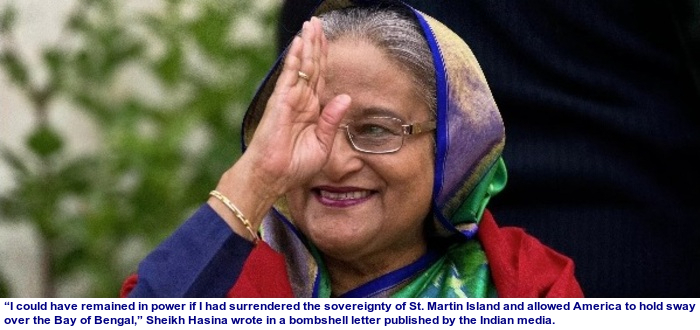
On August 11, 2024, Hasina told the Indian media: “I resigned so that I did not have to see the procession of dead bodies. They wanted to come to power over the dead bodies of students, but I did not allow it. I resigned the premiership.” She also asked the Bangladeshi people not to allow themselves to “be manipulated by radicals”, stressing: “Don’t lose hope. I will return soon. I have lost, but the people of Bangladesh have won, the people for whom my father, my family died.” She made the comment, referring to Sheikh Mujibur Rahman, the Bangladeshi statesman who became the nation’s first President in 1971 and served as Prime Minister from 1972 until his assassination in 1975 in the wake of Bangladesh’s Independence from Pakistan.
Hasina: US Orchestrated My Ouster To Control Strategic Island
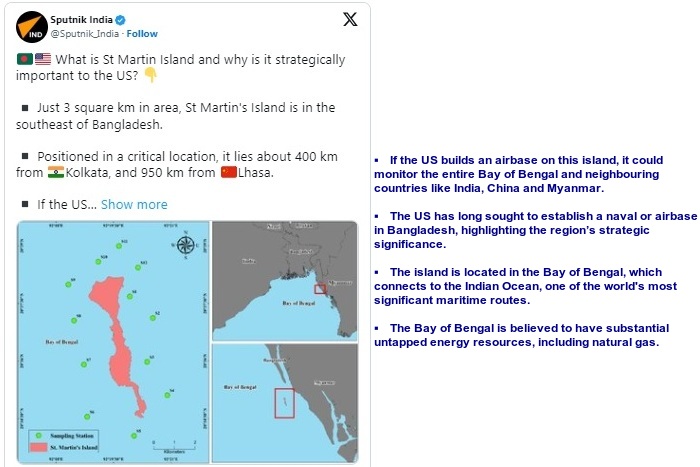
Hasina’s remarks on Saint Martin Island are quite significant. In May (2024), she alleged that the representative of an unnamed Western country had offered her an easy victory ahead of Parliamentary Elections held earlier in 2024 in exchange for permission to build an airbase on St. Martin. Her government rejected the proposal, sticking to its “malice to none” foreign and defence policy, which rules out membership in security alliances. Much of the opposition boycotted the January Election, with the Western media praising the move.
Serving as Bangladesh’s Prime Minister from 1996 to 2001 and again from 2009 until August 5, 2024, Hasina estranged the US and other Western countries with her remarks, slamming the US-led aggression against Muslim-majority countries under the guise of “democratisation”, and her allegations earlier this year accusing the US of seeking to partition Bangladesh and Myanmar and carve out a Christian-majority state.
Hasina resigned from her post and fled Dhaka for India on August 5 while protesters stormed her official residence. Large-scale demonstrations in Bangladesh began in June, triggered by the reinstatement of a quota system for government jobs, and quickly exploited by political and social forces looking to oust the government. Hundreds of protesters and Police were killed or injured in clashes, with the Army stepping in after Hasina’s ouster and tapping US-supported banker and academic Muhammad Yunus to serve as head of an Interim Government. Hasina and Yunus have a well-documented record of bad blood, with the former PM accusing Yunus of “sucking blood from the poor” with his Nobel Prize-winning microcredit schemes.
US-Backed Leader Takes Over Bangladesh
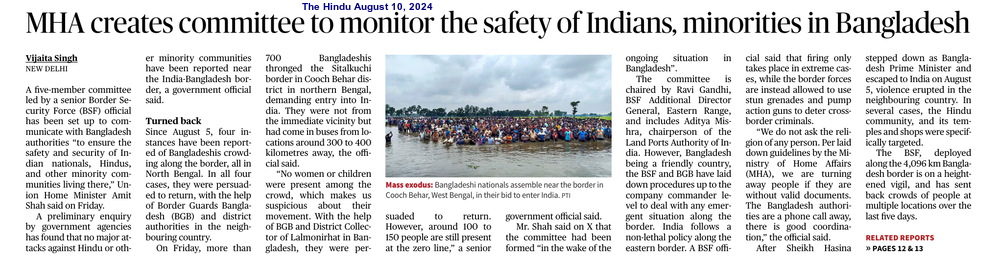
Hasina’s ouster failed to quell the violence, with the Indian and Bangladeshi media reporting on attempts by Bangladeshis of the Hindu faith to illegally cross the border into India amid a spate of targeted attacks which have reportedly left as many as 232 Bangladeshi Hindus dead. Additional reporting says that other minorities, including Christians and Buddhists, have also been targeted, with violence ranging from attacks on homes, shops and religious sites to abuse targeting women.
A Serious Crisis Is Brewing On India’s Doorstep & The West Has A Role
(InterAffairs.RU) Washington DC strategically pressured former Prime Minister of Bangladesh Sheikh Hasina, fully aware that her potential successors might be less democratic and have stronger Islamist ties, writes Kanwal Sibal, a retired Indian Foreign Secretary and former Ambassador to Russia between 2004 and 2007. He also held ambassadorial positions in Turkey, Egypt, France and was Deputy Chief of Mission in Washington DC.
The forced ouster of Sheikh Hasina from power by street agitators has many dimensions, internal and external, all of which will be problematic in the near to medium term for Bangladesh itself, for India, and the entire region. Bangladesh politics has been tumultuous, with Sheikh Hasina’s father, ‘Bangabandhu’ Sheikh Mujibur Rahman, considered the Father of the Nation, killed in 1975 in a military coup, along with all the members of his family, except Sheikh Hasina and her sister Sheikh Rehana, who happened to be abroad at that time.
Since then, Bangladesh has had a series of military coups until the restoration of civilian rule in 1991. This, however, failed to stabilise the country’s politics because of the unending rivalry between Sheikh Hasina’s Awami League (AL) and Begum Khaled Zia, the widow of former coup leader General Ziaur Rahman, who heads the Bangladesh Nationalist Party (BNP).
This has deeply polarised Bangladesh politics, making it virtually impossible for proper democratic processes to function. The BNP has not participated in the last two General Elections. Khaleda Zia had been under house arrest since 2018 on corruption charges, but was released by the Bangladeshi President hours after Hasina’s ouster.
Adding to this complexity of personal rivalry is the presence of radical Islamist forces in the body politic of Bangladesh, which is closely linked to the BNP. The Jamaat-e-Islami (JeI) believes in an Islamic Bangladesh, unlike the more secular-minded AL.
These radical Islamist elements, which did not participate in the Liberation Struggle against the Pakistani military in the then East Pakistan, are pro-Pakistan and anti-India by orientation, given India’s role in Bangladesh’s Liberation. With the ouster of Sheikh Hasina, her party in political disarray, and the BNP politically revitalised, the JeI and associated Islamist elements will wield much more influence and weaken the more secular-minded forces in the country.

The residence of Sheikh Mujibur Rahman, which had been turned into a museum, has been set on fire, and the former Prime Minister’s residence vandalised, just like the Sri Lankan mobs did to the Premier’s residence in Colombo and the Taliban did to the Presidential Palace in Kabul after Ashraf Ghani fled.
The West, especially the US, cynically sought to put political pressure on Sheikh Hasina on the democracy front, in full knowledge that the alternatives were even less democratic, with more Islamist influence to boot. The US played a role in de-legitimising Sheikh Hasina’s rule with many of the steps it took, which no doubt indirectly encouraged her overthrow. This is not to say that there was no democracy deficit in Sheikh Hasina’s functioning, but that does not justify external interference, especially if it is selective.
In 2023, the US State Department announced that it was taking steps to impose visa restrictions on Bangladeshi individuals responsible for, or complicit in, undermining the democratic election process in Bangladesh. In May 2024, it sanctioned a former Bangladesh Army Chief for corruption.
Mohammed Yunus, the founder of the Grameen Bank who was sentenced to six months in jail for violating labour laws in Bangladesh and had opposed Sheikh Hasina, has now been asked to head the Interim Government. He is considered a protégé of the US. The corruption cases against him have been withdrawn by the new dispensation.
The bad blood between Sheikh Hasina and the US has been quite open. The former Prime Minister went to the extent of recently accusing Washington DC of seeking to carve a small Christian State out of parts of Bangladesh, Myanmar and the Indian Province of Manipur (where the US has been provocative in its comments on the internal ethnic turmoil there) on the Timor-Leste model. It would be relevant to remember that the US had opposed the creation of Bangladesh and militarily threatened India at that time. How much of this legacy has continued to influence US policy towards Sheikh Hasina and the AL is a matter of speculation.
India-Bangladesh ties flourished under Sheikh Hasina, with numerous development, connectivity and transit projects. She eliminated the anti-Indian insurgent groups operating from Bangladeshi soil, as well terrorism directed at India by Islamist elements linked to Pakistan.
The statements coming out of the US and the UK on the Bangladesh crisis take no note of India’s concerns, especially the security of the Hindu community there. Both countries, especially the US, liberally make statements about the security of minorities in India, but are silent on the issue of minorities in Bangladesh. The UK Foreign Secretary has called for a UN investigation into the events of recent weeks in Bangladesh, with the seeming intent of internationalising the developments and targeting Sheikh Hasina on Human Rights issues.
India is rightfully concerned about the fall-out from the changes in Bangladesh, not only for the Hindu minority, but also because of the potential for the instability to spill over into India’s northeast, already under pressure due to the turmoil in Myanmar. New Delhi will also be concerned about the disruption to Indian projects in the country, especially those of connectivity and transit. With the insurgencies in Myanmar, instability in Bangladesh de-stabilises India’s neighbourhood in the east.
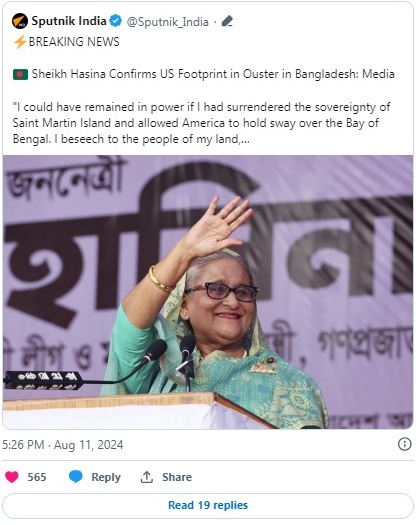
In an exclusive interview, Sheikh Hasina told the Economic Times: “I resigned, so that I did not have to see the procession of dead bodies. They wanted to come to power over the dead bodies of students, but I did not allow it, I resigned from premiership. I could have remained in power if I had surrendered the sovereignty of Saint Martin Island and allowed America to hold sway over the Bay of Bengal. I beseech to the people of my land, ‘Please do not allow to be manipulated by radicals.’”
The Economic Times report, citing Awami League sources, implied that the hatchet man of the colour revolution in Bangladesh is none other than Donald Lu, the incumbent US Assistant Secretary of State for South and Central Asian Affairs who visited Dhaka in May, stressed M K Bhadrakumar, the Indian Ambassador and prominent international observer.
This is credible enough. A background check on Lu’s string of postings gives away the story. This Chinese-American diplomat served as Political Officer in Peshawar (1992 to 1994); Special Assistant to Ambassador Frank Wisner (whose family lineage as operatives of the Deep State is far too well-known to be explained) in New Delhi (1996-97); subsequently, as the Deputy Chief of Mission in New Delhi from 1997-2000 (during which his portfolio included Kashmir and India-Pakistan relations), inheriting the job, curiously enough, from Robin Raphel, whose reputation as India’s bête noire is still living memory – CIA analyst, lobbyist and expert on Pakistan affairs.
Indeed, Lu visited Bangladesh in mid-May and met senior government officials and civil society leaders. And shortly after his visit, the US announced sanctions against then Bangladesh Army Chief General Aziz Ahmed for what Washington DC termed his involvement in “significant corruption”.
After his Dhaka visit, Lu openly told Voice of America: “Promoting democracy and Human Rights in Bangladesh remains a priority for us. We will continue to support the important work of civil society and journalists and to advocate for democratic processes and institutions in Bangladesh, as we do in countries around the world…” He added: “We (US) were outspoken in our condemnation of the violence that marred the election cycle (in January) and we have urged the Government of Bangladesh to credibly investigate incidents of violence and hold perpetrators accountable. We will continue to engage on these issues…”
Lu played a similar proactive role during his past assignment in Kyrgyzstan (2003-06) which culminated a colour revolution. Lu specialised in fuelling and masterminding colour revolutions, which led to regime changes in Albania, Georgia, Azerbaijan, Kyrgyzstan and Pakistan (ouster of Imran Khan).
Sheikh Hasina’s disclosure could not have come as surprise to the Indian intelligence. In the run-up to the elections in Bangladesh in January, the Russian Foreign Ministry had openly alleged that the US diplomacy was changing track and planning a series of events to destabilise the situation in Bangladesh in the post-election scenario.
The Russian Foreign Ministry spokesperson said in a statement in Moscow: “On December 12-13, in a number of areas of Bangladesh, opponents of the current government blocked road traffic, burned buses and clashed with the Police. We see a direct connection between these events and the inflammatory activity of Western diplomatic missions in Dhaka.” Unlike Russia, which has economic interests in Bangladesh and is a stakeholder in the creation of a multipolar world order, the security interests of China and India are going to be directly affected if the new regime in Dhaka fails to deliver and the country descends into economic crisis and lawlessness as a failed state.
British Foreign Secretary David Lammy reached out to Indian External Affairs Minister Dr Subrahmanyam Jaishankar with a phone call on August 8 (2024), coinciding with the appointment of the Interim Government in Dhaka, which the UK has welcomed while also urging for “a peaceful pathway to an inclusive democratic future” for Bangladesh – much as the people of that country deserve “accountability.” (Emphasis added)
The only way Bangladesh can figure a way out of the foxhole is through an inclusive democratic process going forward. But the appointment, ostensibly at the students’ recommendation, of a US-educated lawyer as the new Chief Justice of the Supreme Court in Dhaka is yet another ominous sign of Washington DC tightening its grip.
Against this geopolitical backdrop, a commentary in the Chinese daily Global Times, titled ‘China-India Relations Easing’, navigates new realities that give some food for thought. It spoke of the imperative for India and China “to create a new kind of relationship that reflects their status as major powers… Both countries should welcome and support each other’s presence in their respective neighbouring regions.” Or else, the commentary underscored, “the surrounding diplomatic environment for both countries will be difficult to improve”.
The regime change in Bangladesh bears testimony to this new reality. The bottom line is that while on the one hand, Indians bought into the US narrative that they are a counterweight to China, in reality, the US has begun exploiting India-China tensions to keep them apart with a view to advance its own geopolitical agenda of regional hegemony.
…Thus, the provocation of the US and Britain with the change of power in Bangladesh will be continued in the unexpected rapprochement of India and China against Western penetration into the Southeast Asian region. The collective West is in hysterics, and it began to make strategic mistakes when it provoked a coup d’etat in Bangladesh!
With inputs from Talk Diplomacy, Sputnik & InterAffairs.RU.
Boundless Ocean of Politics on Facebook
Boundless Ocean of Politics on Twitter
Boundless Ocean of Politics on Linkedin
Contact: kousdas@gmail.com

 ISMC
ISMC Boundless Ocean Of Politics