

Post-Independence India As A State…
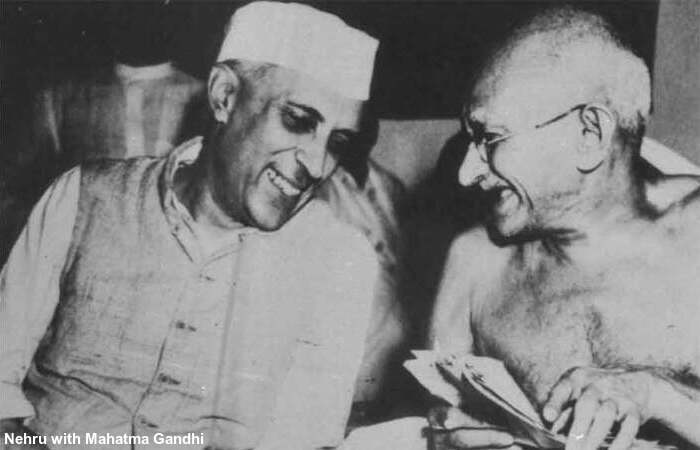
On August 15, 1947, Pandit Jawaharlal Nehru (November 14, 1889 – May 27, 1964), the first Prime Minister of India, called Independence (of the South Asian country from the colonial British rulers) a ‘Tryst with Destiny‘.
Under normal circumstances, Tryst means a secret meeting (between lovers) or an agreement to meet. When two persons are sneaking to meet, notably as secret lovers, it is called a Tryst. The origin of the word Tryst comes from Middle English, and originally referred to a designated hunting station. One may think that it would have been better had Nehru avoided such a word while addressing the Indian Constituent Assembly in the Parliament House, on the eve of India’s Independence, towards midnight on August 14, 1947. Perhaps, the then Prime Minister of India had used the word Tryst in a different perspective. He seemingly expected that the people of India, who were bound by a secret pledge with a destiny, would gradually manifest it in an independent country. He may also have expected that destiny would gradually unfold through the united action of the people of India, as they would always be bound by mutual respect and would assure the dignity of every citizen.
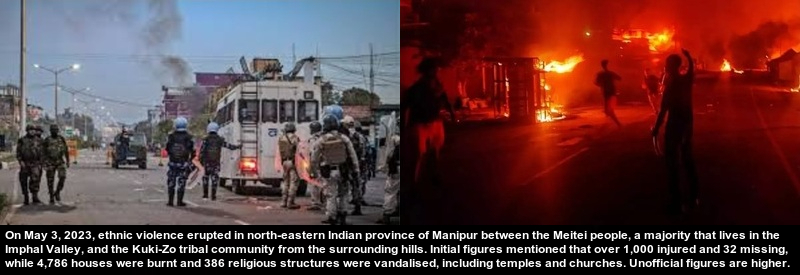
Unfortunately, the Indians have failed to meet Nehru’s expectations in the past 77 years! In Independent India, violent protests have been taking place in the north-eastern Province of Manipur since May 3, 2023. While the conflict (between the dominant Meitei Christians and Kuki-Zo tribal residents) was primarily ethnic in nature, there has been an underlying communal element to the violence. In 2023, nearly 70,000 people left Manipur to find safe places in neighbouring provinces. Surprisingly, current Prime Minister Narendra Modi has not mentioned the word Manipur since the beginning of violence, ignoring the victims of communal clashes.
Later in 2023, the scene shifted to Nuh and Mewat in northern Indian Province of Haryana from Manipur. It should be noted that quite a few followers of Islam live in these two districts. On July 31 (2023), a religious procession, jointly organised by the Vishwa Hindu Parishad (VHP) and Bajrang Dal, turned violent and started attacking the Muslim residents of that area. It was seemingly a pre-planned incident as a person who had previously been accused in a murder case was in that procession! Seven people were killed in the violence, while several houses and shops were torched by the rioters! Thereafter, the Provincial Government deployed bulldozers (to destroy mainly the houses of minority communities). In recent times, bulldozers have become a symbol of instant justice and punishment in India.
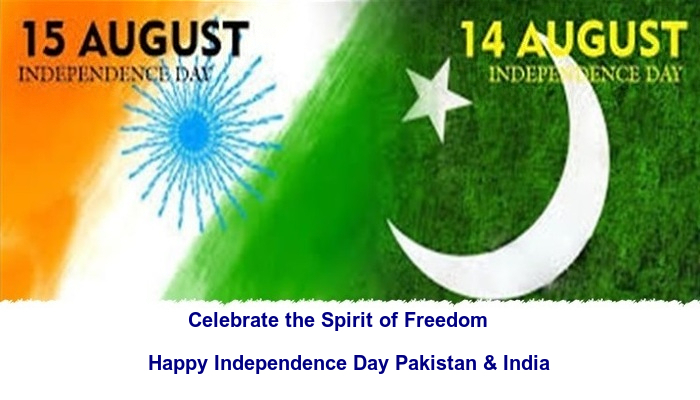
In in the midst of such a situation, India celebrates its 77th Independence Day on August 15, 2024. The question arises here: How can those, who have lost their homes, relatives, voice and dignity in Manipur and Haryana, vouch for the nation called India? No one can celebrate Independence Day while being virtually in chains. Indians have to show patriotism even though countless people are mired in poverty and illiteracy in the country. In today’s India, the opinion of the dominant ones prevails, while the minority bows down their heads in fear. This is certainly not that India for which the freedom fighters had sacrificed their lives!
The Modi Administration often claims that it has implemented various projects to deal with different crises. As expected, those projects have become irrelevant as the majority of Indians do not enjoy the Freedom of Speech, the most important freedom enjoyed by the people of a democratic country. Many journalists are still behind the bars for telling the truth in the face of the Government of India! A number of Indians also remember Stanislaus Lourduswamy (popularly known as Stan Swamy; April 26, 1937 – July 5, 2021). Swamy, an Indian Catholic priest and a Tribal Rights Activist, was the oldest person to be accused of terrorism in India! As he was suffering from Parkinson’s disease, Swamy had requested bail on medical grounds, which was rejected a multiple number of times. While incarcerated, his health deteriorated and he died on July 5, 2021.

With his Tryst with Destiny speech, Nehru wanted to inspire millions of Indians who had suffered persecution at the hands of the colonial British rulers. He also made an attempt to console those families who had laid down their lives for the sake of freedom. However, the promise of convergence with destiny has been broken time and again as some people in India visibly seem to have made a pact with evil forces in recent times.

The Complex Foundations Of Pakistan
(Talk Diplomacy) The emergence of Pakistan as an Independent State on August 14, 1947 brought with it significant challenges that continue to shape its trajectory. Ideologically, the foundation of Pakistan was not just a poetic vision, but a complex philosophical construct, as articulated by Sir Muhammad Iqbal (November 9, 1877 – April 21, 1938). His vision was for a state where spiritual and temporal dimensions of Islam were intertwined, yet the practical application of this ideal led to confusion and political instability.
Economically, the country was burdened with the task of accommodating over nine million refugees while simultaneously combating issues, like land salinity and water-logging, which severely hampered agricultural productivity. This economic strain was exacerbated by widespread corruption, smuggling and inefficient governance.
Geographically, Pakistan faced the unique challenge of being split into two wings, West and East Pakistan, separated by a thousand miles of Indian territory. This division created logistical difficulties and cultural diversity that demanded innovative political solutions to foster unity. It may be noted that East Pakistan became the People’s Republic of Bangladesh in 1971.
Emotionally, the creation of Pakistan required a shift in identity, as millions of people had to transition from being Indians to Pakistanis overnight. This sudden change brought about psychological strains that were compounded by the assassination of key leaders, like Liaquat Ali Khan, leaving a vacuum in leadership and resulting in political instability.
Despite these challenges, Pakistan’s commitment to democracy remains firm, albeit in a form adapted to its unique circumstances. The Basic Democracies scheme, introduced to simplify governance and enhance citizen participation, reflects Pakistan’s ongoing effort to build a stable and inclusive political system.
With inputs from Talk Diplomacy.
Boundless Ocean of Politics on Facebook
Boundless Ocean of Politics on Twitter
Boundless Ocean of Politics on Linkedin
Contact: kousdas@gmail.com

 ISMC
ISMC Boundless Ocean Of Politics