

As The Year 2023 Comes To An End…
The year 2024 is all set to arrive as the year 2023 is coming to an end. As far as the issue of Climate Change is concerned, this is not at all a good phase of time. The year 2023 was reportedly the hottest year, as the temperature remained high for several months in different parts of the globe. There is ample evidence that the international community is not doing enough to tackle Global Warming. It has become quite clear that the global community will fail to achieve the goal of the Paris Agreement (or COP21 held in the French capital on December 12, 2015) to substantially reduce global greenhouse gas emissions in an attempt to hold global temperature increase to well below 2 degrees Celsius above pre-industrial levels and pursue efforts to limit it to 1.5 degrees Celsius above pre-industrial levels. Hence, people thought that the Dubai Climate Conference (or the 28th UN Climate Change Conference or Conference of the Parties or COP28), held on November 30 – December 12, 2023, would be able to take necessary steps and would bring cheers. However, the two-week-long conference ended without meeting this expectation, instead raising a serious doubt about the Human Civilisation’s ongoing war against Climate Change.

It is a fact that the countries present at the COP28 conference reached a consensus to stop using fossil fuels in a rare first. Indeed, it is an important, as well as positive, decision in order to reach global net zero human-caused emissions of Carbon Dioxide by 2050. One might wonder that the COP’s Climate Talks took three precious decades to call for fossil fuel divestment since the scientists proved that fossil fuels are the main cause of Climate Change. Furthermore, the soft language in which the transition has been described makes it less likely that oil and gas companies will cut production in the near future.
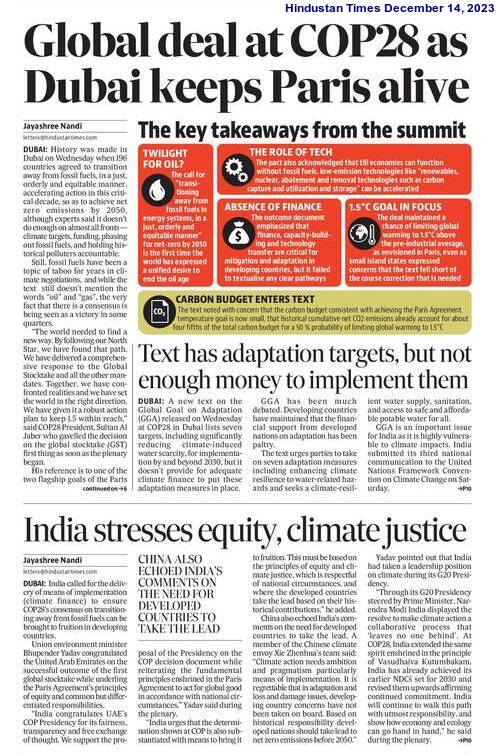
There are quite a few other problems, too. Other urgent measures agreed to by countries during the COP28 are tripling the capacity of renewable energy generation and doubling the rate of energy efficiency. These two steps are necessary to limit the rise of global temperature to 1.5 degrees Celsius above pre-industrial levels. However, these steps require adequate financial support for Developing Nations so that they could facilitate the infrastructural transformation. Unfortunately, the recent conference in Dubai failed to find a clear direction on this.
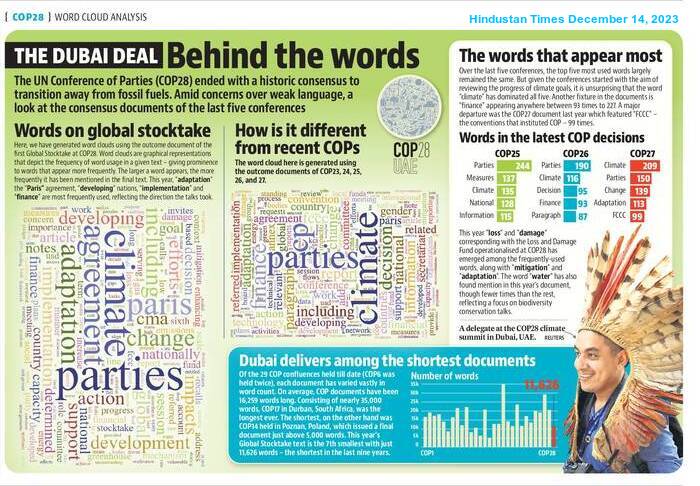
The Developed Nations have always been reluctant to provide Developing Nations with financial aid. They have failed to meet their pledge to create a Climate Finance pool of USD 100 billion by 2030. Both the Developed and Developing Nations experience adverse effects of Climate Change. However, the way to deal with Climate Change and to overcome it is not the same for them mainly because of economic reasons. Since the Developed Nations have historically borne a greater share of the burden of Climate Change than others, the issue of financial support for climate compensation and disaster mitigation infrastructure in Developing Nations is particularly important.

A consensus was reached on the creation of a compensation fund during the 2022 Climate Change Conference in Sharm el-Sheikh, Egypt. The participating countries approved the decision during the COP28 in 2023. However, this financial support is not mandatory. Therefore, it remains doubtful how sincerely the Global North will fulfil this promise in spite of its historic responsibility.
Boundless Ocean of Politics on Facebook
Boundless Ocean of Politics on Twitter
Boundless Ocean of Politics on Linkedin
Contact: kousdas@gmail.com

 ISMC
ISMC Boundless Ocean Of Politics