

Chechen Campaigns – A Learning Process!
Chechnya, a region in the North Caucasus, had a long history of resistance against Russian rule. After the dissolution of the Soviet Union in 1991, Chechnya declared Independence, leading to a period of political instability in the region.
The Chechen Wars refer to a series of conflicts that took place in the Russian region of Chechnya during the 1990s and early 2000s. The immediate cause of the war was Russia’s desire to maintain control over Chechnya and prevent its secession. Russia used to consider Chechnya as a part of its territorial integrity and wanted to prevent the spread of separatism to other regions. The First Chechen War, also referred to as the First Russo-Chechen War, was a struggle for Independence waged by the Chechen Republic of Ichkeria against the Russian Federation from December 1994 to August 1996.

The First Chechen War began in December 1994 when the Russian Forces, under the leadership of President Boris Yeltsin, launched a military campaign to regain control of Chechnya, which had declared Independence from Russia in 1991. The conflict was marked by brutal urban warfare, causing substantial civilian casualties and destruction. After a protracted conflict, a ceasefire was brokered in 1996, and Russia withdrew its forces. Chechnya achieved de facto Independence, although its status remained unresolved.
The First Chechen War left a lasting legacy of resentment and instability in Chechnya. It also set the stage for the Second Chechen War in 1999. The conflict is a stark reminder of the challenges associated with maintaining territory in a multi-ethnic and multi-religious country, especially that with an imperialist history. The First Chechen War was a devastating and unresolved conflict that had significant implications for the subsequent history of the North Caucasus and Russia’s approach to separatism and regional autonomy.
Interwar Period (1996-1999)
During this period of time, Chechnya descended into chaos, with warlords and criminal organisations exerting significant influence. The region became a hub for various illegal activities, including kidnapping and terrorism. Russia maintained a policy of limited engagement, but did not recognise Chechen Independence.
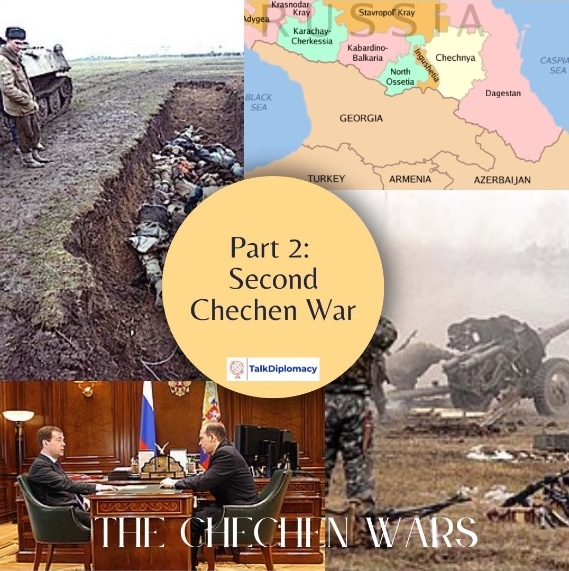
Second Chechen War (1999-2009)
The Second Chechen War took place in Chechnya and the border regions of the North Caucasus between the Russian Federation and the Chechen Republic of Ichkeria from August 1999 to April 2009. The War began in 1999 when Russia, under President Vladimir Putin, launched a new military campaign in response to incursions by Chechen insurgents into the neighbouring Russian region of Dagestan and bombings in Moscow. This conflict saw a more ruthless and brutal approach from the Russian Forces, including heavy aerial and artillery bombardments. Grozny, the Chechen capital, was devastated. By 2009, Russia declared victory and ended its large-scale military operations, although sporadic violence and insurgency continued.
The two Chechen Wars resulted in significant human suffering, displacement and casualties, with estimates of the death toll ranging from tens of thousands to over a hundred thousand. They also had broader implications for Russian Politics, Security Policy and Human Rights. While Chechnya remains part of the Russian Federation, it continues to be a politically sensitive and complex issue in Russian domestic and international affairs.

Both of the Chechen Wars underscore the complexity of ethnic and national identity in regions with diverse populations. The conflicts highlighted how unresolved ethnic and national grievances can lead to protracted and destructive wars. Both Chechen Wars demonstrated that military solutions alone are insufficient for resolving complex political and ethnic conflicts. Despite Russia’s military superiority, it struggled to achieve a decisive victory, highlighting the need for political dialogue and negotiation.
The wars resulted in significant human suffering, including civilian casualties and widespread Human Rights abuses. This emphasises the importance of protecting civilians during armed conflicts and the need for effective humanitarian responses. The Chechen Wars witnessed radicalisation within the region, leading to the emergence of extremist groups. This serves as a stark reminder of the potential for conflict zones to become breeding grounds for terrorism, with global security implications.

The international community’s response to the Chechen Wars was often muted due to Russia’s insistence that it was an internal matter. This raises questions about the international community’s responsibility to protect civilians in conflict zones and the balance between sovereignty and humanitarian concerns. Post-conflict reconstruction and reconciliation are critical components of ending conflicts. The wars left behind a legacy of deep-seated resentment, illustrating the long-term challenges of rebuilding societies and promoting reconciliation. The Chechen Wars highlighted the role of media and propaganda in shaping public perceptions of conflicts. Both sides engaged in extensive information warfare, emphasising the importance of media literacy and accurate reporting.
The Chechen Wars serve as a sobering reminder of the complexities of modern conflicts and the necessity of comprehensive, politically informed, and humanitarian-focused approaches to conflict resolution, peace-building and post-conflict reconstruction.
Source: Talk Diplomacy (Instagram)
Boundless Ocean of Politics on Facebook
Boundless Ocean of Politics on Twitter
Boundless Ocean of Politics on Linkedin
Contact: kousdas@gmail.com

 ISMC
ISMC Boundless Ocean Of Politics