

The Astonishing Facts
Greenland was ice-free approximately 400,000 years ago. At that period of time, the Tundra region was sunny, with lush green forest covering the area. Various species of animals and insects used to live in the Tundra region. Most importantly, the sea level was 20-40ft higher than the current level, and many countries, which are now home to millions of people, were then beneath the sea. Such a claim has been made in a report recently published in the scientific journal Science.
Scientists had an idea that the Greenland ice sheets were almost completely wiped out at some point of time. However, the exact time was not known. Researchers recently came to know about the exact period after examining soil layers (collected during the Cold War) hidden under Greenland’s nearly one-mile-thick ice sheets. It had occurred around 0.416 million (or 400,016) years ago. They have also discovered that Greenland was ice-free for about 14,000 years. The Earth and the primitive people went through Climate Change at that time. Researchers are of the opinion that one can understand how modern man creates a new kind of world for the future by analysing that period, its scope, intensity and impact.

The US scientists and engineers had collected soil layers by digging the Greenland ice sheets in July 1966. The operation was carried out in an infamous Army base, called Camp Century. After reaching the bottom of the ice, engineers dug another 12ft-deep into the frozen rocky ground to collect the soil samples. After analysing those samples in 1969, the US geophysicists explained how Climate Change had taken place in the past. They also gave a glimpse of how nature had been changed time and again over the last 125,000 years.
Currently, people across the globe experience heatwaves, wildfires and abnormal temperatures. Climate Change not only affects the weather conditions, but also affects the land surface, and the impact is considered to be permanent by the geologists. They have come to this conclusion by analysing the sediment layers of a lake in Canada.

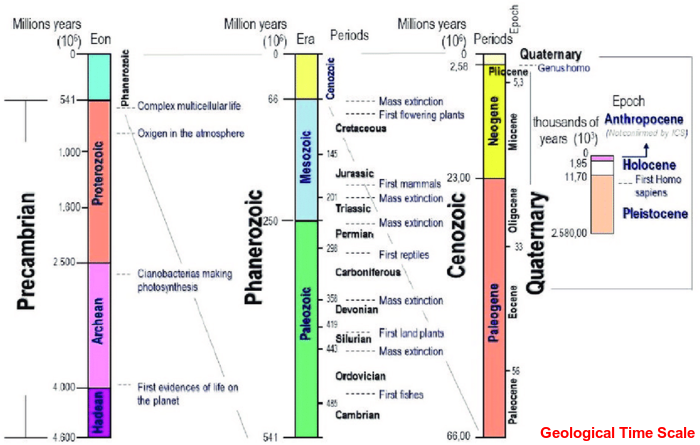
According to these geologists, humans are all set to create a new era in the history of Earth’s geological evolution with their actions, practices and habits. This era is called the Anthropocene. The Anthropocene Epoch is an unofficial unit of geologic time, used to describe the most recent period in Earth’s history when human activities started to have a significant impact on the planet’s climate and ecosystems. Fossil fuels have been destroyed and a number of species have gone extinct during this period due to Climate Change. Thus, humans have left a permanent negative mark on the soil of the Earth.
The Earth is estimated to be 4.54 billion years old, plus or minus about 50 million years. Meanwhile, human beings have been there on this planet only for the last 300,000 years, which is 0007% of the total history of the Earth. The current geological era is called the Holocene Era that began approximately 11,700 years before CE 2000. From the very beginning, the impact of this era on the land surface and seabed was huge. However, geologists believe that the impact of Climate Change on both land and sea during the Anthropocene Era is the worst.
Researchers have got an idea about this after monitoring Crawford Lake in Ontario, Canada for a long time. The water of this 80ft deep and 26,000sqft lake is quite clean. Geologists can easily guess the age of the Earth from the layers of sediment that have accumulated over the years beneath the water of this lake. Analysing those layers, they have found that human activities over the past seven decades have affected the Earth’s surface so much that a new era has begun.

In 2002, Paul Crutzen, the Nobel Laureate in Chemistry in 1995, called the recent geological period the Age of Man. In 2009, a group of scientists started studying the layers of sediment and also began to analyse the surface in different parts of the world. They noticed the adverse effects of human activities on the sediments of Crawford Lake, and discovered that emissions of various wastes (including nuclear waste) and greenhouse gases radically changed the Earth’s atmosphere, as well as land surface. As the geologists have found clear signs of this change in the surface since 1951, they have considered that year as the beginning of the Anthropocene era. However, the nomenclature of this era has not yet received any official recognition.
Geologists attended a conference in Berlin on July 11, 2023 to discuss the Anthropocene era. They agreed on one thing that the adverse impact of human activities on the climate and land made the situation worse. They further discussed ways to reduce the negative impacts of human activities on nature in the future.
Boundless Ocean of Politics on Facebook
Boundless Ocean of Politics on Twitter
Boundless Ocean of Politics on Linkedin
Contact: kousdas@gmail.com

 ISMC
ISMC Boundless Ocean Of Politics