

The Confrontation: Flower, Bayonets….
It is not just another image!
Jan Rose Kasmir (b. 1950) had tried hard to find the meaning of the image and rightly realised its strength later. In fact, she had written the story behind the image 50 years ago.
Kasmir is popularly known as the ‘Flower Child’ of Vietnam War. Humanist French photographer Marc Riboud made her famous by clicking the iconic photograph when Kasmir took part, along with more than 100,000 anti-war activists in the National Mobilisation Committee, to ‘End the War in Vietnam’s March’ on the Pentagon to protest against the US’ involvement in Vietnam on October 21, 1967. The photo – in which 17-year-old Kasmir was shown clasping a chrysanthemum and gazing at bayonet-wielding soldiers – was featured in the December 30, 1969 special edition of ‘Look’ magazine under the title ‘The Ultimate Confrontation: The Flower and the Bayonet’. Riboud (June 24, 1923 – August 30, 2016) once said: “I had the feeling the soldiers were more afraid of her than she was of the bayonets.”
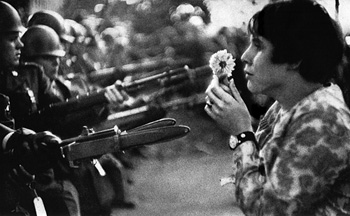
The iconic image of Kasmir
The 68-year-old Kasmir recently penned a book, ‘Flower Child: The Story Behind the Photo’, to spread her message of peace. A massage therapist by profession and a resident of South Carolina, the Flower Child visited Washington in January 2017 to participate in an anti-Trump impeachment rally. Speaking at the protest rally, she said that racism and hatred in the modern American society hurt her, adding that she was shocked of how the country was tolerating a leader, like President Trump, “who has no dignity, who has no integrity”. “I see things happening that absolutely amaze and disgust me. I think right now we’re in some kind of, I don’t know, psychotic episode of American history. It’s just so outrageous,” stressed Kasmir.

Marc Riboud
Many believe Riboud’s iconic photograph had changed the direction of the Vietnam War. And his Flower Child is still ready to change the course of the American history. Surprisingly, Kasmir had no idea about her photograph made famous worldwide for a long time. “It wasn’t until the 1980s that I discovered the photograph. My father had gone to Scotland and he bought a photography magazine, and he opened it to find his daughter in it. I wrote to Marc Riboud, the photographer, via Magnum, saying, ‘I’m the girl in the photo. I am not sure you care, but here is my address.’ I didn’t hear back, and it wasn’t until I was in my 40s that people started getting interested in who I was, and news agencies started to contact me,” she said. (The Guardian, Nov 7, 2014) Later, she realised the strength of protest.
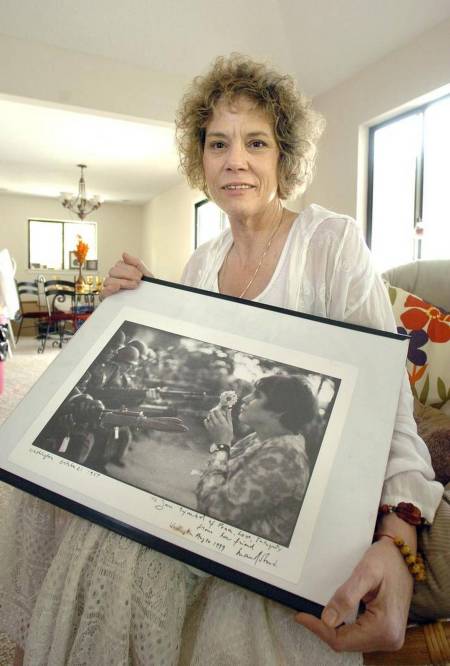
Kasmir with the photograph
In the past, she used to write poems. “I didn’t have the patience to write,” said Kasmir, the author of ‘Flower Child: The Story Behind the Photo’, which contains 7,000-8,000 words! She wants to spread love through her publication.
“It seems that Army personnel were like me…..They were just as much a victim of the war machine as anyone else. When I saw the picture exhibited for the first time, many years later, I teared up; it took me back to that overwhelming sadness,” stressed Kasmir. (The Guardian, Nov 7, 2014)
We can easily find similarity between Kasmir’s book and ‘A Mortal Flower’, an autobiography by Han Suyin. In her novel (published in 1966), Han describes her journey from China to England via Belgium after the Japanese invasion of China (1928-38). Through her works, the Chinese writer (naturalised British) tries to express concerns of a post-colonial Asian generation.
Boundless Ocean of Politics on Facebook
Boundless Ocean of Politics on Google Plus
Boundless Ocean of Politics on Twitter
Contact us: kousdas@gmail.com

 ISMC
ISMC Boundless Ocean Of Politics
Thanks for finally writing about >The Confrontation: Flower,
Bayonets…. – Boundless Ocean Of Politics <Loved it! http://www.neanarchist.net/event/how-draw-state-matter-essay
LikeLike