

Strange Evolution Of People In South America
The World Health Organisation (WHO) has mentioned in its guidelines that the presence of more than 10 micrograms of inorganic arsenic per litre (μg/L or parts per billion) of drinking water poses a serious health risk. Surprisingly, a population living in the high-altitude town of San Antonio de los Cobres in the Argentinian Andes has been consuming water containing roughly 200 micrograms of arsenic per litre, about 20 times the WHO’s safe limit, for nearly 7,000 years. Yet, there are no negative impacts of arsenic exposure on them!
Researchers are of the opinion that indigenous populations in the Andean highlands (in Argentina, Chile and Bolivia) have evolved a genetic adaptation that allows them to process and excrete high levels of arsenic safely. Their study has been published in the Molecular Biology and Evolution journal.

San Antonio de los Cobres is a high-altitude mining town in northwestern Argentina, serving as the capital of the Los Andes Department in Salta Province. There is the largest concentration of volcanoes in that region and Nevado Ojos del Salado – the world’s highest active volcano, reaching an elevation of 6,893 metres (22,615 feet) – is one of them. Volcanic formations in the Andes have caused severe, long-term groundwater contamination across parts of Argentina, Bolivia, Chile and Peru over a long period. In other words, volcano-sedimentary deposits and volcanic tuff in this region release high levels of arsenic into local aquifers. In 2012, a water filtration system was installed in San Antonio de los Cobres to remove dangerously high levels of naturally occurring arsenic from the local drinking water. Previously, the locals used to drink water with 200 micrograms per litre of arsenic.
The Atacameño people, who refer to themselves in their native language as Lickanantay (or Lickan Antay, meaning inhabitants of the territory), have been living in the Andean highlands for over 11,000 years. Archaeological analysis of a 7,000-year-old mummy recovered from that region revealed high levels of arsenic in its hair. Usually, the risks of miscarriage, infant mortality, a newborn’s inability to fight off disease, and lung and heart conditions increase with rising arsenic levels in the body. However, nothing such happened with this population. According to researchers, these people have evolved a genetic adaptation that allows them to process and excrete high levels of environmental arsenic with dramatically lower toxicity.

A study titled Human Adaptation to Arsenic-Rich Environments has revealed that a change has occurred in the bodies of these people through natural processes because of long-term exposure to high levels of arsenic. When arsenic enters the human body, the liver converts it into compounds suitable for excretion through the enzyme arsenic methyltransferase (AS3MT), a process that uses S-adenosylmethionine (SAM) as a methyl donor. This process essentially has two stages. Initially, it is converted into Monomethylarsonic acid (MMAV) which is a highly harmful and toxic compound. The MMAV is not excreted directly through urine. As a result, another compound – Dimethylarsinic acid (DMAA) – is formed from MMAV. DMAA is relatively less harmful and is quickly eliminated from the body through urine.
A specific gene located on Chromosome 10 of human DNA, which holds roughly 700 to 800 protein-coding genes, plays a major role in carrying out this process. That gene produces the AS3MT gene, which provides instructions for making the enzyme arsenite methyltransferase. With the help of this enzyme, arsenic is converted into MMAV and DMAA compounds. The questions arose among the researchers were: Whether this specific gene has undergone some change or adaptation in the bodies of these people? Whether this adaptation has enhanced their bodies’ ability to eliminate arsenic?

Researchers initially selected 385 local women for this study. From them, 124 women were selected who had no blood relations and never got pregnant. They also had no underlying medical condition that interfered with the elimination of arsenic; and the level of arsenic in their urine did not exceed a certain amount. Later, their urine samples were collected and analysed. It was observed that the levels of the toxic compound MMAV in the urine of those women significantly lower than those in the general population. While the levels of the MMAV are 10-20% (and in some cases, even 30%) for the general population, it is only 7.5% for the Atacameño people. Furthermore, the level of the less harmful DMAA in the urine of the general population ranges from 60-70%; while the figure rises to approximately 80% in the urine of the Atacameño people. Hence, researchers came to the conclusion that the lower percentage of MMAV in the urine of the Atacameño people reflects an evolutionary adaptation that allows them to detoxify and clear inorganic arsenic from their bodies much faster than the general population.
Researchers also collected DNA samples from those selected women mainly to analyse the gene responsible for producing S3MT. Then, those were compared with the chromosomes of people from various regions of the world, including neighbouring Colombia and Peru. Researchers claimed that a cluster of genes had formed around the Chromosome 10, a configuration that is rare in the DNA of other populations, as a result of adaptation. While there are some similarities in the DNA of people from Peru or Colombia, they are far less pronounced than those found among the inhabitants of the Andes.
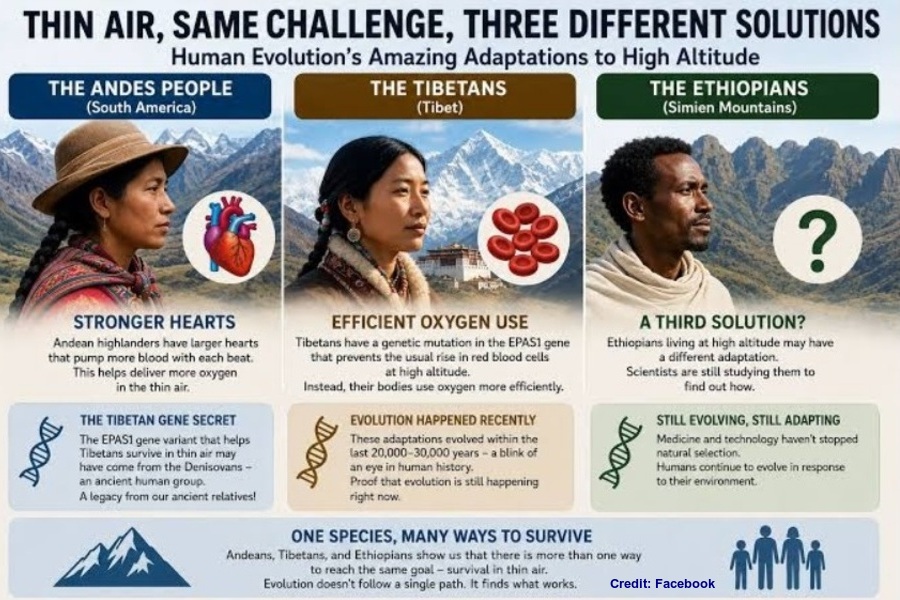
Carina Schlebusch, a prominent Evolutionary Biologist and Professor of Human Evolution at Uppsala University, believes that the adaptation of this gene set is an important discovery. She stated: “Adaptation drives genomic changes; however, evidence of specific adaptations in humans remains limited. Our data show that adaptation to tolerate the environmental stressor arsenic has likely driven an increase in the frequencies of protective variants of AS3MT, providing the first evidence of human adaptation to a toxic chemical.“
Meanwhile,











Boundless Ocean of Politics on Facebook
Boundless Ocean of Politics on Twitter
Boundless Ocean of Politics on Linkedin
Contact us: kousdas@gmail.com

 ISMC

