

From A Spark To A Wildfire
For the digital generation, the boundary between day and night has blurred. Chatting with friends online all night, going to bed in the morning, shopping online and a reliance on on-demand delivery apps for food and other items are the main characteristics of their lifestyle. Hence, Gen Z experiences frequent mood swings and high rates of emotional distress compared to previous generations at the same age, driven by unique cultural, digital and economic pressures. This selfie generation is thoroughly self-absorbed and detached from reality.
This particular image of today’s young adults has been peddled extensively in advertising for quite some time. This is just the opposite of what has typically been seen. Perhaps, Gen Z is the only generation which has rightly realised that the world is a cruel and heartless place to live. This is the generation that has heard that Planet Earth is being devastated by environmental pollution and climate disasters. They grew up witnessing an economic downturn and also experienced a pandemic. From environmental protection to industrial development – there is no simple promise of a way forward. This generation’s path is quite uncertain, thorny and extremely difficult to traverse.
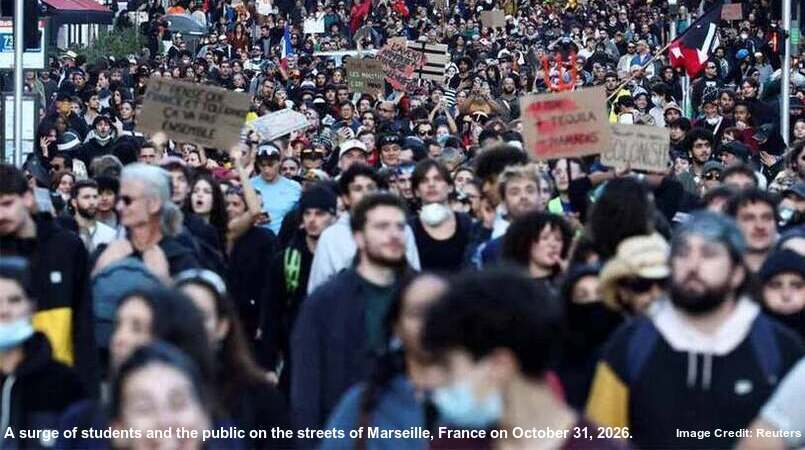
Yet, even unimaginable things happen sometimes. This autumn, France has witnessed such a students’ movement. The spontaneous protests by school students against the progressive decline of the public education system has gradually evolved into an expression of discontent from other segments of society. Workers, employees, retirees and people who had taken part in the Yellow Vests Movement have joined the students’ protests. The most notable feature of this movement is the solidarity among seemingly disparate social groups.
France has just begun to experience its first notable cold dips and morning frosts of the autumn season. Schools and colleges have reopened after a long break. Upon returning to classes, students found that the situation had deteriorated even further compared to the previous year. The plaster is crumbling, the windows are broken, the classrooms are so crowded that there is nowhere to sit and, most importantly, the number of teachers is not sufficient. Students had anxiety about their future. Now, the current situation in educational institutions has made them extremely frustrated.
Small sparks of protest were smoldering in the end of August as the movement began when parents and teachers in Mayotte blocked access to the Lycée du Nord d’Acoua to protest against abysmal school conditions. Unfortunately, major metropolitan media initially ignored this localised issue. However, those small sparks quickly ignited what became a massive, nationwide wave of civil unrest in September 2026. By mid-September, the isolated frustrations reached mainland France, beginning with student walkouts in the Paris suburbs. Lycée (high school) and university students staged protests against teacher shortages, overcrowded classrooms, crumbling infrastructure and unbearable heat in schools. What started as a student-led educational protest rapidly fused with broader economic grievances, such as the Cost-of-Living Crisis, Union & Yellow Vest Convergence and Widespread Disruption.
The government initially ignored the students’ protests and tried to repress protesters by using the Police force. It also made an attempt to label the movement a conspiracy. Various restrictions were imposed on civil liberties through measures, such as bans on processions, curfews, drone surveillance, searches, the use of algorithms and facial recognition. The government also decided to build detention centres and cut off social welfare benefits of those accused of vandalism.
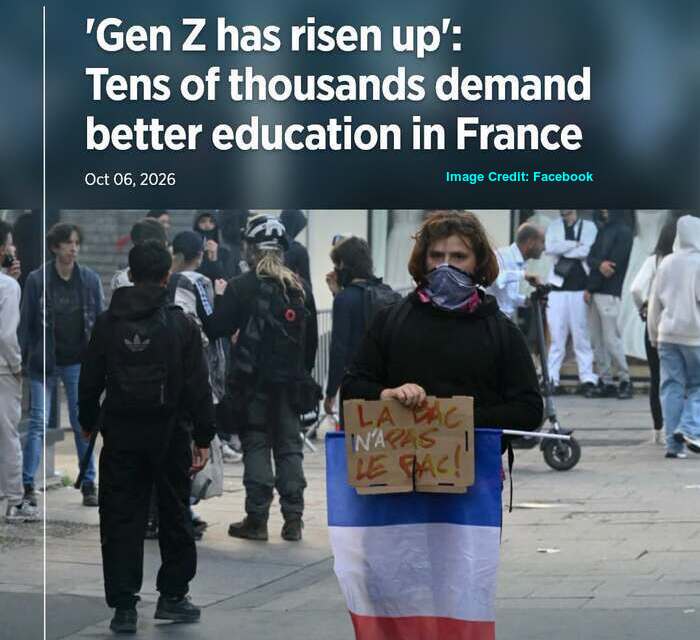
National protests took place in France on October 17, 24 and 31; as common people paid no heed to tear gas, baton charges by the Police and restrictions imposed by the concerned authorities. The ruler rightly realised that it would not be easy to consider this discontent merely as a law-and-order issue, as the objective of protesters was no longer limited to reforming the education system. Instead, the very legitimacy of the entire social order was being called into question.
In a society where people have been divided based on geographical identity, social standing and cultural differences for so long, a new possibility is suddenly emerging and that possibility can transcend those conventional lines of division. The protesters have raised some important questions: How does the very structure of a society that loudly proclaims lofty ideals, like equality, equal rights and democratic participation, actually perpetuate discrimination and stifle the collective aspirations of its people? How does it serve to shrink the space for protests?
To some, the unity among students from suburban and rural areas has seemed remarkable. For the past 15 years, the persistent rhetoric surrounding a regional divide has ingrained in people’s minds the notion that there lies a metropolitan France at one extreme and a peripheral France at the other. There are urban youth on one side and rural youth on the other. In spite of facing criticism from some researchers, this explanation has been widely disseminated in the mainstream media.
The French media have often highlighted that there are two distinct groups among the youth of the poor and working classes. Their problems, values and future prospects are entirely different. Suburban youth are undoubtedly victims of racism, discrimination and urban-based alienation. However, they live near dynamic urban centres; consequently, the door to the outside world remains, to some extent, open to them. They can gain access to professional and educational networks with relative ease, paving the way for social advancement. On the other hand, young white people in rural areas are generally considered to be more conservative and traditional. They are confined within their own geographical boundaries and are neglected by the government.
Far-right ideology turns this division into a political tool. It starkly highlights how urban-based, non-white immigrant families are favoured by the state, thus, provoking the marginalised (?) white populations. Under these circumstances, one might well conclude that oil and water do not mix. Yet, the picture completely changes when one sets aside geographical boundaries and focuses instead on socio-economic conditions. It also dissolves the apparent contradiction between the two sides. Whether in rural areas or the suburbs, young people are victims of deindustrialisation. A lack of permanent employment, insufficient investment in public services and the burden of social stigma are affecting both sides. While some are branded as rustic bumpkins, others are labelled anti-social elements. There are also some similarities in their social interaction patterns, as well. In both cases, the scope is limited and confined to one’s own group.
The question arises here: Why is the students’ movement taking the form of a broader mass movement? Poverty, food insecurity, inflation, staff shortages in hospitals, schools and the judicial system, the housing crisis and the deterioration of public transport – all point to long-standing weaknesses in public services. Hence, the crisis in the education system cannot be treated as an isolated issue. Instead, it becomes a manifestation of the decay of the broader public service system. Meanwhile, the trend of increasing military spending, investing in security systems and granting tax breaks to the wealthy continues. As a result, the burden of government debt is growing on one hand, while there is a massive increase in the accumulation of private wealth on the other. Whenever the issue of government debt arises, there is a clamour for cutting public expenditure. Yet, the issue of wealth redistribution is carefully kept out of the discussion.
The 2026 French students’ protests have effectively served as a detonator for a far broader mass movement, drawing deep comparisons to the historic social uprisings of May 1968. In fact, the wave of 2026 French students’ movement has ignited a broader European youth movement, with its impact rapidly spilling over France’s borders into at least 31 other European nations. A groundbreaking movement often transcends the confines of a specific period to become a symbol of the hopes and aspirations of an entire generation. During the 1960s and 1970s, the world witnessed an unprecedented wave of global youth unrest and generational rebellion. However, that was a different time. We have transitioned from the rigid verticality of top-down hierarchies into a horizontal, interconnected network society in the 21st Century. We have also transitioned from an industry-based society to an information-based society (or Information Age or Knowledge Economy), where the primary driver of economic growth, cultural shifts and societal structure has shifted from physical goods and manual labour to intellectual capital (knowledge) and digital connectivity. Therefore, the production, processing, distribution and application of knowledge have become extremely essential.
The manner of the struggle may have changed, but the struggle, itself, continues.
Meanwhile,







Boundless Ocean of Politics on Facebook
Boundless Ocean of Politics on Twitter
Boundless Ocean of Politics on Linkedin
Contact us: kousdas@gmail.com

 ISMC

