

An Indian Visited Pharaonic Tombs 2,000 Yrs Ago
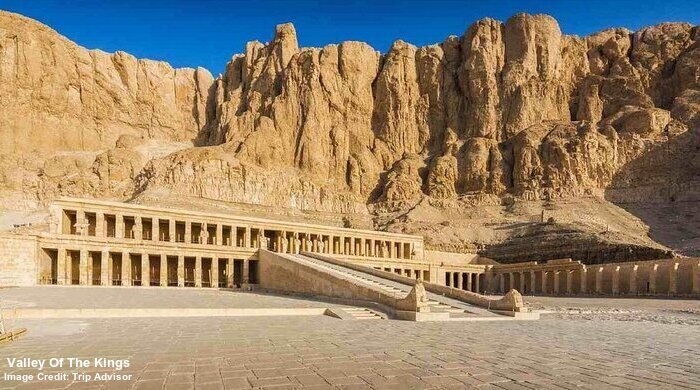
Mysteries spanning millennia lie buried beneath layers of Egyptian desert and sun. It was in this part of the ancient Egyptian city of Thebes where the tombs of pharaohs were discovered. Later, this site was named the Valley of the Kings – a hidden, cliff-bound gorge on the Nile’s west bank in Upper Egypt. Built over a span of 3,000 years, the monumental tombs of Ancient Egypt are filled with countless tales, legends, ritual texts, magical art and treasures to guide the pharaohs toward immortality. Traces of an Indian, who visited the Valley of the Kings 2,000 years ago, have recently been found in five tombs there.
Archaeologists have identified nearly 30 ancient inscriptions, including 20 written in Tamil-Brahmi, Sanskrit, Prakrit and Gandhari-Kharoshthi scripts, within the Valley of the Kings. Dated between the 1st and 3rd Centuries CE, these graffiti marks, including “I came and I saw“, provide concrete evidence of Indian merchants travelling deep inland for trade. Archaeologists also found evidence that the Indian visitor left a mark of his presence in five royal tombs nearly 2,000 years ago.
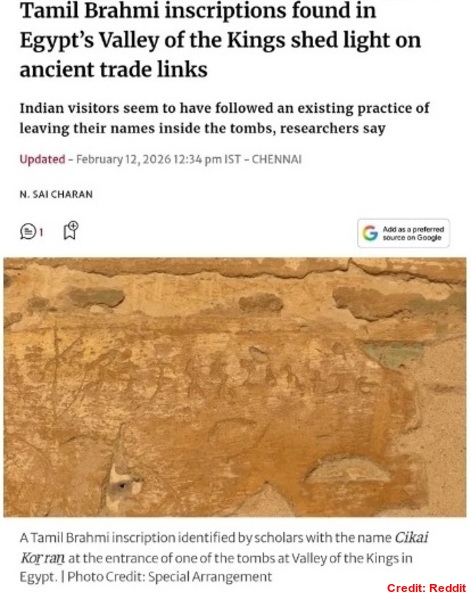
According to archaeologists, Cikai Korṟan, a Tamil trader from the southern Indian Province of Kerala, sailed to Egypt 2,000 years ago and carved his name inside the tombs of pharaohs. In fact, he left his name in ancient Tamil script in the Valley of the Kings eight times, and no one could read it until 2025. Archaeologists are of the opinion that Korṟan’s signature is real. Professor Ingo Strauch of the University of Lausanne and Epigraphist Charlotte Schmid of the French School of the Far East discovered the phrase “Cikai Korṟan came here and saw” in inscriptions (in Old Tamil) on the walls of five pharaonic tombs.
Researchers are certain that Korṟan was one of the dozens of Indian visitors who came to tour the most sacred burial sites of Egypt between the 1st and 3rd Centuries CE. According to experts, the word Cikai derived from the Sanskrit word Śikhā (or Sikha), referring to a crown, tuft or traditional hairstyle; while Koṟraṉ is a quintessential Tamil name rooted in words, like Koṟṟam (victory/slaying), Koṟṟavan (King) and Koṟṟavai (the goddess of victory).
Inscriptions carved on the tomb walls of ancient Egypt indicate that there were commercial, as well as cultural, ties between India and Egypt at that period of time. Ancient Egyptian royal tombs became major tourist attractions during the Ptolemaic and Roman periods. Thousands of sightseers, including Greeks, Romans and even Indian merchants, visited the sites and left their mark by scratching their names, professions and travel reviews directly onto the stone walls. Hence, over 100 Greek and Latin tags litter the tombs, left by ancient sightseers from the Roman Empire who marvelled at the pharaohs’ resting places.
At an international conference on Tamil Epigraphy in Chennai (India) held on February 11, 2026, Professor Strauch and Epigraphist Schmid presented findings of 2,000-year-old Tamil-Brahmi and Prakrit inscriptions discovered on the walls of rock-cut tombs at the Valley of the Kings. Professor Strauch claimed that he had noticed some graffiti, which were completely different from the graffiti found previously, while inspecting the tombs in 2024. As the graffiti he discovered resembled Indian scripts, Professor Strauch shared the images of them with his colleague Schmid. Schmid confirmed that those were indeed written in Tamil.
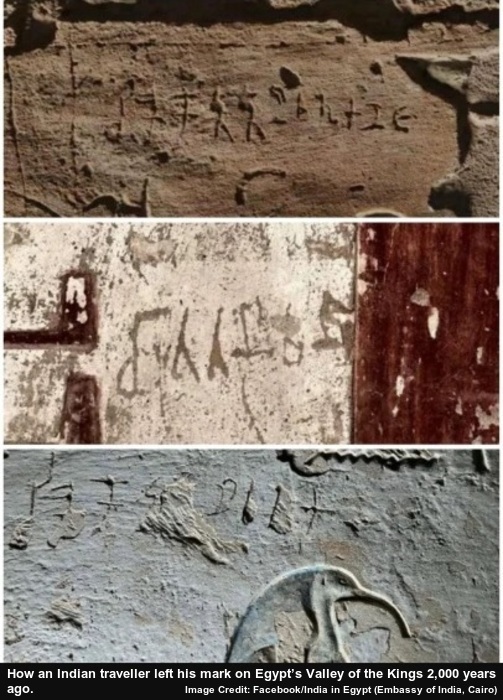
Meanwhile, Schmid claimed that they had come across a peculiar method of leaving behind marks by Korṟan. Some of the Indian’s prolific graffiti are placed remarkably high-up to 16-20 feet above tomb entrances. How he managed to place it there remains a mystery! “No one’s quite sure how he got up there. It is weird, to be frank,” stressed Schmid. Korṟan also made his mark on the entrance of the tombs of Pharaohs Tausert and Setnakhte. Interestingly, his was the only graffiti found there, suggesting the tombs might still have been sealed when he visited.
Schmid told the audience that Korṟan was evidently quite excited about this trip and decided to leave his name at almost every tomb in the Valley of the Kings. His act further suggests that the Indian visitor was not just a passerby, but culturally involved enough to follow the local custom of marking a visit. “This level of multilingual awareness would indicate travellers, who were deeply enmeshed in the cosmopolitan world of Roman Egypt, were not just passing merchants or tavellers having a quick look around,” said Schmid.
Meanwhile,












Boundless Ocean of Politics on Facebook
Boundless Ocean of Politics on Twitter
Boundless Ocean of Politics on Linkedin
Contact us: kousdas@gmail.com

 ISMC
ISMC
