

Allied Powers
Amidst tumultuous situations in the 21st Century world, India and France have chosen the path of cooperation. France has long been one of India’s most reliable partners and their relationship has gained a new momentum in recent times. Currently, the bilateral cooperation spans diverse areas, including defence, artificial intelligence (AI), critical minerals, renewable energy and health. The significant expansion of cooperation has elevated the strategic bilateral partnership to a Special Global Strategic Partnership.
During French President Emmanuel Jean-Michel Frédéric Macron‘s recent visit to India, the two countries signed a total of 21 agreements, including one on a joint venture between Bharat Electronics Limited (BEL) and Safran Electronics & Defence (SED) to manufacture HAMMER missiles in the South Asian country. On February 17, 2026, Indian Prime Minister Narendra Modi and President Macron virtually inaugurated the Tata Advanced Systems Limited (TASL) and Airbus H-125 helicopter final assembly line (FAL) in southern Indian city of Vemagal, marking India’s first private-sector helicopter FAL, capable of producing the high-altitude H-125 for domestic and regional markets, with the first Made in India unit expected in early 2027. India wants to export this helicopter in the future.
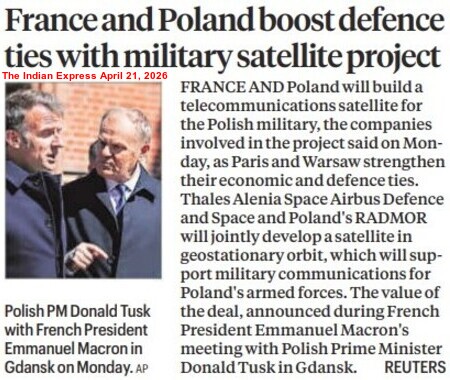
Meanwhile, the deeper foundation for a greater cooperation and technology transfer depends on the details of a potential USD 40 billion proposal to acquire 114 Rafale fighter jets from France that was approved by the Defence Acquisition Council (DAC) just before the visit of the French President. The move signalled a major boost to India-France strategic ties and the Make in India initiative of Prime Minister Modi. The deal, which aims to strengthen the Indian Air Force and reduce dependence on imports, involves manufacturing a significant portion, reportedly 90 jets, in India.
It may be noted that India purchased 36 Rafale jets from France in 2016 and another 26 jets for the Navy in 2025. Under the new deal, India would receive 18 of the 114 Rafale fighter jets in ready-made condition and the rest would be manufactured in the South Asian nation, using Indian, as well as foreign, technology. The private organisations of India, too, would play an important role in the production. According to defence analysts, the cooperation with France could reduce India’s dependence on Russia as a major military supplier, apart from diversifying defence imports.
Technology and innovation have established themselves as the primary engines of economic growth and social advancement. The 2026 India-France Year of Innovation, inaugurated by Prime Minister Modi and President Macron in February 2026, focuses mainly on AI, critical minerals and advanced materials. It has recognised strategic competition not only as a technological issue, but also a regional one. Needless to say, such cooperation is a wonderful piece of news for both countries in the context of technological rivalry between China and the US.
The visit to India by German Chancellor Joachim-Friedrich Martin Josef Merz and the top leadership of the European Union (EU) in January 2026, and the signing of the long-discussed India-EU Free Trade Agreement (FTA) reflect the growing importance of Europe in India’s strategic thinking, which has shifted from a primarily trade-focused relationship to a multifaceted, high-level strategic partnership. This evolution is driven by shared concerns over geopolitical shifts, a desire to diversify economic and defence dependencies away from China and Russia, and a mutual commitment to a rules-based global order.
The cooperation with Europe could prove invaluable to New Delhi at a time when India is engaged in negotiations with the US over the finer points of a bilateral trade deal.
Meanwhile,
Boundless Ocean of Politics on Facebook
Boundless Ocean of Politics on Twitter
Boundless Ocean of Politics on Linkedin
Contact us: kousdas@gmail.com

 ISMC
ISMC
