

The Importance Of Democratically Elected Leaders
Begum Khaleda Zia (August 15, 1946 – December 30, 2025), the former Prime Minister of Bangladesh, has left behind a definition of leadership. The moment of her demise created an image of unity in a turbulent and restless Bangladesh. Although the image is partly symbolic and fleeting, it is quite valuable in the current context.
Both Muhammad Yunus, the Head of the Interim Government, and Sheikh Hasina Wazed, the ousted former Prime Minister, expressed heartfelt condolences immediately after receiving the news of her passing away, while people poured onto the streets to pay their last respects to the former leader. People, irrespective of their political affiliation, made complimentary remarks about Khaleda Zia’s leadership qualities. The deceased leader deserves the credit for creating such a scene (even in the context of a death) at a time when the Indian Subcontinent almost forgets the importance of courtesy, as well as respect, in the political arena, with the entire society plunging into intense hatred and anarchy.
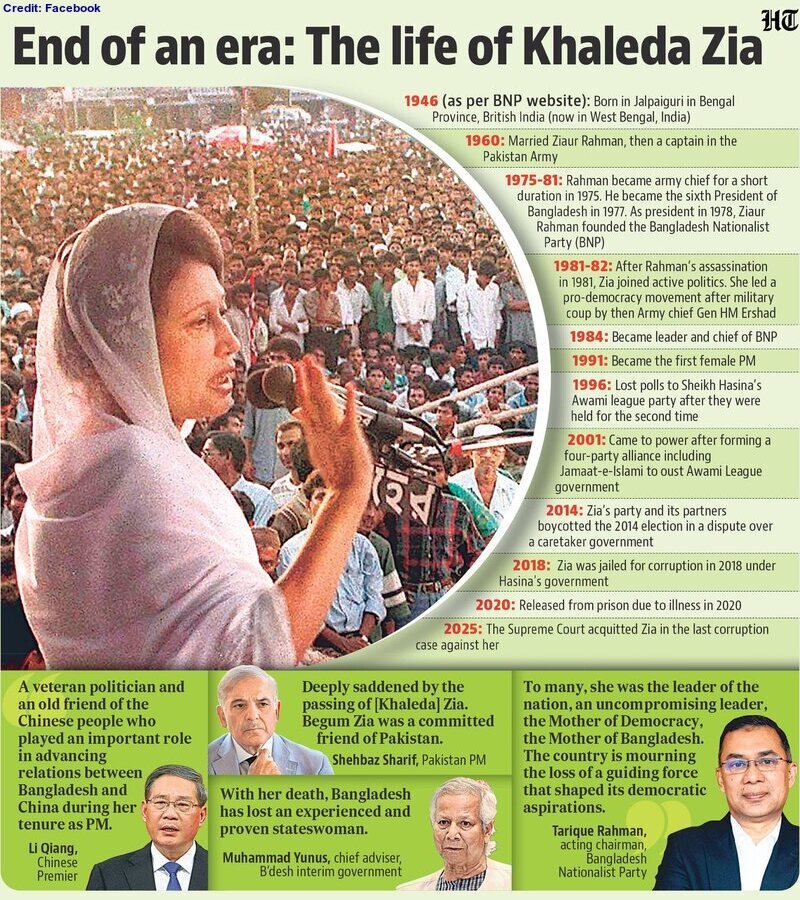
The wife of former President of Bangladesh and Army Commander Ziaur Rahman (January 19, 1936 – May 30, 1981), Khaleda Zia herself was an accomplished politician and a democratically-elected Head of State. Narendra Modi, the Prime Minister of India, paid rich tribute to Begum Khaleda in a personal letter addressed to her son and Chairperson of the Bangladesh Nationalist Party (BNP) Tarique Rahman, describing her as a leader of “rare resolve and conviction” whose legacy would continue to shape ties between India and Bangladesh. Dr Subrahmanyam Jaishankar, the Indian Minister of External Affairs, represented New Delhi at the funeral of Bangladesh’s three-time Prime Minister in Dhaka on December 31, 2025. This seemingly ordinary event is also particularly precious at this moment, keeping in mind that anti-India sentiments, amplified by Islamist forces, have further inflamed tensions in Bangladesh in recent times.
Of course, Khaleda Zia’s periods in power (1991-96, a brief period in 1996 and 2001-06) were marked by significant debates and controversies. Those issues, alongside her intense political rivalry with Sheikh Hasina, defined Bangladeshi politics for decades. Questions can and should be raised regarding the extent to which she expanded democracy and social unity, or whether she did so at all. However, her recognition as a leader beyond controversy was firmly established after her demise.
The current administration of Bangladesh should learn a lesson from this. The Interim Government, led by Muhammad Yunus, should realise that the responsibility of saving a country from sinking further into a vortex of unrest ultimately rests with the government. It is also the duty of a government to employ various methods in order to manage and control large frenzied crowds, ranging from preventative measures and de-escalation techniques to more direct intervention. True leadership qualities are often most clearly revealed during times of significant challenges. Unfortunately, Muhammad Yunus, the Chief Adviser of the Interim Government, is constantly trying to evade that responsibility.
Read: Battle of the Begums
Above all, Khaleda Zia also emphasised the importance of leaders being created through democratic elections. Regardless of the accumulated grievances against the previous Awami League Government, everyone is well aware of the fact that Bangladesh cannot ensure justice, unity and stability through endless killings, destruction and arson, or by spreading anti-India rhetoric and hatred towards minorities. Hence, the responsibility of ensuring that it happens smoothly, in accordance with the scheduled Parliamentary Elections in February 2026, lies with the Interim Government. It is also the government’s responsibility to remove any unwanted obstacles that may arise along that path by virtue of its power and authority.
It must be acknowledged that Muhammad Yunus is in a quite difficult situation as he is facing multiple crises. However, it was widely understood even in August 2024 that the situation in Bangladesh was becoming extremely difficult, marked by unprecedented political turmoil, an escalating economic crisis and widespread violence. The culmination of the student-led mass uprising led to the resignation and flight of Prime Minister Sheikh Hasina on August 5, 2024, creating a constitutional and security vacuum that exposed severe underlying vulnerabilities. At that time, Yunus had accepted the top administrative position with great enthusiasm and also made a number of promises. Subsequent events have shown that he and his government are not only unable to fulfil those promises, but probably unwilling to do so. Political change not only requires bloodshed and destructive programmes, but also positive thinking, strategic planning, and the envisioning of peace and stability.
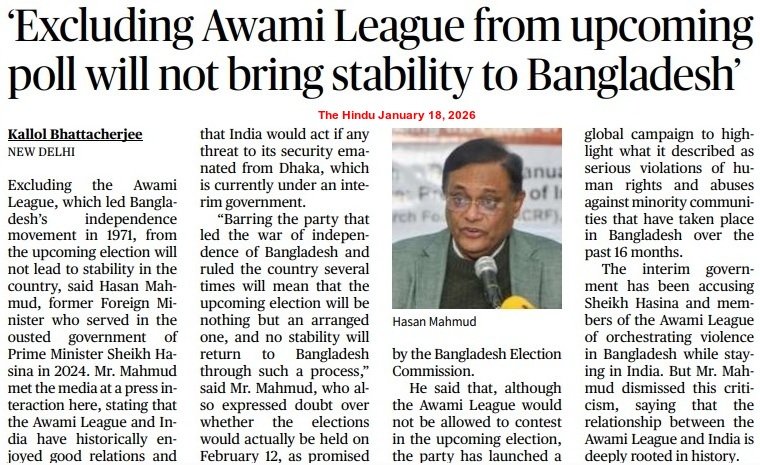
Tarique Rahman recently returned to Bangladesh after 17 years in exile in London and the moment marked by a significant outpouring of support from a large section of the population. Political analysts have linked this event to a strong public desire for socio-political stability. India and other South Asian nations have consistently stated that they are in favour of peace and stability returning to Bangladesh, viewing it as essential for their respective national security and regional development. The current political turmoil in Bangladesh, which intensified after the fall of the Sheikh Hasina Government in August 2024, is considered a significant challenge to regional stability.
You may also like: The Spectre Of East Pakistan Haunts India
Meanwhile,





Boundless Ocean of Politics on Facebook
Boundless Ocean of Politics on Twitter
Boundless Ocean of Politics on Linkedin
Contact us: kousdas@gmail.com

 ISMC
ISMC Boundless Ocean Of Politics
1 Comment »