

When Earth’s Magnetic Shield Collapsed 41,000 Years Ago
Our ancestors were afraid of an event that reportedly changed the destiny of humankind, 41,000 years ago.
Human evolution is not linear; rather, it is like a web, the complexities of which are still being unravelled. There are varying opinions among experts regarding who the closest ancestors of modern humans were – chimpanzees, gorillas or someone else. Debates also take place regarding the lifestyle, customs and evolution of humans. A group of researchers believes that an event from 41,000 years ago should be there in the history of evolution.

Although events, like a solar storm, often take place in outer space; humans and animals do not feel their effects because of the Earth’s magnetic field. However, the electromagnetic field of the Earth faced a catastrophic disruption approximately 41,000 years ago. This event is popularly known as Laschamp Excursion that completely transformed the lifestyle of our ancestors. The Science Advances journal published a research paper on Laschamp Excursion in September 2025.
Just as auroras (Aurora Borealis or Aurora Australis) are seen in the polar regions when a solar storm sends charged particles toward the Earth, similarly, the Earth’s sky displayed a range of colours, including red and green, during the Laschamp Excursion. It may be noted that the Laschamp Excursion was a major, short-lived shift in magnetic field of the Earth around 41,000 years ago, when the poles briefly flipped and the field dramatically weakened, allowing increased cosmic radiation, leading to atmospheric changes, potential megafauna extinctions and Neanderthal decline, all recorded in lava flows and ancient trees near Laschamp, France where it was first found. During this event, the magnetic field weakened and shifted dramatically, causing auroras to appear globally. Researchers speculate that our ancestors were astonished, as well as frightened, by the aurora. Ancient people were so frightened that they perhaps started performing various rituals. However, it is difficult to find archaeological evidence of their activities at that period of time.
Although geographic poles of the Earth are fixed points defining its rotation axis, the magnetic poles wander due to fluid iron movements in the outer core, causing them to drift erratically and even reverse polarity over geologic time, a process driven by the dynamo effect. For example, the North Magnetic Pole is currently moving rapidly from the Canadian Arctic towards Siberia. The Magnetic North Pole has been continuously shifting its position for the past few centuries because of the complex, as well as turbulent, motion of molten iron and nickel in the Earth’s outer core, which generates the magnetic field of Planet Earth.
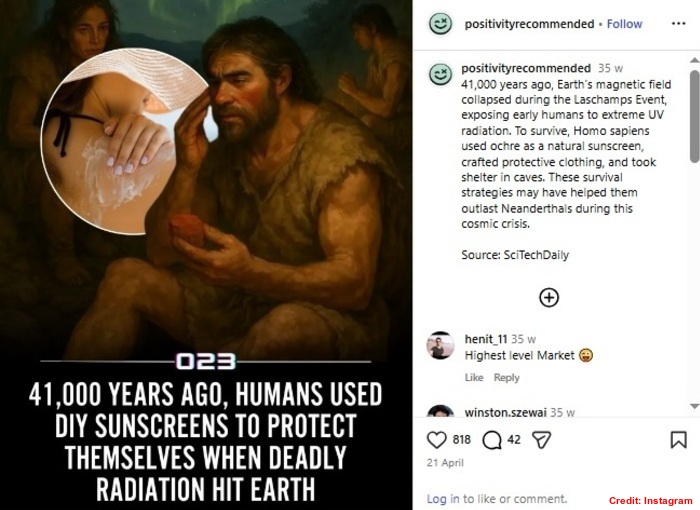
Scientists are of the opinion that the cosmic catastrophe of the Pleistocene epoch caused the Earth’s magnetic poles to shift randomly by several thousand miles. Moreover, the strength of the magnetic field had plummeted to under 10% of current levels during the Laschamp Excursion, causing poles to wander, auroras to appear at lower latitudes and leaving the surface exposed to increased cosmic radiation. The increased cosmic radiation prompted early humans to adapt with cave dwelling, tailored clothing and ochre as sunscreen, significantly influencing their survival and innovation. According to scientists, our ancestors applied a special type of mineral powder to their faces and bodies in an attempt to protect themselves from cosmic radiation. Archaeological studies across Europe reveal evidence for all these.
Homo sapiens emerged in Africa, likely between 300,000 and 200,000 years ago, evolving from earlier human relatives. Scientists believe that they definitely had encounters with Neanderthals in West Asia and Europe. They were skilled in lighting fire and using weapons, and also accustomed to the cold. The debate on whether early human evolution was characterised primarily by conflict or coexistence is a major, ongoing one in evolutionary sciences. It seems that the continuous efforts and adaptation of ancestors of modern humans triggered the extinction of the Neanderthals. Meanwhile, scientific consensus suggests that it was a combination of factors, including demographic pressures, resource competition, interbreeding and climate change, and there is no single, agreed-upon cause.
Since the dawn of human evolution, many unknown characters have emerged who, unable to adapt to the changing environment, have been lost in the annals of history. According to researchers, weakened magnetic shielding increased harmful UV/cosmic radiation, stressing Neanderthals who may have had less UV protection than Homo sapiens. It ultimately led to health issues, reproductive problems and behavioural shifts, like cave use and sunscreen use with ochre. Finally, the Neanderthals went extinct around 40,000 years ago.
However, it was likely one of several interacting factors as the researchers have not confirmed this.
Meanwhile,








Boundless Ocean of Politics on Facebook
Boundless Ocean of Politics on Twitter
Boundless Ocean of Politics on Linkedin
Contact us: kousdas@gmail.com

 ISMC
ISMC Boundless Ocean Of Politics