

Pakistan May Behind Death Of Libyan Army Chief
Field Marshal Mohammed Ali Ahmed al-Haddad, the Chief of the General Staff of the Libyan Army, died in a plane crash near Kesikkavak, Turkey on December 23, 2025. Earlier on that day, he travelled to Ankara, where he attended a formal military ceremony, apart from holding separate talks with Turkish Defence Minister Yasar Guler and Chief of Staff of the Turkish Army Selçuk Bayraktaroğlu. A Dassault Falcon 50 jet, carrying al-Haddad and seven others, crashed near Kesikkavak shortly after taking off from Ankara, killing all occupants.
The incident is gradually heating up the politics of North Africa after news emerged that Pakistan recently finalised a major arms deal with a significant Libyan rebel group, specifically the eastern-based Libyan National Army (LNA) led by Saddam Khalifa Haftar. The LNA, which controls eastern Libya, is considered a rebel or non-state faction by some international observers as it operates in opposition to the UN-recognised Government of National Unity (GNU) in Tripoli. They believe that the Pakistani Army played a key role in the sudden death of Field Marshal al-Haddad. The Pakistani Army generals could face punishment, if found guilty.
In late 2024 and early 2025, various media-outlets reported a flare-up in violence near Tripoli and elsewhere, leading security analysts to believe that a Third Civil War was imminent in the fourth-largest country in Africa and the Arab World. In such a scenario, the Turkish authorities are not ready to accept the demise of al-Haddad as a mere accident. As expected, Ankara’s position has triggered a controversy. Within hours of the Libyan Army Chief’s death, an explosive information regarding Field Marshal Syed Asim Munir Ahmed Shah, the Chief of Pakistani Defence Forces and the 11th Chief of the Army Staff of Pakistan, stunned the global community. Reports suggest that Field Marshal Munir met LNA rebels in Libya just before al-Haddad’s visit to Turkey. The Pakistani Army Chief also finalised a deal to supply the Libyan rebels with a huge amount of ammunition and defence equipment, including the CAC/PAC JF-17 Thunder (or FC-1 Xiaolong), a fourth-generation, single-engine, lightweight, multirole combat aircraft developed jointly by Pakistan and China. On December 22, 2025, Reuters reported that “Pakistan reached a deal worth over USD 4 billion to sell military equipment to the LNA, despite a UN arms embargo on the fractured North African country“. It added: “The deal, one of Pakistan’s largest-ever weapons sales, was finalised after a meeting between Field Marshal Asim Munir and Saddam Khalifa Haftar, the Deputy Commander-in-Chief of the LNA, in the eastern Libyan city of Benghazi.“
The mystery has deepened as the aircraft carrying al-Haddad crashed in Turkey days after Field Marshal Munir met rebel leader Khalifa Haftar. A section of security analysts has claimed that the Inter-Services Intelligence (ISI, the foreign intelligence agency of Pakistan responsible for counterintelligence, espionage and conducting covert operations around the world) is behind the murder of Field Marshal al-Haddad. In fact, Field Marshal Munir has killed two birds with one stone by eliminating the Libyan Army Chief. Firstly, Pakistan will be able to import crude oil at a cheap rate from the North African country in the coming days. Secondly, Islamabad will get an opportunity to increase its influence in Africa. The demise of al-Haddad could further intensify the civil war in Libya. Needless to say, Pakistan would then become the best choice for the Libyan rebels for weapons and ammunition. It would allow Islamabad to make a huge profit by selling arms to the rebels.
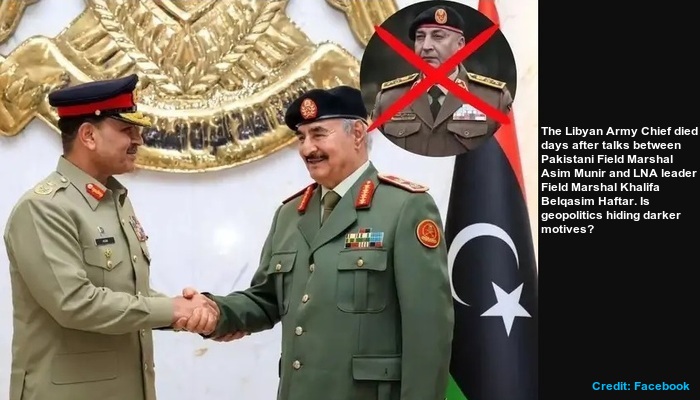
Interestingly, the Army Chief of Pakistan addressed the local media in Benghazi after holding talks with Khalifa Haftar. He told the press: “In our recent war with India, we showed our Pakistani technology to the world. Nearly 90% of that was indigenous Pakistani technology. Using that technology, the Pakistan Air Force took out the Rafale, Su-30, MiG-29, MiG-2000 and S-400.” Although there is no credible evidence that India lost a single Rafale, Su-30, MiG-29, Mirage 2000 fighter or its S-400 Air Defence System during or after Operation Sindoor, Field Marshal Munir made such a claim in Libya to promote the arms sale.
Currently, the Government of National Unity (GNU) controls the northwestern part of Libya, including the capital city of Tripoli. The UN recognised this government and al-Haddad was the Commander of the GNU Army. On the other hand, the LNA has seized control of the rest of the country. Significantly, Pakistan, Russia and the United Arab Emirates (UAE) are supporting this rebel group from behind the scenes.
Libya is a major oil producer that holds significant reserves, often ranking in the top 10 globally for reserves (largest in Africa) and a top producer in OPEC. However, the country has reduced the extraction and sale of oil because of the civil war. Hence, Libya’s actual production has become volatile due to political instability, although the African nation still remains a major player, especially for European markets. The problem is that most of Libya’s oil wells are located in the areas controlled by the rebels. This is why Field Marshal Munir has become desperate to strengthen ties with the LNA.
Meanwhile, Turkey backs the Tripoli-based GNU. Ankara recently started supplying weapons to the GNU Army in order to counter rebels. Field Marshal al-Haddad reportedly visited Turkey to procure more sophisticated weapons. He was accompanied by his advisor Mohammed al-Asawi Diab, Major General al-Fitouri Ghraibil, advisor Mahmoud al-Qatiwi and photographer Mohammed Omar Ahmed Mahjoub.
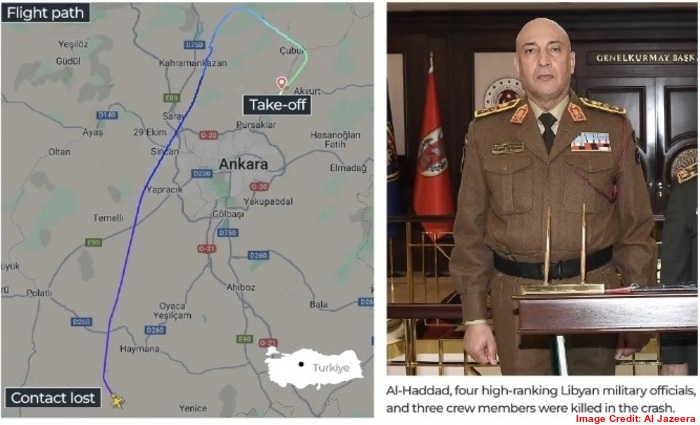
Ali Yerlikaya, the Interior Minister of Turkey, stressed that air traffic controllers lost contact with the Dassault Falcon 50-type jet carrying the Libyan Military Chief and others home after a visit to Ankara. According to the minister, the aircraft departed from the Esenboga Airport of Ankara at 8:10pm (local time) and contact with the jet was lost 40 minutes later. The private jet reported a technical failure, requesting an emergency landing. However, it crashed 70km south of Ankara. Meanwhile, local residents claimed that they saw the plane flying low and emitting a very loud noise just before the accident.
Transport Minister of Turkey Abdulkadir Uraloglu stated that the black box of the ill-fated plane would be analysed “in a neutral country“.
Meanwhile,




Boundless Ocean of Politics on Facebook
Boundless Ocean of Politics on Twitter
Boundless Ocean of Politics on Linkedin
Contact us: kousdas@gmail.com

 ISMC
ISMC Boundless Ocean Of Politics