

India Warned Of China’s Dual-Track Strategy
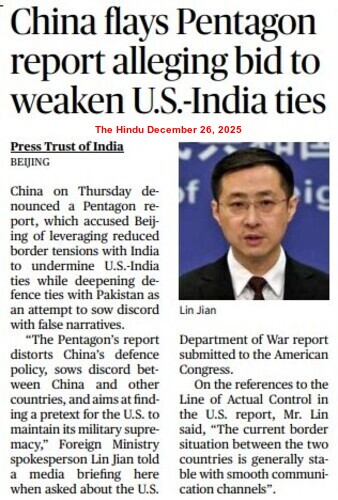
The Donald Trump Administration has virtually warned India that neighbouring China and Pakistan are constantly strengthening defence ties.
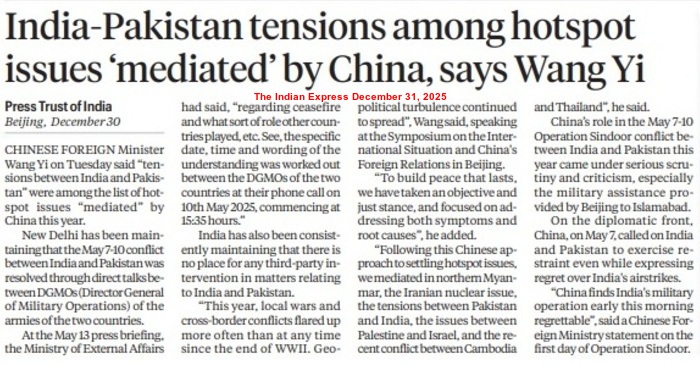
The Pentagon recently submitted a defence-related report to the US Congress, explaining Beijing’s dual-track strategy: easing tensions along the Line of Actual Control (LAC, the de facto boundary, separating Indian-controlled territory from Chinese-controlled territory, established after the 1962 Sino-Indian War) while strengthening military ties with Islamabad.
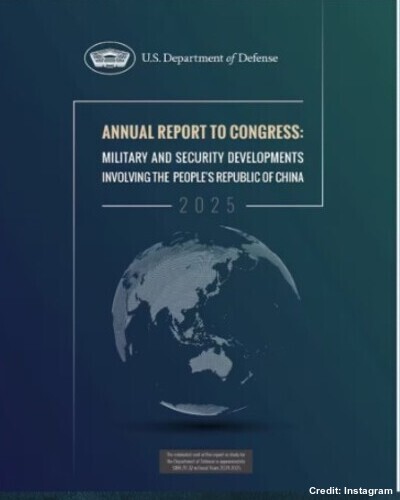
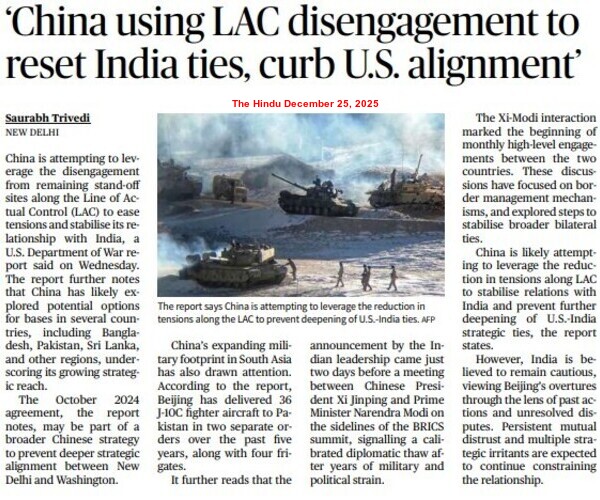
The report has explained how the relationship between Islamabad and Beijing is gradually becoming stronger in the field of intelligence cooperation. It has also highlighted the ongoing mistrust, northeastern Indian Province of Arunachal Pradesh as a key flashpoint, and China’s delivery of 36 J-10C jets, co-production of JF-17s, drones, naval platforms and joint drills with Pakistan, raising concerns over potential Chinese military facilities near India.
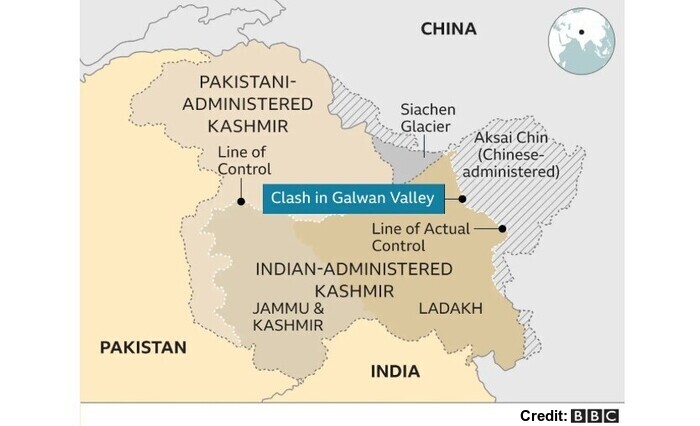
In its report, the US Defence Department has specifically mentioned various areas of tension in Sino-Indian relations. Following the unprecedented clash between the Armies of the two countries in the Galwan Valley on the Ladakh border in 2020, India and China reached significant disengagement agreements in October/December 2024, resolving standoffs at key friction points, like Depsang and Demchok. The move led to troop pullbacks and restoration of patrolling rights along the LAC in an attempt to de-escalate tensions and normalise ties.
The report has clearly stated that New Delhi and Beijing softened their stand as Indian Prime Minister Narendra Modi and Chinese President Xi Jinping were scheduled to meet at the BRICS Summit in Kazan just a few days later. Immediately after the meeting, India and China took various steps, including the launch of direct flight services, simplification of the visa application process, and the initiation of student and journalist exchange programmes, to improve bilateral relations.
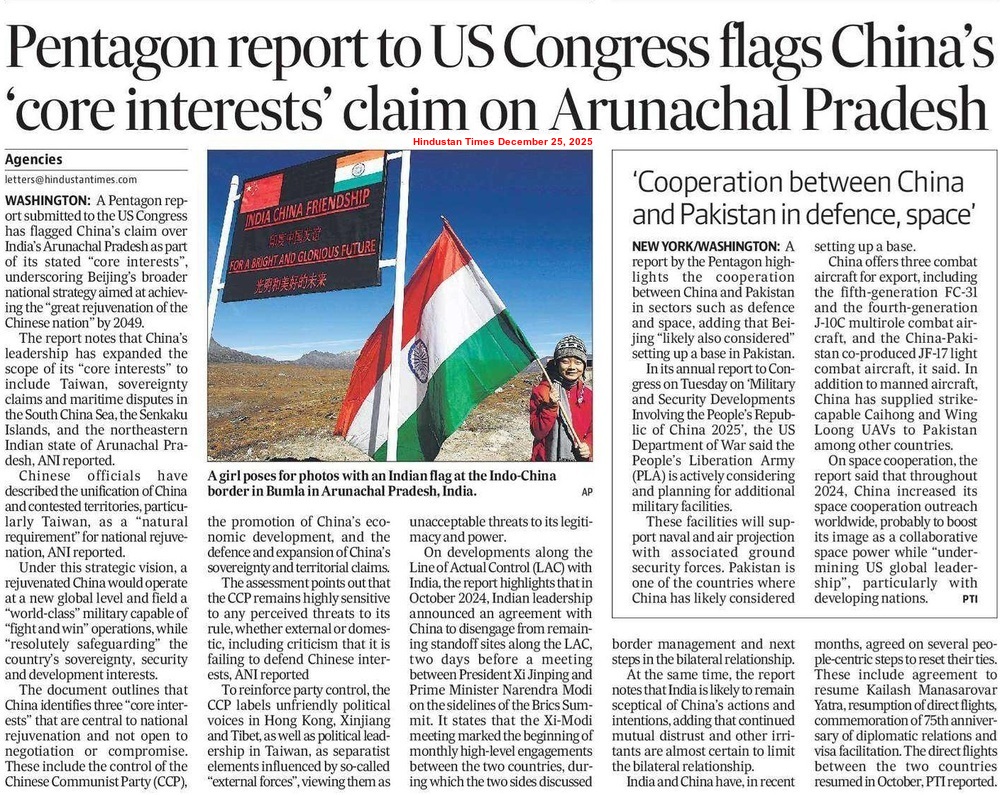
In spite of all these, the Pentagon has specifically warned New Delhi about China’s particular focus on acquiring the Indian Province of Arunachal Pradesh as part of its “core interests“, a classification of non-negotiable territory in the national strategy of China. According to the Pentagon, China has expanded its definition of “core interests” to include its claims over Taiwan, the Senkaku Islands and the South China Sea, alongside Arunachal Pradesh.
The Pentagon report has further included detailed information about the significant defence equipment Pakistan has purchased from and co-produced with China. It contains detailed descriptions of how Beijing has provided Islamabad with fighter jets, armed drones and modern Air Defence Systems over the past few years. China has also planned to provide Pakistan with several modern submarines over the next five years in order to bolster the Pakistani Navy.
The annual report of Pentagon on Military and Security Developments Involving the People’s Republic of China 2025 reads: “China has likely also considered basing in Angola, Bangladesh, Burma, Cuba, Equatorial Guinea, Indonesia, Kenya, Mozambique, Namibia, Nigeria, Pakistan, Papua New Guinea, Seychelles, Solomon Islands, Sri Lanka, Tajikistan, Thailand, Tanzania, the United Arab Emirates (UAE) and Vanuatu.“
The US Department of Defence has further warned that China’s rapid nuclear expansion continues, with its stockpile in the low 600s as of late 2024 despite a recent slowdown in warhead production. The assessment has reaffirmed that the Asian Giant remains on track to field approximately 1,000 nuclear warheads by 2030, equipping President Xi with a more diverse and flexible array of missiles, submarines and bombers capable of ranging the US homeland.
Although China’s arsenal remains far smaller than the US (5,177 warheads) or Russia (5,459), the pace of growth is the fastest among nuclear powers. This escalation raises alarms about global strategic stability, deterrence dynamics and the challenges of engaging Beijing in arms control talks. Analysts have noted China’s official “no first use” policy. However, the US assessments highlight increasing readiness and flexibility that could alter crisis behaviour in the coming years.
Hence, according to the Pentagon, the world is entering a more complex nuclear era and the global community would have to stay tuned for further developments.
Meanwhile,

Boundless Ocean of Politics on Facebook
Boundless Ocean of Politics on Twitter
Boundless Ocean of Politics on Linkedin
Contact us: kousdas@gmail.com

 ISMC
ISMC Boundless Ocean Of Politics