

Just A Short-Term Relief
The US, on October 30, 2025, granted India a six-month sanctions waiver to operate the Iranian port of Chabahar, boosting New Delhi’s effort to enhance trade with Afghanistan and Central Asian countries bypassing neighbouring Pakistan. The Donald Trump Administration announced that it revoked the exemption granted in 2018 under the Iran Freedom and Counter-Proliferation Act (IFCA). According to the US State Department, the move is a part of President Trump’s maximum pressure policy aimed at isolating the Islamic Republic amidst deteriorating relations (between Washington DC and Tehran) over the nuclear deal.
The extension of the waiver has allowed India to continue port operations, planned development processes and humanitarian cargo transport without the immediate risk of US sanctions for the next six months. It may be noted that the US has made the move at a time when New Delhi and Washington DC are in the final stages of a bilateral trade agreement negotiation. The waiver has certainly created an opportunity to boost trade ties with Asian countries for India. Chabahar has been in the headlines whenever the US has lifted or reconsidered sanctions, making it clear that even the sea becomes an integral part of contemporary global geopolitics.
The Iranian port has emerged as India’s only direct maritime connection to Afghanistan and Central Asia, bypassing Pakistan, in recent times. The port, located on the Gulf of Oman, not only reduces travel time and transportation costs, but also helps India to get access to the markets of landlocked Central Asian countries, like Uzbekistan and Kazakhstan. Hence, keeping the Chabahar Port viable is strategically important for India.
One should not forget that China has helped Pakistan to develop the Gwadar Port as part of its Belt and Road Initiative (BRI) project, and the Pakistani port is geographically close to Chabahar. In such a scenario, Chabahar has provided India with an opportunity to expand its trade with Afghanistan and Central Asia, apart from maintaining close economic, as well as strategic, ties with Iran. Furthermore, the port fits into India’s larger International North-South Transport Corridor (INSTC) project to connect Mumbai (popularly known as the business capital of India) to Russia and Europe via Iran, which could shorten various maritime trade routes. Therefore, losing the Chabahar Port would not only weaken India’s maritime trade with other countries, but would also allow China to stamp its authority across the Arabian Sea and Central Asia.
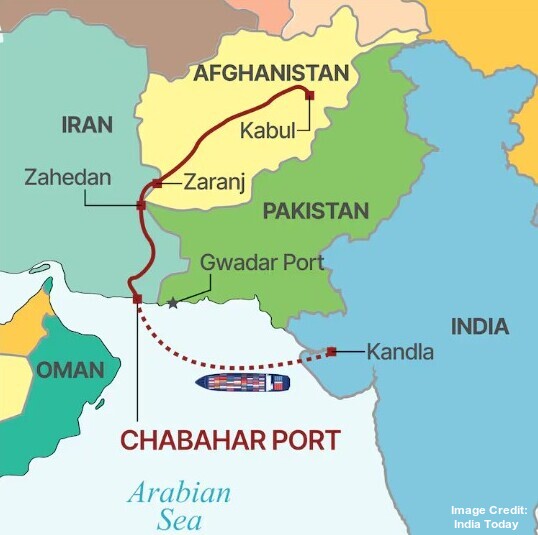
As India has been negotiating with the US to lift the sanctions on the Chabahar Port for long, many consider the waiver as a diplomatic success for the Narendra Modi Administration. However, this is only a short-term relief.
India needs to use this short period of time wisely in order to protect its investments and to push for long-term solutions. Patience is essential for achieving long-term goals. However, one cannot be too passive or slow in the face of rapid change and external pressures in a volatile global environment because such an approach typically leads to being outpaced by competitors, missing critical opportunities and failing to mitigate risks effectively.

It seems that New Delhi would have to engage in intense diplomatic negotiations with Washington DC for the continued use of the Chabahar Port.
Boundless Ocean of Politics on Facebook
Boundless Ocean of Politics on Twitter
Boundless Ocean of Politics on Linkedin
Contact us: kousdas@gmail.com

 ISMC
ISMC Boundless Ocean Of Politics