

Infectious Diseases Decimated Napoleon’s Army
Napoleon Bonaparte (also known by his regnal name Napoleon I; August 15, 1769 – May 5, 1821) invaded Russia with a multinational Army of approximately 600,000 soldiers in 1812. However, the venture, known as the Russian Campaign, turned out to be a disaster for the French Emperor due to various factors, like a scorched-earth retreat by the Russians, a lack of supplies and the brutal Russian winter, which decimated his Grande Armée. The illness of his soldiers was another important factor that severely weakened Napoleon and also encouraged other European powers to rise against him. While historical records documented symptoms consistent with typhus as the main cause of the Army’s illness, recent DNA analysis of Napoleon’s soldiers has found evidence of paratyphoid, as well as relapsing, fever. As the latest study did not find the corresponding bacteria in the analysed remains, it suggests a more complex picture of multiple overlapping diseases.
When Napoleon’s Grand Army invaded Russia in June 1812, the Russian troops adopted the strategy of retreating, avoiding major battles. As they retreated, the Russian forces burned crops, villages and supplies, a tactic known as the Scorched-Earth Policy, which severely hampered the French Army‘s ability to resupply itself. A major exception was the bloody, large-scale Battle of Borodino, a costly but indecisive clash that occurred before the French forces reached Moscow. By the time Napoleon reached the Russian capital, his Army was significantly depleted by disease, starvation and desertion, even before the harsh winter began. After the Russians burned Moscow and Tsar Alexander I Pavlovich (December 23 (O.S. December 12), 1777 – December 1 (O.S. November 19), 1825) refused to negotiate, the French General was forced into a disastrous retreat in October 1812 that ultimately destroyed his Army.

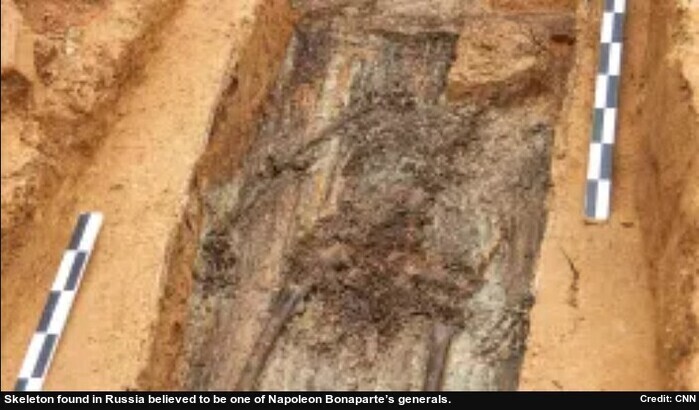
Previously, researchers assumed that there was one infectious disease – the typhus – which decimated Napoleon’s Army. The dead soldiers from Grand Army were buried in Vilnius, Lithuania during the disastrous retreat from the Russian campaign after tens of thousands died in that region. Their bodies were often thrown into trenches because the ground was frozen. Mass graves were discovered in 2001 during construction work, and subsequent archaeological studies confirmed the remains belonged to Napoleon’s Army. In 2006, scientists, studying the remains of Napoleon’s soldiers, found evidence of infection with Rickettsia prowazekii, the bacterium that causes Epidemic Typhus.
A study, published in Current Biology journal on October 24, 2025, suggests that a combination of several diseases, along with fatigue and cold, were the culprits. Recent analyses of teeth from soldiers who died during Napoleon’s retreat from Russia have revealed the presence of Salmonella enterica and Borrelia recurrentis, suggesting that a number of diseases contributed to the demise of soldiers. These two bacteria cause paratyphoid and relapsing fever. Surprisingly, the presence of Salmonella enterica and Borrelia recurrentis was not found in the study carried out in 2006. Hence, it can no longer be claimed that Napoleon’s Army fell ill only because of the Typhus Epidemic.
In addition to the two bacteria found in the new study, the possibility of infection with other bacteria cannot be ruled out as the scientists have carried out research only on 13 skeletal samples. Dental samples from other skeletons may reveal a wide range of infections and disease patterns. Significantly, no typhus infection has been found in those 13 samples. Lead author Rémi Barbieri, a former postdoctoral fellow at the Institut Pasteur in Paris who currently holds a postdoctoral position at Estonia’s University of Tartu, has stressed: “Previously, we just thought that there was one infectious disease that decimated the Napoleon Army – the typhus. However, the researchers found something unexpected, opening the door to potentially uncovering other infectious diseases that could have contributed to the soldiers’ deaths.“
The 2006 study had some technical limitations. Although researchers had identified Rickettsia prowazekii at that time, they failed to make further progress. CNN reported that the authors of the new study used a method, called high-throughput sequencing, to find out whether typhus was the sole culprit for the demise of soldiers. The method can sequence millions of DNA fragments at a time, allowing researchers to identify highly degraded DNA, such as the genome fragments extracted from samples more than 200 years old.
CNN quoted study coauthor Nicolás Rascovan, the supervisor of the research and head of the Microbial Paleogenomics Unit at the Institut Pasteur, as saying: “This is something that can be only done with these machines that are very powerful to go and sequence a lot of high quantity of DNA.” He stressed: “This sort of analysis, these kinds of projects, can really give a much clearer picture about the landscape of infectious disease in the past… and how (historical events) have also shaped the landscape of infectious diseases today.” “What changes (with) our study is the fact that now we have direct evidence there were several different infectious diseases present in this site,” added Rascovan. He further said: “Something that is quite impressive is how, in so little time, since 2006 with the first study to today, the technologies have been developed so much that we can do things that were impossible to even conceive a few years ago and now are possible. So, I am very excited to think what is going to be next in terms of technological developments.”
Although paratyphoid and relapsing fever are not quite common nowadays, most of Napoleon’s Great Army was destroyed by a combination of diseases, rather than just illness alone, in 1812. He was defeated at the Battle of Waterloo on June 18, 1815, marking the end of his rule and the conclusion of the Napoleonic Wars.
Boundless Ocean of Politics on Facebook
Boundless Ocean of Politics on Twitter
Boundless Ocean of Politics on Linkedin
Contact us: kousdas@gmail.com

 ISMC
ISMC Boundless Ocean Of Politics