

Study: Electricity Produced 2,000 Years Ago
There is a cylinder made of copper inside a 13-15cm-long ceramic pot. One can find an iron rod inserted into that cylinder. Archaeologists discovered such a battery near the ruins of Ctesiphon, an ancient city in modern Iraq situated on the eastern bank of the Tigris about 35km southeast of Baghdad, in 1936. After analysing the object, they named it the Baghdad Battery. Researchers believe that the ancient battery was created more than 2,000 years ago (during the rule of the Parthian or Sasanian Empires (BCE 250-650)) as ancient people had made an attempt to generate electricity with it. However, the real purpose of creating the Baghdad Battery still remains unclear.
A section of archaeologists is of the opinion that the copper cylinder used to contain a liquid chemical, and not water. It is believed that ancient people had mixed an acidic or alkaline solution with copper and iron rods inside the pot in order to generate electricity through an electrochemical reaction. According to researchers, it is possible to generate electricity by mixing chemical solutions inside a container in a perfect manner. However, others believe that the object was used for religious or spiritual purposes and there was no role of chemical reaction. When archaeologists discovered the Baghdad Battery, it was largely decayed.
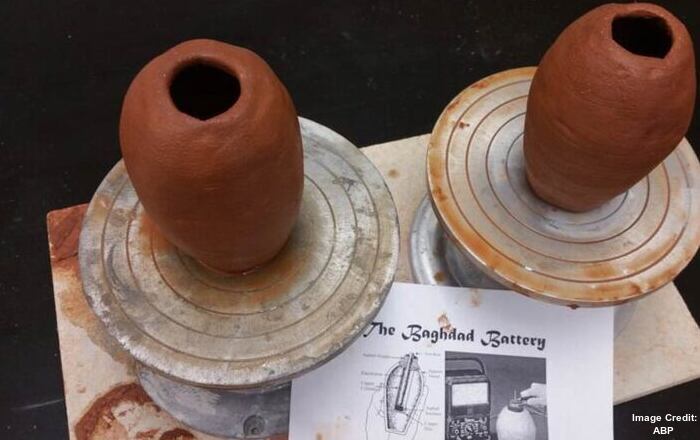
Scientists have conducted various experiments on the Baghdad Battery for decades from which several pieces of information have emerged. The Plating and Surface Finishing journal published a report in 2002, mentioning that the battery was not created to generate electricity. As per the article, two pieces of iron and copper need to be connected to make a circuit. That was not possible given the structure of this ceramic pot. It may be noted that researchers also discovered some strange pottery during the excavation. They initially thought that those were normal artefacts. Later, they realised that those were no ordinary pots.
Researchers also discovered four 15-20cm-long pots in that area and found small, but perfectly crafted, bronze cylinders hidden inside each pot. Their height and radius were 7.5cm and 3.5cm, respectively. Some of the cylinders were filled with dried plant powder. Inside one such pot, researchers noticed a rolled thin paper-like object, with two neatly-folded edges.

Just as the purpose of creating the Baghdad Battery still remains unclear, researchers have failed to understand the exact procedure of using such objects. They believe that it would have been possible to produce electricity by mixing chemicals in those pots. A team of archaeologists, under the leadership of Sherif Youssef and Jawad al-Safar, carried out excavations at Khujut Rabu in 1936 and sent all the artefacts to the National Museum of Iraq.
German archaeologist Wilhelm König discovered the Baghdad Battery while conducting research on those artefacts at the National Museum in 1938. He was the first to propose identifying this pot as an ancient galvanic cell or battery. Scientists agreed with his proposal only after conducting further research.

After the Second Gulf War between Iraq and the US (2003-11), the Baghdad Battery disappeared from the National Museum and was never found.
Boundless Ocean of Politics on Facebook
Boundless Ocean of Politics on Twitter
Boundless Ocean of Politics on Linkedin
Contact us: kousdas@gmail.com

 ISMC
ISMC Boundless Ocean Of Politics