

Queen Leading The Dynasty Forward Alone
Approximately 0.03-2.5 inches in length … Yet the tiny creature has shattered fundamental concepts of biology. The mystery has recently been published in the journal Nature.
Scientists have been surprised by the act of a well-known species of ant in Europe as they have noticed that Iberian harvester ant (Messor ibericus) queens give birth to cloned males of entirely different species (Messor structor)! Research has revealed that there is a shortage of male ants as far as Messor ibericus are concerned. Hence, the queens clone themselves and give birth to a different species of male ants. Later, they mate with their own creation, the male, in order to produce hybrid worker ants.
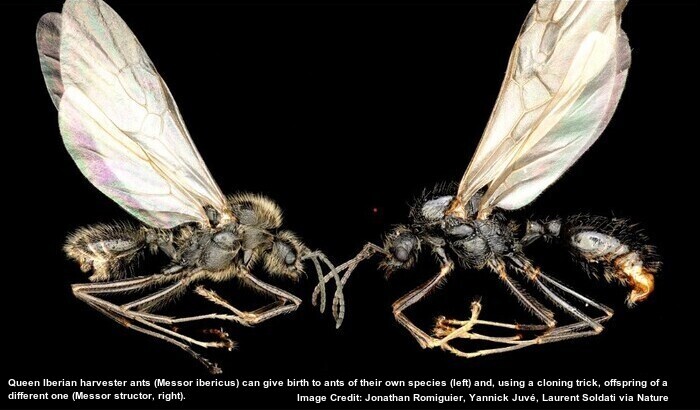
Queens of the Iberian harvester ant are sexually parasitic because they use stored sperm from males of Messor structor to produce hybrid worker ants, effectively cloning the paternal species for colony labour. This rare phenomenon, called Xenoparity, allows Messor ibericus to create a vital workforce even in areas where Messor structor is absent. However, it results in the use of the other species’ sperm without its males’ contribution to produce offspring.
Scientists were well aware of the relationship between these two different species of ants. However, they have noticed that even if there is no colony of Messor structor near the Messor ibericus ant colony, the Ibericus queens can clone the Messor structor males! Researchers have found the DNA of Messor structor in the eggs laid by the Messor ibericus queens. In the article published in the Nature, Jacobus Jan ‘Koos’ Boomsma, the Dutch Evolutionary Biologist and a Professor of Biology at the University of Copenhagen, has stated: “It’s an absolutely fantastic, bizarre story of a system that allows things to happen that seem almost unimaginable.”
According to researchers, the Messor ibericus ants are found in some parts of Europe and they coexist with the Messor structor almost everywhere. Hence, Ibericus queens easily find lovers from the Structor family. However, a strange phenomenon has caught the attention of Biologist Jonathan Romiguier and his colleagues at the University of Montpellier in France. They have found Iberian harvester ants everywhere on the Italian island of Sicily, but not a single colony of Messor structor.
While peering inside colonies of the Iberian harvester ants, researchers found two types of ants which looked quite different. Genetic analyses confirmed that the colonies contained both Messor ibericus and Messor structor, in spite of the lack of Messor structor populations on the island. Further analyses have solved the mystery as Romiguier and his colleagues have discovered that Iberian harvester queens clone Messor structor ants in order to maintain a steady supply of (the latter’s) sperm. Then, they mate with those Messor structor ants to produce hybrid worker ants who take care of the colony, including by building the nest and foraging for food. Nature has quoted Romiguier as saying: “In effect, Messor ibericus has domesticated the Messor structor and its genome.“
Researchers have come to the conclusion that the queen performs the duty of carrying forward the lineage in the matriarchal Messor ibericus society.
Boundless Ocean of Politics on Facebook
Boundless Ocean of Politics on Twitter
Boundless Ocean of Politics on Linkedin
Contact us: kousdas@gmail.com

 ISMC
ISMC Boundless Ocean Of Politics