

The White Death
He used to shoot from a concealed position, specifically behind dense snow mounds, and hit the enemies with perfect accuracy. Immediately after eliminating the Soviet soldiers at the snow-covered battlefield, he disappeared from the scene.
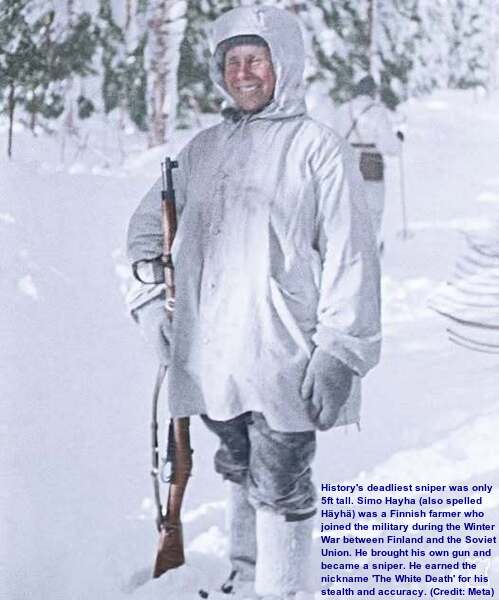
The erstwhile Soviet Union invaded Finland during the Second World War, triggering the 1939-40 Winter War. The sniper stunned the Soviet Army during the three-and-a-half-month-long war by attacking them just like a snow leopard with his Finnish-produced M/28-30 rifle (a variant of Mosin-Nagant) and a Suomi KP/-31 submachine gun. He never used a telescope, as the sniper preferred using iron sights on his rifle, instead of telescopic sights. Simo Häyhä (December 17, 1905 – April 1, 2002), the Finnish military sniper, is popularly known as The White Death. He, single-handedly, turned the tide of the Winter War by inflicting heavy casualties on the Soviet forces. When he would get ready with his rifle in hand, death would appear as if with a warrant. Häyhä is widely known as the world’s deadliest sniper.

At the beginning of the Second World War, the Soviet Union, under the leadership of Joseph Vissarionovich Stalin (born Dzhugashvili; December 18, 1878 – March 5, 1953), invaded Finland on November 30, 1939 as the Soviet leader thought that the Northern European country would be an easy target. However, it was soon proven wrong. Finland mounted a strong resistance against the Soviet forces, relying on Häyhä’s skills. Despite being heavily outnumbered and outgunned, the Finnish military, with the support of volunteers and utilising guerilla tactics, as well as knowledge of the terrain, inflicted significant casualties on the Red Army. Although Finland ultimately ceded territory to the Soviet Union in the Moscow Peace Treaty, the Finns’ valiant defence earned them global respect. The Soviet entered Finland with more than 500,000 troops, while the tiny Nordic nation had only 300,000 soldiers, a few tanks and around 100 aircraft. However, the Soviet did not have a sharpshooter, like Häyhä.
Häyhä, the seventh of eight children in a Lutheran family of farmers, was born on December 17, 1905 in the Kiiskinen hamlet of the Rautjärvi Municipality in Viipuri Province of southern Finland. Currently, this province is located in Russia and known as the Vyborgsky District of Leningrad Oblast. After joining the Armed Forces at a young age, Häyhä was promoted to the rank of corporal. While undergoing training, his shooting skills caught the attention of senior Army officers. After completing his compulsory military service at the age of 20, he returned to his village and concentrated on farming.
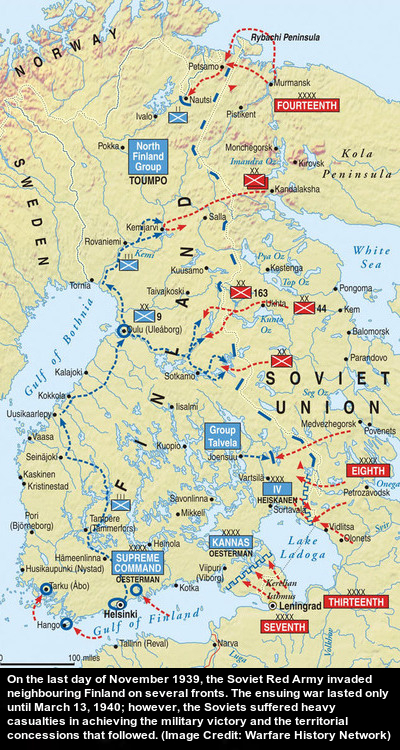
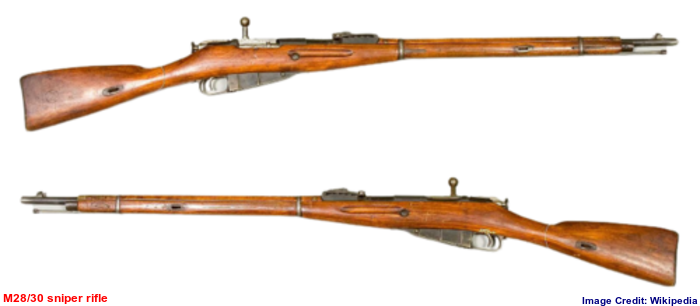
Häyhä was called upon to serve as a sniper in the Finnish Army after the Soviet forces invaded Finland in 1939. He joined the 13th Infantry Regiment (JR 34) in the Kollaa region, north of Lake Ladoga, during the Winter War. He was assigned to the 6th Company of the regiment. It may be noted that the Kollaa region was the site of intense fighting between the Finnish and Soviet forces, particularly during the Battle of Kollaa. After joining the regiment, he picked up a Mosin-Nagant M28/30 sniper rifle that was first manufactured in 1928. It was a little shorter, as well as heavier, than other rifles. Häyhä, renowned for his solitary work, preferred operating alone, relying on his skills and a white camouflage suit to ambush, as well as eliminate, enemy soldiers. His approach to the task was also a little different from others as Häyhä used adverse weather conditions to his advantage and silently launched attacks on the Soviet troops. Major Tapio Saarelainen, who met the sniper several times and also penned five books about him (including his biography), reportedly claimed that Häyhä was able to estimate distances up to 150mt (490ft) within a margin of error of 1mt (3ft-3inch)!
Häyhä would quietly enter the forest after gathering a day’s worth of supplies and ammunition. He used to wait for the right opportunity to stop the Soviet infiltration. While his fellow soldiers used telescopic lenses to hit the targets, Häyhä preferred to aim without a telescope (by using iron sights). He was concerned about light reflecting off his rifle telescope and potentially revealing his position to the enemy. Hence, he took measures to prevent this by using a black, non-reflective sight and burying his scope slightly into the snow. Häyhä also minimised the time he spent looking through the scope in an attempt to reduce the chance of being spotted. Häyhä’s concern about the scope’s reflection was a key element in his exceptional stealth and effectiveness as a sniper.
Häyhä’s concealment methods, too, were unique. He employed a combination of camouflage, patience and clever tactics to remain hidden from the enemy, making him a formidable and elusive opponent. He frequently built snow mounds around his sniper position to enhance his concealment. The mounds used to create a makeshift barrier, providing him with both cover and a stable platform. Häyhä could easily eliminate enemies even at -40 degrees Celsius! It highlights his resilient character and ability to operate effectively in extreme cold. He reportedly put ice in his mouth while aiming to prevent his breath from revealing his position.
Häyhä is believed to have gunned down 505 Soviet soldiers in 100 days, the highest number of sniper kills in any major war. The Winter War began on November 30, 1939. As per official records, Häyhä killed 138 Soviet soldiers in just 22 days (by December 22). The figure reached 199 by January 26, 1940 and 219 on February 17. He eliminated another 40 enemy soldiers over the next 18 days. The Red Army shelled Häyhä’s possible positions to eliminate him. Surprisingly, he received no injuries.
On March 6, 1940, Häyhä was severely injured when an explosive bullet fired by a Red Army soldier tore through his face and shattered his lower left jaw. As he appeared to be dead, he was placed on a pile of corpses. Later, someone noticed his foot moving and took him to a hospital. Häyhä regained consciousness a week later, on March 13, the day peace was declared. He underwent a total of 26 surgical operations on his jaw. However, his speech was never fully restored. Despite this, he requested permission to return to the front lines when the Continuation War (1941-44) broke out. However, the concerned authorities denied his request because of the severity of his facial injuries from which Häyhä was still recovering.
After spending his final years in a war veterans’ nursing home in Hamina, Häyhä passed away on April 1, 2002 at the age of 96. Later, he was buried in his home town of Ruokolahti.
Boundless Ocean of Politics on Facebook
Boundless Ocean of Politics on Twitter
Boundless Ocean of Politics on Linkedin
Contact us: kousdas@gmail.com

 ISMC
ISMC Boundless Ocean Of Politics