

New Delhi: Trump Can’t Derail Indian Economy
A couple of days after US President Donald John Trump announced a 25% tariff on Indian goods (from August 1, 2025), alongside an additional but unspecified “penalty” for its defence and energy imports from Russia; New Delhi managed to overcome the initial shock.
The Narendra Modi Administration in New Delhi issued a statement on August 1 (2025), mentioning that the tariff imposed by the US would not have much impact on India. The government argued that most of the goods exported from India to the US, such as medicines and electronic products, were covered by duty exemptions. According to the statement, only exports worth around USD 40 billion are at risk. The Modi Administration further claimed that the GDP growth rate of India could decline by just 0.2 percentage points.

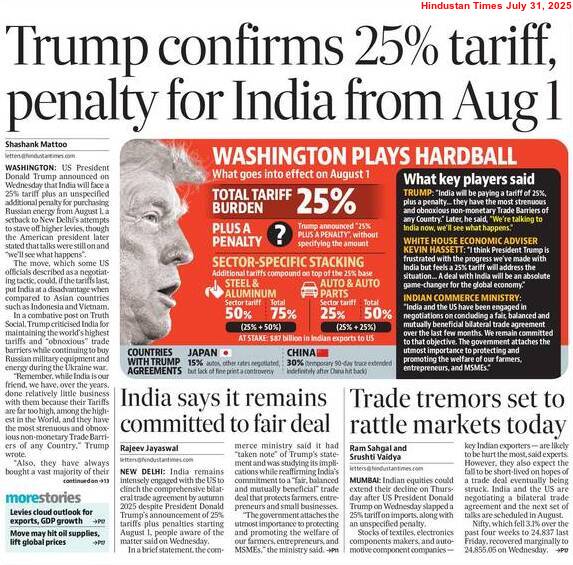
Talking to the media, a senior Indian official has stressed that the government is closely watching the developments, but sees no reason for alarm. “There may be a marginal impact of the 25% tariff, but this impact is not at all alarming on Indian markets. The worst-case scenario may lead to a GDP loss of less than 0.2%, which is manageable,” he told the press.
India has also made it clear that it would not open up its market to the US by offering any tariff relief on agricultural products, including genetically modified (GM) crops, milk and dairy products (by bowing to the US pressure). The official stated: “The farmers’ interest is paramount. There is no question of allowing the import of GM crops. India will not agree to any terms that hurt our agriculture or dairy sectors.” It may be noted that Washington DC is seeking free access to the vast Indian market for agricultural products, GM crops, milk and dairy products. A trade deal between the two countries has been stalled because of New Delhi’s reluctance.


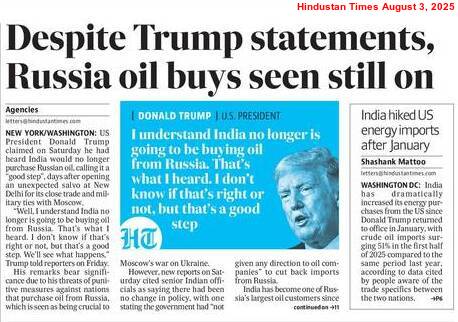
With the unending war in Ukraine frustrating the White House, President Trump announced that India would have to pay punitive penalties for purchasing defence equipment and oil from Russia. However, the US President did not confirm the exact amount of the penalty. According to sources close to the Modi Government, Indian refiners have begun cutting down on Russian oil imports and trying to find alternative sources.


A section of economists believes that the 25% tariffs would not put India under pressure right away as the economic growth of the South Asian nation depends mostly on domestic demand. Although about 18% of total Indian exports went to the US in 2024, its share in GDP was just 2%. However, they have admitted that the US has made the move at a time when the Indian economy is going through a difficult phase. Lower consumer confidence, weak demand and sluggish corporate investment are slowing the economic growth. The Indian economy grew by 6.5% in 2024-25 financial year, marking the slowest pace of growth since the COVID-19 pandemic. While the Indian Rupee has faced its sharpest depreciation (1.8%) against the US Dollar in the past couple of years, rising global oil prices directly increase the cost of importing crude oil (impacting India heavily reliant on foreign oil).

Meanwhile, exporters are of the opinion that President Trump’s decision to impose 25% tariffs on goods imported from India could hit the growth prospects of the country. According to exporters, some sectors, including textiles, gems and jewellery, and oil refining, would face the heat as these are generally export-dependent and labour-intensive. They have argued that higher tariffs would increase the export costs. Hence, prices of those products would also increase and create troubles for workers, large companies and others associated with the production of such goods.

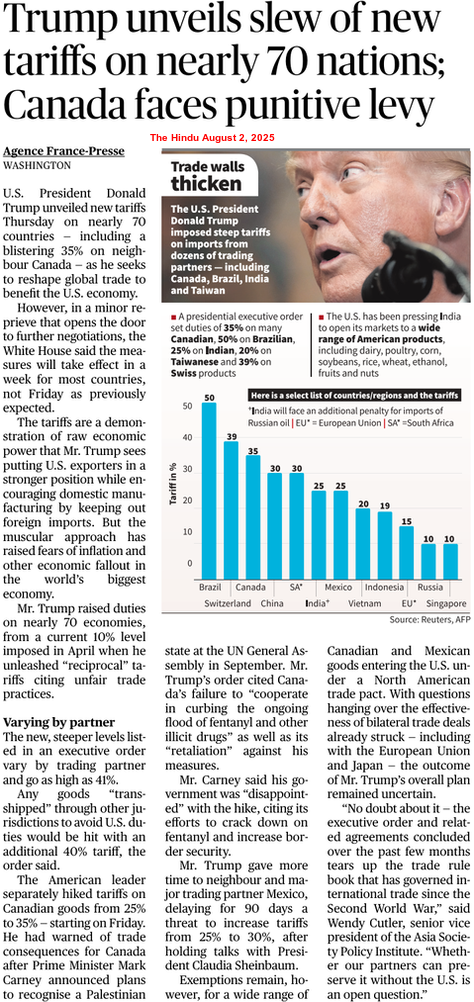
There is a growing concern among experts that Indian products, previously known for their competitive pricing in the US market, might lose ground due to increasing costs. This shift could make them less attractive compared to goods from other countries that maintain lower price points. Therefore, concerns are growing for some, if not all, industries. A decline in exports can affect overall production, triggering the possibility of layoffs.
You may also like: Political Decisions Analysed By Game Theory
Boundless Ocean of Politics on Facebook
Boundless Ocean of Politics on Twitter
Boundless Ocean of Politics on Linkedin
Contact us: kousdas@gmail.com

 ISMC
ISMC Boundless Ocean Of Politics
1 Comment »