

Ancient Riverbed Discovered In Mars
Scientists previously found substantial evidence of past water, as well as the existence of river basins, on Mars. A number of successful missions have been launched to the Red Planet in the past few decades. Although humans have not yet been able to reach there, landers and rovers sent from the Earth have touched the soil of Mars and also clicked images there. Scientists found traces of water on ancient Mars from those images. However, the latest research is slightly different. In a rare first, evidence of river basins has been found in a particular region of the planet. Scientists have come to know that Mars once had thousands of small and large rivers which were sometimes filled with ice, sometimes with rain! Hence, they are so excited!
New research reveals the discovery of over 15,000km of ancient river valleys in the southern highlands of Mars. The findings indicate that surface water may have been stable in the Noachis Terra region of the planet during the Noachian-Hesperian transition, a period of geologic and climatic change around 3.7 billion years ago. There were rivers of various lengths and some of them extended up to 160km.

Adam Losekoot, a researcher at the Open University in England who presented the new research paper at the Royal Astronomical Society‘s National Astronomy Meeting 2025 in Durham on July 11, stressed: “Studying Mars, particularly an underexplored region like Noachis Terra, is really exciting because it’s an environment which has been largely unchanged for billions of years. It’s a time capsule that records fundamental geological processes in a way that just isn’t possible here on Earth.” He added: “Our work is a new piece of evidence that suggests that Mars was once a much more complex and active planet than it is now, which is such an exciting thing to be involved in.“
Researchers have also discovered a number of canyons in the southern part of Mars. It is believed that they were created by the friction of river water. Scientists have come up with this new and unprecedented theory about the southern highlands of Mars by analysing data received from artificial satellites (launched from the Earth) orbiting the Red Planet. Scientists have also analysed data received from NASA’s Mars Reconnaissance Orbiter (MRO) and the Mars Global Surveyor (MGS). Cameras, installed on the MRO and the MGS, have captured images of a region almost the length of Australia.
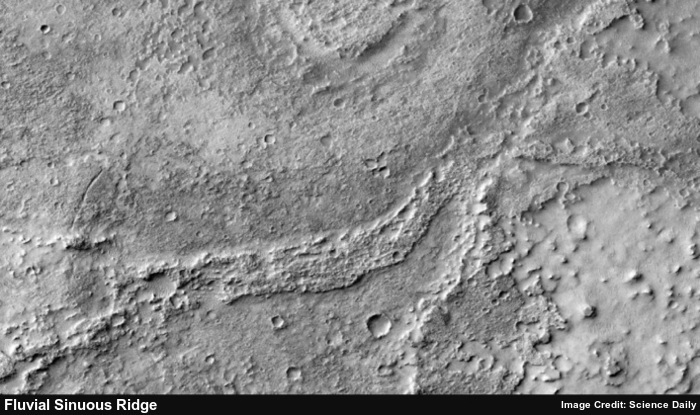
The MRO and the MGS have found evidence of a special type of geological feature, called Fluvial Sinuous Ridge (FSR), with lots of small craters in it, standing out clearly above the surrounding material. These are also called inverted channels. The FSRs are geological formations that result from the hardening (or lithification) of ancient river sediments, effectively creating ridges that mirror the winding paths of those past river channels. The ridges become exposed when the soft soil erodes, providing valuable insights into ancient fluvial systems both on Earth and Mars.
According to scientists, an entire river network, consisting of rivers, their tributaries and branches, used to exist on Mars. Evidence suggests that two rivers merged and flew into a large crater on ancient Mars, likely filling it with water and potentially creating a lake.

Scientists are of the opinion that Mars once had a vast body of water. However, the magnetic field of the planet gradually waned, allowing the solar wind to erode its atmosphere and the water to escape into space. Some of them have opined that a vast reservoir of water could lie hidden deep beneath the Martian surface, although there is no evidence of that yet.
Meanwhile, the latest findings challenge existing theories that Mars was generally cold and dry, with a few valleys formed by ice-sheet meltwater in sporadic, short periods of warming. Instead, the ridges form extensive interconnected systems, suggesting that the watery conditions must have been relatively long-lived. In other words, Noachis Terra experienced warm and wet conditions for a geologically relevant period.
Boundless Ocean of Politics on Facebook
Boundless Ocean of Politics on Twitter
Boundless Ocean of Politics on Linkedin
Contact us: kousdas@gmail.com

 ISMC
ISMC Boundless Ocean Of Politics