

Netanyahu Goes Beyond ‘Begin Doctrine’
Immediately after launching the Operation Rising Lion on June 13, 2025, Israeli Prime Minister Benjamin ‘Bibi’ Netanyahu made it clear that his only goal was to trigger a regime change in Iran. He also hinted that his prime target was not President Masoud Pezeshkian, but Supreme Iranian Leader Ayatollah Ali Hosseini Khamenei.
In the late 1970s, then-Israeli Prime Minister Menachem Begin (August 16, 1913 – March 9, 1992) declared that any West Asian nation that attempted to develop nuclear weapons would be attacked. He made the declaration following the Israeli attack on Iraqi nuclear reactor Osirak during the Operation Opera. Since then, the Begin Doctrine has been the common term for the Israeli Government‘s preventive strike and counter-proliferation policy regarding their potential enemies’ capability to possess Weapons of Mass Destruction (WMD), particularly nuclear weapons. Even in the 1980s, Israel carried out airstrikes on Iranian nuclear facilities in accordance with the Begin Doctrine. However, Tel Aviv did not directly send the message of a regime change to Tehran at that time.
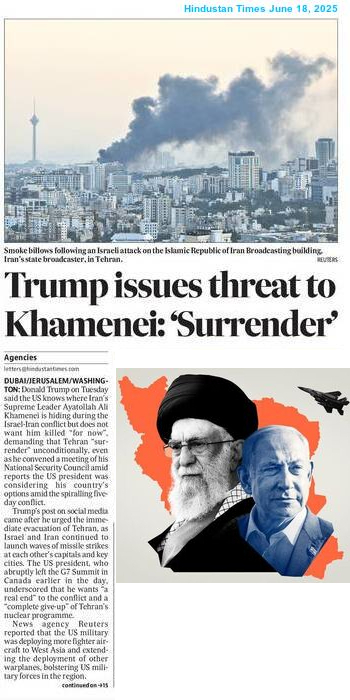
Now, Netanyahu has sent such a message to the people of Iran. In a video message, he issued a direct appeal to the Iranians, urging them to stand up against what he called an “evil and oppressive regime”. “The time has come for the Iranian people to unite around its flag and its historic legacy, by standing up for your freedom from the evil and oppressive regime. And as we achieve our objectives, we’re also clearing the path for you to achieve your objective, which is freedom,” said the Israeli Prime Minister on June 13, 2025. Political analysts believe that US President Donald John Trump and several European nations are helping Israel to trigger the regime change in the Islamic Republic. However, top US officials recently claimed that President Trump strongly opposed Tel Aviv’s plan to eliminate Ayatollah Khamenei.
The 1979 Islamic Revolution
If Tel Aviv manages to achieve its goal, Tehran could witness another regime change after nearly four and a half decades. Ayatollah Ruhollah Musavi Khomeini (May 17, 1900/September 24, 1902 – June 3 1989), the predecessor of Ayatollah Ali Khamenei, seized power in Iran through a “mass revolution” in early January 1979. The event is popularly known as the Islamic Revolution that triggered the fall of Mohammad Reza Pahlavi (October 26, 1919 – July 27, 1980), the last Shah (Monarch) of Iran. As public outrage prompted Mohammad Reza Pahlavi to leave the country, Ayatollah Ruhollah Khomeini returned to Iran from exile in France.
The character of the Iranian State changed abruptly soon after the formation of a new government on February 14, 1979 by the Islamic Republican Party (IRP) approved by Ayatollah Khomeini. It may be noted that the IRP was formed in 1979 to assist the Iranian Revolution and Ayatollah Khomeini in their goal to establish theocracy in Iran. However, the outfit was disbanded in 1987 because of internal conflicts. After becoming an Islamic Republic, Iran developed hostile relations with the US, Europe, Israel and even with Sunni Islamic nations, like Saudi Arabia and the United Arab Emirates (UAE). Incidentally, Tehran also began nuclear activities at that time and Israel started considering Iran as its fierce enemy.

Khamenei: The Source Of Power
There have been repeated allegations that socio-political freedoms in Iran have been severely curtailed during the past four and a half decades of Islamic Fundamentalist rule. The demand for basic Human Rights or Women’s Rights has been brutally suppressed. However, Iran, like Afghanistan, experienced a period of modernisation in the 1960s and 1970s, including advancements in education and some expansion of women’s freedoms. Although there is an elected President and a Cabinet, the Guardian Council led by Ayatollah Khamenei enjoys real power.
The Return Of Shah’s Rule?
Speculation has begun that the Trump-Netanyahu duo wants to bring back the Shah Dynasty by staging a coup in Tehran. Although Mohammad Reza Pahlavi passed away on July 27, 1980, his eldest son Crown Prince Reza Pahlavi Shah (born October 31, 1960) lives in the US. On June 14 (2025), he told BBC that the weakening of the Khamenei Regime created an opportunity for the Iranian people to “finally liberate themselves“.

In 1925, Reza Shah Pahlavi (born Reza Khan; March 15, 1878 – July 26, 1944) rose to power, replacing the Qajar Dynasty with the Pahlavi (or Shah) Dynasty that ruled Iran for roughly 53 years. Maybe, the Pahlavi Dynasty would return to Iran with the help of Trump and Netanyahu after a century.
Boundless Ocean of Politics on Facebook
Boundless Ocean of Politics on Twitter
Boundless Ocean of Politics on Linkedin
Contact us: kousdas@gmail.com

 ISMC
ISMC Boundless Ocean Of Politics