

Operation Spider’s Web & The Future Of Drone Warfare
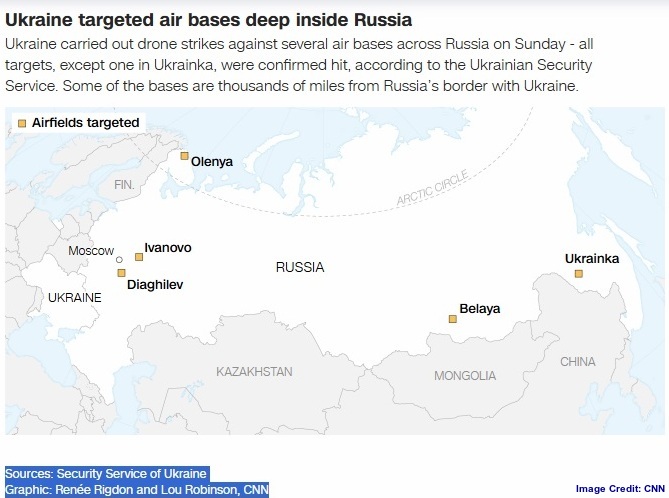
The Security Service of Ukraine (SBU) carried out a covert drone attack, codenamed Operation Spider’s Web, deep inside Russia on June 1, 2025. The coordinated strikes targeted the Russian Air Force‘s Long-Range Aviation assets at airbases in Belaya, Dyagilevo, Ivanovo Severny, Olenya and Ukrainka, using drones concealed in and launched from trucks on the Russian territory. The SBU reportedly destroyed 41 Russian fighter jets during this operation. Kiev has released satellite images of the destruction, claiming that Russia tried to avert the drone strikes, but failed.
On June 1 afternoon (local time), the Ukrainian drones launched the precision attack, targeting strategically important airbases situated thousands of kilometres inside the Russian territory. As the Ukrainian Armed Forces planned to launch a spider web-like attack inside Russia, President Volodymyr Oleksandrovych Zelenskyy chose the code-name Operation Spider’s Web. Later, the SBU revealed that it used 117 drones to destroy five airbases in Russia. It may be noted that the Belaya airbase in Irkutsk is located approximately 4,500km from the Russia-Ukraine border. The Olenya airbase, located in the Murmansk region of Russia, is nearly 2,000km from Ukraine. It is a strategic location for Russian military aircraft, including nuclear-capable ones. While the Diaghilev airbase in Ryazan Oblast is situated 520km from Ukraine, the Ivanovo airbase, a base for Russian military transport aircraft, is 800km away from the border. The geographical locations of these airbases have proven the military success of Ukraine.

Capella Space, a US-based space company, has shared satellite images of the destruction with Reuters, showing the wreckages of several aircraft. According to the SBU, some Russian bombers, including Tupolev Tu-95s and Tupolev Tu-22s, were stationed at Belaya airbase. The Tupolev Tu-95 is a large, four-engine turboprop-powered strategic bomber and missile platform, while the Tupolev Tu-22 was the first supersonic bomber to enter production in the erstwhile Soviet Union. Moscow uses these aircraft mainly to launch long-range missiles during combat. Brady Africk, an open source intelligence analyst, claimed that the SAR imagery of Irkutsk airbase showed several Tu-95s and Tu-22s had been destroyed and damaged, although more imagery was required to properly assess the impact. Reuters quoted him as saying: “It is clear that the attack on this airbase was very successful. The aircraft targeted in the attack were a mix of Tu-22 and Tu-95 bombers, both of which Russia has used to launch strikes against Ukraine.“
Satellite images of the Ivanovo Severny airbase have also been released, showing the wreckages of Russia’s advanced A-50 AWACS or airborne early warning aircraft. These are considered precious assets for any military. However, Russia had already lost several such aircraft during the years-long war with neighbouring Ukraine. With only a limited number of these AWACS left, the Operation Spider’s Web has delivered a serious blow to the Russian Air Force. Satellite images of the Dyagilevo airbase in Ryazan show the Ilyushin IL-78 tankers and how decoys of the aircraft are painted on the tarmac to give the illusion of an actual jet.
President Zelenskyy has informed the press that he approved the attack 18 months ago. Since then, preparations have been underway. According to the Ukrainian officials, the assault required Kiev to secretly smuggle the drones into Russia over several months. Vasyl Maliuk, the head of the Security Service of Ukraine, stressed that the “drones were smuggled into Russia inside wooden cabins mounted on the back of lorries and concealed below remotely operated detachable roofs.” The Centre for Strategic and International Studies (CSIS) has mentioned: “At the designated time, the roofs of the cabins were remotely opened, and the drones launched directly from within the trucks. This minimized the distance between launch and impact, allowing the drones to bypass Russia’s layered air defence systems, including Pantsir and S-300 units, before they could react.” In fact, Russia had no idea that they were coming and the strikes demonstrated Ukraine’s ability to be at the cutting edge of technology, as well as tactics. As expected, the Operation Spider’s Web has boosted the morale of Ukraine. However, the operation has failed to diminish intensity of the Russian airstrikes on Ukraine.

Meanwhile, defence experts are of the opinion that the Operation Spider’s Web has shown the future of drone warfare. The use of drones for attack has become a new and ubiquitous form of conventional warfare, as many are based on commercially-available technology and relatively cheap. Experts have admitted that drones have changed the dynamic of the Russia-Ukraine conflict, with one-way attack drones of different sizes, and ranges at speed and scale helping Ukraine to maintain an edge throughout the war.
The Operation Spider’s Web has also redefined Asymmetric Warfare. According to the CSIS, “Ukraine demonstrated a hybrid approach to drone warfare that combined remote human control with elements of autonomy and potentially AI-assisted functionality. While the operation was not fully autonomous, the available evidence suggests that artificial intelligence likely played a supporting role in both flight stability and targeting, particularly in enabling precise strikes on vulnerable components of high-value aircraft.“
The scale, audacity, novelty and effectiveness of Operation Spider’s Web has shown novel drone tactics, offering lessons to other countries about modern warfare.
Boundless Ocean of Politics on Facebook
Boundless Ocean of Politics on Twitter
Boundless Ocean of Politics on Linkedin
Contact us: kousdas@gmail.com

 ISMC
ISMC Boundless Ocean Of Politics