

India Receives Igla-S Missiles From Russia
As tension escalates in the Indian Subcontinent after the April 22 (2025) Pahalgam terror attack and the May 7 Indian airstrikes on terror bases in Pakistan, Russia has sent Igla-S shoulder-fired air defence missiles to India. Defence experts believe that Russia’s move is quite significant, keeping in mind the ongoing political tension between New Delhi and Islamabad.
Reports suggest that the Indian Army received the first batch of Igla-S missiles, capable of destroying drones, fighter aircraft and combat helicopters in mid-air, in the last week of April 2025. Naturally, the Indian Army can use them as additional protective armour. The Narendra Modi Government in New Delhi recently signed a deal, worth more than USD 30 million, with Moscow to acquire the Russian state-of-the-art Very Short Range Air Defence System (VSHORADS) on an urgent basis due to the deteriorating relations with neighbouring Pakistan. This sophisticated missile has two parts: A launcher that looks like a funnel and a rocket-shaped missile inside it.
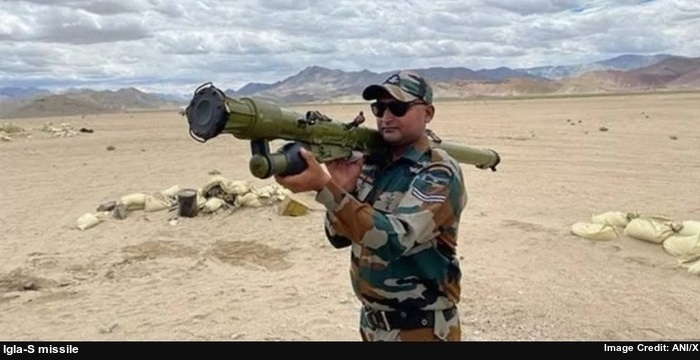
The biggest advantage of this Russian missile is that it is a man-portable one. During the attack, a soldier has to shoulder the launcher and to launch the surface-to-air missile towards the designated target. The missile system uses infrared (IR) homing technology to lock onto the heat signatures of aerial targets, as its compact form makes Igla-S ideal for mobile ground units in high-threat zones. This sophisticated missile also has the ability to detect, as well as attack, combat helicopters and drones within a range of 6km after being launched from the launcher.
The Indian Air Force (IAF), too, is looking for this type of missile. It may be noted that the Indian Armed Forces have been using the Igla missiles since 1990. However, the new batch of missiles recently received by the Indian Army are much more advanced than their older versions. At the same time, Indian defence researchers are trying to increase the capacity of the older versions of Igla with the help of domestic defence equipment-manufacturing companies.

The Indian Army has placed an order to purchase 48 more launchers and 90 missiles from Russia on an urgent basis, apart from exploring opportunities to import a short-range laser beam air defence system. India is quite concerned about the Pakistani Army drones. The Indian Army officers have always stressed on quick identification and destruction of the Pakistani drones in mid-air.
The Indian Army has already deployed the advanced anti-drone Mark-1 defence system along the Line of Control (LoC) in Kashmir and the international border with Pakistan in order to intercept (the Pakistani) drones. The Mark-1 system includes jamming technology to disrupt drone communication and “hard kill” methods using lasers to neutralise the enemy drones. India is also developing other counter-drone systems, including those using micro missiles to neutralise aerial threats over 6km. These systems can also fire 64 guided micro missiles simultaneously, ensuring precision targeting.
Boundless Ocean of Politics on Facebook
Boundless Ocean of Politics on Twitter
Boundless Ocean of Politics on Linkedin
Contact us: kousdas@gmail.com

 ISMC
ISMC Boundless Ocean Of Politics