

Avoiding War Requires True Statecraft
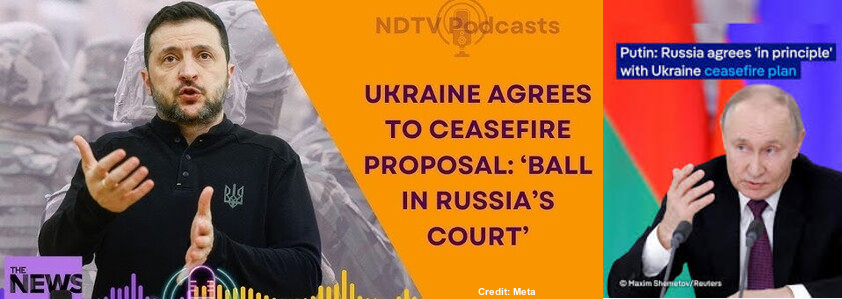
The March 11, 2025 meeting between the US and the Ukrainian representatives in Jeddah (Saudi Arabia), where a 30-day ceasefire was agreed to, has shifted the global attention, yet again. However, who is actually doing the shifting? Reports now abound that after Tuesday’s agreement, “the ball is in Russia’s court“. Former British Prime Minister and notorious anti-peace fanatic Boris Johnson said on March 12: “The Ukrainians have proved that they can make peace. Now it is up to the Kremlin to sign up to the Trump plan – or face the consequences. If (Russian President Vladimir Vladimirovich) Putin refuses, we will know that he is not serious about peace and never was.“
This particular theme has been echoed by many of the worst trans-Atlantic war hawks over the course of the past couple of days, obsessively repeating that President Putin is now cornered and must accept the ceasefire proposal dictated to Moscow. Coming on the heels of Ukraine’s enormous drone attack on Monday night (March 10), which Russia labelled a terrorist attack and vowed to retaliate, as well as Russia’s historic rout in Kursk that has eliminated Ukraine’s only battlefield gains in years, it seems unlikely at best. President Putin’s visit to newly-liberated areas in Kursk on March 12, dressed in full military garb, is a clear message in this regard.
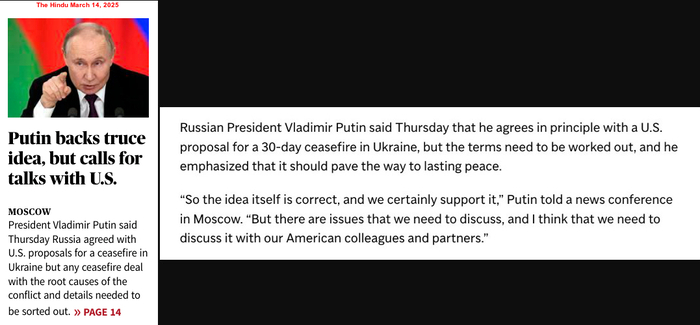
US President Donald John Trump’s Middle East Envoy Steve Witkoff is now on his way to Moscow to meet the Russian President, assuredly to discuss this topic. In the meantime, US National Security Adviser Mike Waltz reportedly spoke with his Russian counterpart about the proposal on March 12. Waltz also confirmed that the US restarted sending military and intelligence assistance to Ukraine following the latter’s agreement to the peace proposal.
This veritable tornado of activity is enough to confuse anyone. However, what do we actually know about the situation and its context? The Trump Administration’s stated intention to normalise relations with Russia has freaked out the defenders of today’s unipolar world order, who have sought for years to keep the great powers divided. As a result, they have gone into a full mobilisation to derail President Trump’s efforts. As BBC reported on March 12: “Over the past week, there has been a concerted European effort, led by Sir Keir Starmer, to get the US and Ukraine back in good favour” and to instead “ensure that it is now Russia that is in the spotlight“. Whether or not it played a role in the Jeddah ceasefire proposal, one can be sure the Britons are engaged in massive levels of manipulation aimed at keeping themselves in the passenger seat, with at least one hand on the wheel.
Does Donald Trump, whose actions are often counterproductive and contradictory, understand these matters? Are his good intentions sufficient enough to navigate through the obstacle course that appears to have been set up for him in Ukraine? No one knows. However, one must understand them and act accordingly to shape a presidency that has clearly shown its potential to overthrow the old axioms of this failed system.
As Helga Zepp-LaRouche, the founder of the Schiller Institute, stressed in her weekly webcast: “The only way how you can get order into this very quickly evolving situation… is to move to a completely New Paradigm: Namely, the idea that you have to have a new security and development architecture which addresses all of these problems at once, by creating a new system in which everybody has their interests taken care of. And the most for that, obviously, is the Peace of Westphalia of 1648… where the war parties agreed on principles first, and then proceeded to hammer out the details. And, I think such an approach is absolutely what is needed today.”
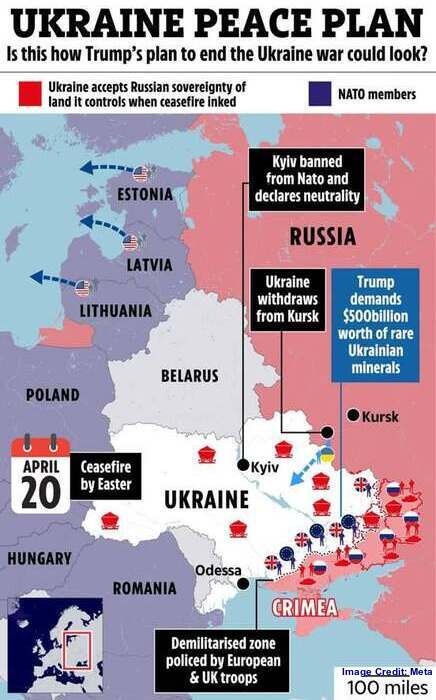
The global strategic situation requires intervention of the global community, whether that be in Ukraine, Israel or Syria.
Schiller Institute published this article on March 14, 2025.
Boundless Ocean of Politics on Facebook
Boundless Ocean of Politics on Twitter
Boundless Ocean of Politics on Linkedin
Contact: kousdas@gmail.com

 ISMC
ISMC Boundless Ocean Of Politics