

Mountain To Enjoy ‘Human Rights’
Believe it or not… A mountain has become a living being as it shall enjoy basic Human Rights from now on. The Government of New Zealand made a final decision in this regard in the first week of February 2025. Mount Taranaki (or Taranaki Maunga, also known as Mount Egmont), a dormant stratovolcano in the Taranaki region on the west coast of New Zealand’s North Island, has become a legal person as it has been granted legal rights equal to a human being. At 2,518mt (8,261ft), Mount Taranaki is the second highest mountain in the North Island (after Mount Ruapehu), with a secondary cone, Fanthams Peak (1,966mt or 6,450ft), on its southern side. New Zealand has enacted such a law after a long time.
Mount Taranaki is an ancient snow-capped dormant volcano as the Māori people, the indigenous population of mainland New Zealand, call it Taranaki Maunga. Reports suggest that local tribes and Government officials would work together to take care of the mountain from now on. The Māori people consider this mountain not just a gift of nature, but also their ancestor! In Māori culture, human beings, animals, plants and even mountains are considered as integral parts of a larger ecosystem. The Government of Prime Minister Christopher Mark Luxon has described the move as a larger effort to respect indigenous traditions, apart from promoting environmental conservation.
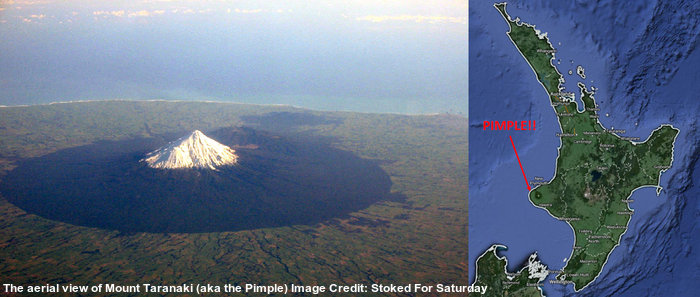
According to political analysts, the Government of New Zealand has granted Mount Taranaki full Human Rights as the newly passed law would consider the mountain as a separate entity. They also consider the move as an important step towards ensuring justice. As per the newly enacted law, the legal personality of the mountain also has a name, Te Kahui Tupua, which the law views as “a living and indivisible whole“. It includes Taranaki and its surrounding peaks and land, “incorporating all their physical and metaphysical elements“. The BBC has reported that the Parliament of New Zealand passed the law after holding debates for years.
Mount Taranaki is also one of the famous tourist destinations in New Zealand. Tourists from different parts of the globe gather here every year mainly to enjoy the snowfall and hiking. The local media have reported that the Government enacted the law in order to provide the Māori people with a sort of compensation for using their property as a tourist spot. The colonial British rulers had forcibly taken the land from the ancestors of the Māori community hundreds of years ago. The Government has enacted the law in order to restore the dignity of the mountain, as well as the Māori people.
Paul Goldsmith, the Minister for Arts, Culture and Heritage of New Zealand, stressed: “We must acknowledge the hurt that has been caused by past wrongs, so we can look to the future to support iwi to realise their own aspirations and opportunities.” He added: “I want to acknowledge the hard work of the iwi and Crown negotiators to reach this momentous day. It has been a long journey, since Ngā Iwi o Taranaki signed the Terms of Negotiation in 2016.”
The British rulers had deprived the Māori people of their land to suppress their rebellions in the 18th Century. They also prioritised tourism and hunting in the region mainly for commercial gain. The colonial rulers banned traditional Māori activities around the mountain by enacting laws. In fact, the colonial rulers discovered the dormant volcano. British explorer Captain James Cook sighted the peak from his ship in 1770 and named it Mount Egmont.

Meanwhile, the new law would allow no one to purchase land in that region. It would also restore the traditional Māori practices surrounding the mountain, apart from helping the concerned authorities to take necessary steps in order to preserve local biodiversity. However, tourists can visit the mountain.

With this, New Zealand has become the first country in the world to legally recognise a mountain as a human being. New Zealand has always taken care of nature. Te Urewera National Park (or the Urewera Forest), a national park near the east coast of New Zealand’s North Island, was given environmental personhood in 2014. Later in 2017, the Whanganui River, a major river in the North Island and the third-longest river of New Zealand, got a special status owing to its importance to the Māori people. In March 2017, it became the world’s second natural resource (after Te Urewera) to be given its own legal identity, with the rights, duties and liabilities of a legal person. The Whanganui Treaty settlement brought the longest-running litigation in history of New Zealand to an end.
Boundless Ocean of Politics on Facebook
Boundless Ocean of Politics on Twitter
Boundless Ocean of Politics on Linkedin
Contact: kousdas@gmail.com

 ISMC
ISMC Boundless Ocean Of Politics