

Sunken Greek Village Re-Emerged
A village that was sunken has re-emerged near the Greek capital city of Athens after a record rise in temperature recently triggered severe draught in the southeastern European country. Reports suggest that the lost village of Kallio was flooded way back in 1980. The flood also created a lake in that area to meet the ever-increasing water needs of Athens. Residents of that village had evacuated their homes when Greece constructed the Mornos Dam there in 1970. The concerned authorities had also built an artificial canal near the dam. The village was submerged after the flood in 1980. As the water in the canal has decreased by 30% due to the recent drought, a school building and some houses of Kallio have emerged.
Yorgos Iosifidis, a sexagenarian who used to live in Kallio decades ago, said that he, along with his family members, had left their home in 1980. According to Iosifidis, the level of water in the canal dropped 131ft because of drought in August-September 2024. He told the AFP: “You see the first floor that remains of my father-in-law’s two-storey house… and next to it you can see what’s left of my cousins’ house.“
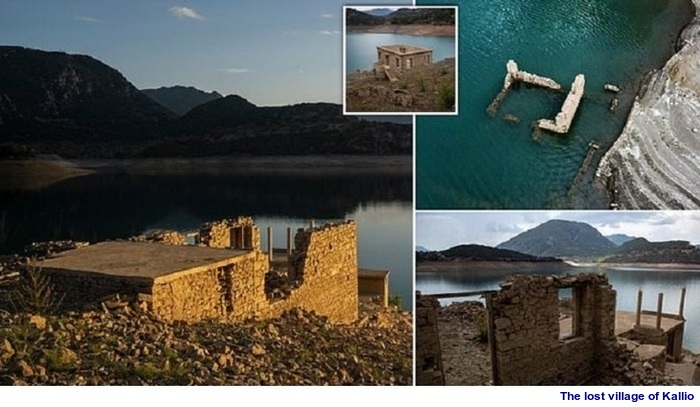
Konstantinos Gerodimos (80), another former resident of Kallio, recalled that 80 buildings, including a church and some schools, had to be sacrificed for ensuring a steady supply of water to residents of Athens four decades ago! The reemergence of the village surprised, as well as saddened, him. “I used to see it full and say it was a beach. Now all you see is dryness,” stressed Gerodimos. His 77-year-old wife Maria stated: “If it continues like this, the entire village will appear, all the way to the bottom, where the church and our home was.” The couple told the media that some parts of Kallio had emerged after the 1990 drought in a rare first!
It may be noted that Greece experienced no snowfall last winter. The punishing heatwaves in summer and months of little rain triggered drought across the country. Hence, the huge lake dwindled to its lowest level in decades. According to the concerned authorities, the surface area of the lake shrunk from around 6.5 square miles in August 2022 to 4.5 square miles in 2024. Dimitris Giannopoulos, the Mayor of the broader Dorida Municipality, claimed that nothing close to this had been seen in the last 33 years, stating: “Day by day, the water goes down.”
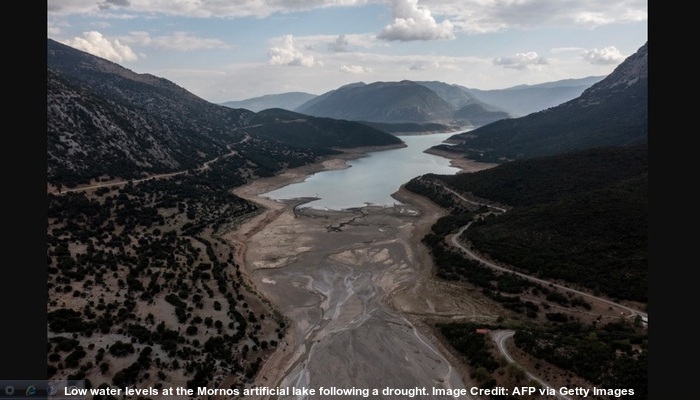
Water reserves near the Mornos artificial lake and three other reservoirs, supplying water to Attica (a region of around four million people that includes Athens), have dropped substantially in recent times because of the drought. The scenario has prompted the Greek authorities to urge nearly 3.7 million people living in that region not to waste water. Prime Minister Kyriakos Mitsotakis said that his government would have to take necessary steps in order to protect water resources. “We do not have the luxury to waste water… at a time when we know with certainty that we will have less,” added the Prime Minister.
Efthymis Lekkas, a Professor of Disaster Management at the University of Athens, has expressed serious concern over the changing weather pattern, stressing: “It is an alarm bell. We do not know what will happen in the coming period. If we have a rainless winter, things will get difficult.”
Meanwhile, countries, bordering the Mediterranean Sea, have experienced the worst drought in history in 2024. Greece recorded its highest temperature in June-July (2024) as the water levels at the Mornos Dam were down by 30%.
Boundless Ocean of Politics on Facebook
Boundless Ocean of Politics on Twitter
Boundless Ocean of Politics on Linkedin
Contact: kousdas@gmail.com

 ISMC
ISMC Boundless Ocean Of Politics