

Ethnic Cleansing In Sudan: Gruesome!
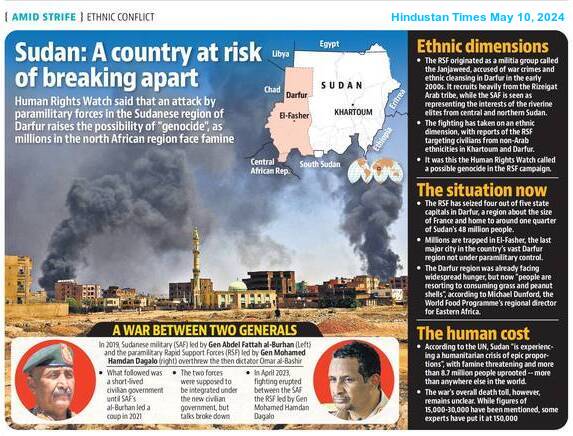
Rapid Support Forces (RSF), the paramilitary forces of Sudan, and their allied militias, recently killed “thousands of people” in West Darfur. In a report published on May 9, 2024, the Human Rights Watch (HRW) stated that the RSF committed Crimes against Humanity and Genocide between April and November 2023 mainly to eliminate the Masalit tribe and other non-Arab population. According to the New York-based international Non-Governmental Organisation (NGO) that conducts research and advocacy on Human Rights, the RSF is responsible of carrying out the worst atrocities of the ongoing Civil War in the African nation. It may be noted that the Civil War began in Sudan in April 2023.
The attacks on people in el-Geneina, the capital of West Darfur, prompted Masalit communities to leave the entire neighbourhoods that mainly housed the displaced tribe! The RSF not only looted the Masalit people, but also burnt down their houses by shelling. The HRW mentioned in the 186-page report that the atrocities amounted to ethnic cleansing, leaving hundreds of thousands of people as refugees. It further stated that the violence included mass torture, rape, infanticide and looting. In June and November 2023, the RSF personnel killed thousands of people, including children, within days.
Talking to the media, a 17-year-old witness stressed that the RSF murdered children after killing their parents in front of them. He reportedly said: “Two RSF personnel… grab(bed) the children from their parents and, as the parents started screaming, two other RSF personnel shot the parents. Then, they piled up the children and shot them too. Later, they threw their bodies, along with their belongings, into a river.”
Meanwhile, Alan Boswell of the International Crisis Group claimed that although an arms embargo was imposed on Darfur years ago, the concerned authorities did not enforce the embargo, allowing serious violations to take place in el-Fasher. Al Jazeera quoted Boswell as saying: “The Sudanese have basically been forgotten, obviously there’s the war in Gaza which has taken a lot of attention.” He added: “Frankly it would take a very high-level political focus on trying to pressure those who are arming the various sides and have the actual belligerence themselves to stop this. Obviously, the UN tools are not very functional.”

From June 2023 to April 2024, HRW interviewed more than 220 people in Chad, Uganda, Kenya and South Sudan, apart from reviewing and analysing more than 120 photographs and videos of the events, satellite imagery and documents shared by various humanitarian groups to corroborate accounts of abuses. The HRW came to know that chaos rocked Sudan in April 2023, as an armed conflict began between the Sudanese Armed Forces (SAF), led by General Abdel Fattah Burhan, and the RSF, led by Mohamed ‘Hemedti’ Dagalo, in Khartoum. Fierce fighting between the two forces also rocked el-Geneina, where Masalit people make up more than half of the population. In the first week of May 2024, the World Food Programme (of the UN) claimed that the situation was constantly deteriorating in Darfur, as aid was cut off by the advancing RSF. The RSF made a serious attempt to take control of el-Fasher, where an estimated 500,000 displaced civilians had taken shelter.
Expressing serious concern over the current scenario in Sudan, HRW Executive Director Tirana Hassan said: “As the UN Security Council and Governments wake up to the looming disaster in El Fasher, the large-scale atrocities committed in el-Geneina should be seen as a reminder of the atrocities that could come in the absence of concerted action.” She added that more than half a million refugees fled West Darfur for Chad in the past one year. According to her, a new approach to ethnicity that underscores its relative territoriality brings together previously separate arguments that focus on domestic and international factors in order to offer a coherent theory of what causes ethnic cleansing.

A Brief History Of Sudan’s Islamic Revolt
(Talk Diplomacy) The Mahdist State, also known as the Mahdist Sudan, was an Islamic state established in Sudan between 1885 and 1898. It was founded by Muhammad Ahmad, who proclaimed himself the Mahdi, the prophesied redeemer of Islam. The Mahdist Movement emerged as a reaction against the oppressive Egyptian rule and the subsequent British influence in the region.
In 1881, Muhammad Ahmad declared his Mahdihood and called for a Holy War (Jihad) against the Turco-Egyptian Administration. His message resonated deeply among the Sudanese people, who were suffering under heavy taxation and harsh governance. The Mahdist forces, characterised by their zeal and determination, rapidly gained support and strength.

In January 1885, after a protracted siege, the Mahdists captured Khartoum, the Sudanese capital. This victory marked the collapse of the Turco-Egyptian Administration and the establishment of the Mahdist State. Muhammad Ahmad set up his capital at Omdurman, and implemented Islamic laws and governance according to his interpretation of Sharia.
The Mahdist State was marked by a strict Theocratic Rule, with Muhammad Ahmad seeking to purify Islam and enforce religious orthodoxy. After his death in June 1885, his successor, Khalifa Abdallahi, continued to expand the Mahdist State’s territory. However, his rule faced internal dissent and external threats.
The Mahdist State’s existence came to an end in 1898 when British and Egyptian Forces, led by General Herbert Kitchener, defeated the Mahdist Army at the Battle of Omdurman. This victory reasserted British-Egyptian control over Sudan, marking the beginning of the Anglo-Egyptian Condominium, under which Sudan was jointly administered by Britain and Egypt.
The Mahdist State is remembered for its significant impact on Sudanese history, its resistance to colonial rule, and its role in the broader context of Islamic Revivalism in the 19th Century.
With inputs from Talk Diplomacy.
Boundless Ocean of Politics on Facebook
Boundless Ocean of Politics on Twitter
Boundless Ocean of Politics on Linkedin
Contact: kousdas@gmail.com

 ISMC
ISMC Boundless Ocean Of Politics